
Kato 58750800100 HD1250 HD1430 Track Bottom Roller / Track Lower Roller Assembly / Heavy duty EXC Undercarriage Parts Source Supplier and Manufacturer / CQC TRACK


Precision Undercarriage Engineering for Kato HD1250 and HD1430 Excavators: A Definitive Technical Analysis of the Track Bottom Roller Assembly (Part Number 58750800100) and the Manufacturing Excellence of CQC TRACK
Author: Jack
Date: April 5, 2026
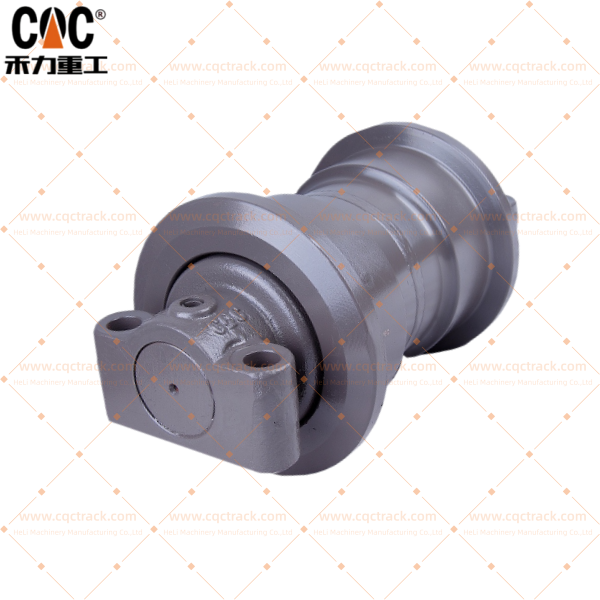
1. Technical Overview: The Critical Role of the Bottom Roller in Heavy-Duty Crawler Systems
The track bottom roller—also referred to as the lower roller, track roller, or load-bearing wheel—is arguably the most heavily stressed component in the undercarriage system of any crawler excavator. Positioned between the track chain and the track frame, each bottom roller bears a substantial portion of the machine‘s total operating weight, transfers ground contact pressure evenly across the track footprint, and maintains proper clearance height to minimize stress on other components such as sprockets and front idlers. In the harsh and unforgiving environment of large-scale mining and heavy construction, where excavators operate continuously on abrasive terrain with daily production demands measured in thousands of tons, the durability of the track bottom roller is not merely a maintenance consideration—it is a direct determinant of machine uptime, operational safety, and total cost of ownership.
For operators of Kato HD1250 and HD1430 excavators—a 125-ton and a 30-ton class machine respectively, spanning the ultra-class and medium-heavy segments of the market—the reliability of the track bottom roller assembly directly affects track chain life, undercarriage alignment, and overall machine productivity. The Kato HD1250 is a flagship 125-ton mining excavator designed for large-scale earthmoving and quarry operations, while the HD1430 is a 30-ton versatile excavator widely deployed in construction, infrastructure, and medium-duty excavation. Both platforms share a common undercarriage component design philosophy, enabling certain parts—including the 58750800100 bottom roller—to be used across multiple Kato models.
This publication delivers a comprehensive technical examination of the Kato OEM part number 58750800100 (also referenced as 587-50800100), which represents the complete track bottom roller assembly for the HD1250VII and HD1430 excavator platforms. This component is mission-critical for supporting the extreme operating weights of these machines, distributing massive ground pressure across the track footprint. Particular focus is placed on CQC TRACK (HELI MACHINERY MANUFACTURING CO., LTD.), a vertically integrated manufacturer with over two decades of specialization in heavy-duty undercarriage components, and why its position as a source factory matters for global procurement professionals seeking OEM-quality chassis components at competitive price points.
2. The Kato HD1250 and HD1430 Platforms: Engineering for Diverse Applications
2.1 Kato HD1250: Ultra-Class Mining Excavator
The Kato HD1250 is a flagship ultra-class hydraulic excavator engineered for the most demanding mining and heavy construction applications. The HD1250VII variant represents a modern iteration of this platform, incorporating advanced engine technologies and hydraulic systems for maximum productivity.
Key specifications for the Kato HD1250VII include:
| Parameter | Specification | Source |
|---|---|---|
| Operating Weight | 125 tons (113,000–125,000 kg depending on configuration) | [19†L21-L23][24†L4-L8] |
| Engine Model | 6D22T (turbocharged) | [24†L34-L36] |
| Net Power | 217–232 hp (162–173 kW) | [24†L35-L36][20†L15-L17] |
| Max Torque | 745 lb-ft (1,010 N·m) | [24†L35-L36] |
| Fuel Capacity | 135–148 gal (510–560 L) | [24†L37-L39][20†L36-L37] |
| Hydraulic Pump Flow | 154–160 gpm (582–606 L/min) | [24†L38-L39] |
| Track Width | 600 mm (standard) | [8†L6-L7] |
The HD1250VII features a robust 125-ton operating weight, a cutting-edge Tier 4 Final engine for maximum efficiency and reduced emissions, and an advanced hydraulic system that delivers precise control and exceptional digging force, making it ideal for heavy-duty excavation projects, including open-pit mining, quarry operations, and large-scale earthmoving. [19†L21-L25]
2.2 Kato HD1430: Versatile 30-Ton Excavator
The Kato HD1430 is a versatile 30-ton class hydraulic excavator engineered for a wide range of applications including general construction, infrastructure development, quarrying, and medium-duty excavation. The HD1430V and HD1430R variants represent different generations of this platform, with operating weights ranging from 30 to 31.6 tons.
Key specifications for the Kato HD1430 include:
| Parameter | Specification | Source |
|---|---|---|
| Operating Weight | 30,000–31,600 kg (66,000–69,700 lb) depending on configuration | [8†L4-L5][25†L28-L29] |
| Engine Model | Mitsubishi 6M60-TL / 6D16-TLC1A | [9†L16-L17][11†L4-L5] |
| Rated Power | 183 kW (245 HP) at 2,150 rpm | [9†L16-L17][11†L20-L21] |
| Max Torque | 824 N·m (608 lb-ft) at 1,400–1,800 rpm | [9†L16-L17] |
| Fuel Capacity | 580–600 L | [11†L4-L5] |
| Track Width | 600 mm | [8†L6-L7] |
| Max Travel Speed | 5.5 km/h (high) / 3.7 km/h (low) | [11†L19-L20] |
| Gradeability | 70% (35°) | [11†L19-L20] |
| Bucket Capacity | 1.4–1.6 m³ (standard) | [11†L3-L5] |
The HD1430R features a Mitsubishi 6D16-TLC1A turbocharged engine delivering 183 kW of power, supporting three adjustable operating modes for optimized efficiency across different construction scenarios. The machine is designed for earthmoving, rock breaking, and other heavy-duty operations, with a maximum digging height of 10,320 mm and a maximum dumping height of 7,310 mm. [11†L3-L7]
3. Part Number 58750800100: Identification and Functional Architecture
3.1 OEM Part Number and Application
The Kato 58750800100 Track Bottom Roller Assembly (also referenced as 587-50800100) is a precision-engineered undercarriage component specifically designed for the Kato HD1250VII and compatible excavator platforms. This complete bottom roller assembly is manufactured to deliver OEM-equivalent fit, form, and function, with 100% interchangeability with the original Kato specification. The part number is also documented in supplier catalogs as 587-50800100 – 1250VII BOTTOM ROLLER. [22†L4-L6][17†L28-L31]
The 58750800100 designation corresponds to Kato‘s proprietary engineering drawings, which define precise dimensional tolerances, material grades, heat treatment parameters, and assembly specifications developed through the original equipment manufacturer’s rigorous validation and field testing protocols.
This bottom roller assembly is compatible with multiple Kato models. Verified supplier compatibility data indicates that Kato HD250, HD400, HD450, HD550, HD700, HD770, HD800, HD820, HD850, HD880, HD900, HD1023, HD1250, and HD1430 models share undercarriage component compatibility, confirming that the 58750800100 assembly can be used across a wide range of Kato excavators. [3†L16-L18][22†L17-L19]
3.2 Functional Responsibilities
The 58750800100 track bottom roller assembly performs three mission-critical functions that directly impact undercarriage longevity:
1. Load Bearing and Weight Distribution: Each bottom roller supports a portion of the excavator‘s operating weight—up to 125 tons for the HD1250—transferring vertical loads through the track chain to the ground surface. The bottom roller directly supports a significant portion of the machine’s immense operational weight, transferring the load from the mainframe through the track roller frame and onto the track chain. [16†L27-L31] The track roller (also known as an undercarriage roller) is a critical component in the undercarriage system of tracked heavy equipment, whose primary function is to support the machine‘s weight and guide the track chain as it moves around the track frame. [6†L28-L32]
2. Track Guidance and Alignment: The roller features precisely machined flanges on both sides that guide the inner edge of the track chain links, preventing lateral derailment and ensuring the track runs true along the entire undercarriage. [16†L31-L34] This guidance function minimizes stress on sprockets and idlers while improving operator comfort and machine stability on rough, uneven ground typical of mining and construction environments. [6†L28-L32]
3. Track Sag Management and Dynamic Tension Regulation: The bottom roller maintains the correct amount of pre-tension and sag in the track chain, which is crucial for efficient sprocket engagement, reduced vibration, and optimal power transmission. [16†L34-L37] By preventing excessive track sag, the roller reduces vibration during movement and prevents the track chain from contacting the track frame, which would otherwise lead to accelerated wear and potential derailment.
A failure in a bottom roller can lead to accelerated wear on the entire undercarriage, including track links, pins, bushings, and sprockets, and even pose a risk of track derailment—a catastrophic event in a mining operation where downtime is measured in lost production revenue.
3.3 Component Breakdown
A complete Kato 58750800100 track bottom roller assembly consists of the following subcomponents, each engineered to meet the specific performance requirements of heavy-duty excavators:
| Component | Function | Engineering Notes |
|---|---|---|
| Roller Body (Shell) | Forged steel cylindrical body providing the rolling surface contacting the track chain | Hot-forged from high-strength alloy steel (50Mn or 40Mn2) with integral double-flanges for lateral track containment |
| Roller Shaft (Axle) | Hardened and precision-ground axle supporting the roller body | High-strength alloy steel with induction-hardened bearing journals |
| Tapered Roller Bearings | Enable smooth rotation under high radial and axial loads | High-capacity sealed bearing design; selected for exceptional capacity to handle combined heavy radial loads from machine weight and substantial axial loads during steering and side-slope operation |
| Sealing System | Prevents contamination ingress and retains lubricant | Double-labyrinth seals + floating face seals with high-temperature grease for contamination protection |
| Double-Flange Guide | Provides lateral track chain containment | Integral double-flanges machined into roller body; extra-wide flanges for track stability |
| Mounting Hardware | Secures roller assembly to track frame bracket | High-strength grade bolts |
4. Material Specifications and Heat Treatment Standards
4.1 Material Selection
Premium track bottom roller assemblies for Kato excavators are manufactured from high-grade forged alloy steels selected for their exceptional yield strength, toughness, and wear resistance. The primary materials specified for the 58750800100 assembly include:
| Material Grade | Characteristics | Surface Hardness | Typical Application |
|---|---|---|---|
| 50Mn (AISI 1050) | High carbon-manganese alloy; excellent hardenability, good wear resistance | HRC 52–58 | Standard heavy-duty mining and quarrying |
| 40Mn2 | High carbon-manganese alloy with enhanced hardenability | HRC 52–58 | Heavy-duty mining and quarrying |
| 42CrMo (AISI 4140) | Chromium-molybdenum alloy; high fatigue strength, superior wear resistance | HRC 55–60 | Premium mining-grade applications |
| 35MnB | Boron-alloyed medium-carbon steel; excellent hardenability and toughness | HRC 48–55 | Heavy-duty excavation, rock digging |
CQC TRACK utilizes premium 52Mn, 55Mn, and 40CrNiMo alloy steels sourced from certified mills. Through strategic control of forging, optimal grain flow and material density in component blanks are ensured, which is fundamental for impact strength and fatigue life. [15†L48-L49]
4.2 Heat Treatment Specifications
The performance of a track bottom roller depends critically on its heat treatment profile, which creates a gradient hardness structure optimized for both wear resistance and impact toughness:
| Parameter | Specification | Engineering Significance |
|---|---|---|
| Surface Hardness (Tread/Flanges) | HRC 52–58 (induction hardened) | Resists abrasive wear from track chain contact in mining environments |
| Hardened Depth (Case) | 6–12 mm (maintaining HRC 45 minimum) | Uniform case depth prevents rapid wear-through under continuous operation |
| Core Hardness | HB 280–350 (through-hardened and tempered) | Maintains toughness to absorb impact loads from rock and uneven terrain |
| Shaft Surface Hardness | HRC 48–55 (induction hardened) | Prevents shaft wear and extends bearing life |
| Heat Treatment Method | Quenching and tempering + induction hardening | Provides deep, uniform case hardness while maintaining ductile core |
The heat treatment protocol involves through-hardening and tempering for the core structure, combined with induction hardening on the running surface. This creates a deep, wear-resistant case while maintaining a ductile, shock-absorbing core to prevent brittle fracture under extreme impact loads.
CQC TRACK‘s dedicated heat treatment facility features computer-controlled induction hardening and tempering furnaces, specializing in achieving deep, uniform case hardness profiles. Track rollers forged from deep hardening steel and heat treated for internal strength resist bell mounting and increase rebuilding ability, with heat-treated shells providing body strength and longer wear life. [14†L18-L21]
4.3 Bearing and Sealing Specifications
| Component | Specification | Function | |
|---|---|---|---|
| Bearings | XXL tapered roller bearings | Handle combined radial and axial loads; high-capacity design; selected for exceptional capacity to handle heavy radial loads from machine weight and substantial axial loads during steering and side-slope operation | [7†L23-L25] |
| Sealing System | Double-labyrinth seals + floating face seals | First-stage contamination barrier prevents ingress of large debris; second-stage dynamic seal maintains lubricant retention; provides a critical barrier against mud, sand, and moisture—common contaminants in mining and quarry environments | [7†L20-L21] |
| Lubrication | Pre-filled with high-temperature, high-pressure lithium-complex EP grease | Provides continuous lubrication to bearings, reducing friction and dissipating operational heat | |
| Operating Temperature Range | -40°C to +120°C | Suitable for extreme climate conditions | [7†L25-L26] |
| Dynamic Load Capacity | 18,000 kg | Maximum load capacity per roller under dynamic operating conditions | [7†L23-L24] |
5. CQC TRACK: A Specialized Manufacturer of Kato Undercarriage Components
5.1 Corporate Profile and Manufacturing Heritage
CQC TRACK, operating under HELI MACHINERY MANUFACTURING CO., LTD., is a vertically integrated manufacturer based in Quanzhou, China—a region recognized as a premier industrial cluster and key supply hub for global earthmoving equipment. Founded in the late 1990s, HELI has systematically evolved from a specialized parts workshop into one of the top three undercarriage component manufacturers in the Quanzhou region.
The brand name CQC TRACK symbolizes three foundational commitments that form the core of the company‘s engineering philosophy: Crawler systems, Quality assurance, and Commitment to durability under the most abrasive and high-impact environments encountered in mining, quarrying, and major infrastructure projects. It represents a product line built for resilience, engineered to endure the most abrasive and high-impact environments in mining, quarrying, and major infrastructure projects.
5.2 Quality Certifications and Manufacturing Standards
CQC TRACK operates under a rigorous quality assurance framework, holding ISO 9001:2015 quality system recognition with full component traceability from raw material through finished assembly. The company is also certified under CQC (China Quality Certification) product certification standards. [13†L10-L12]
Every CQC TRACK undercarriage component is manufactured under ISO 9001:2015 certified processes, with components traceable from raw material to finished assembly. [18†L8-L10] As a vertically integrated manufacturer, HELI combines design and engineering expertise with extensive research and development, utilizing advanced manufacturing technologies to develop innovative, reliable, and competitive products that meet the highest quality standards.
5.3 Manufacturing Capabilities and Quality Control
CQC TRACK’s manufacturing strength rests on complete vertical integration and controlled sequential processes:
| Process Stage | Capability Description |
|---|---|
| Raw Material Selection | Premium 52Mn, 55Mn, and 40CrNiMo alloy steels sourced from certified mills |
| Forging | In-house forging or strategic forging alliance control ensures optimal grain flow and material density in component blanks, fundamental for impact strength and fatigue life |
| CNC Machining | Modern CNC lathes, milling centers, and drilling centers perform rough and finish machining to ISO 2768-mK dimensional tolerances, ensuring consistent interchangeability |
| Heat Treatment | Computer-controlled induction hardening and tempering furnaces achieve deep, uniform case hardness while maintaining ductile core; specialized whole-quenching techniques for bottom rollers |
| Sealing Assembly | Double-labyrinth seals + floating face seals + high-temperature grease provides robust barrier against contamination |
| Quality Inspection | Hardness profile testing, chemical composition verification, magnetic particle inspection, and CMM dimensional validation |
CQC TRACK‘s comprehensive undercarriage parts portfolio includes track chains, shoes, sprockets, idlers, bottom rollers, and carrier rollers—engineered specifically for heavy-duty crawler excavators used in mining and construction worldwide. The company has documented cross-reference compatibility for its undercarriage components across multiple global brands, including Kato, Caterpillar, Komatsu, Hitachi, Doosan, Volvo, XCMG, SANY, and Sumitomo.
5.4 OEM and ODM Service Model
CQC TRACK operates a dual service model that accommodates both standardized replacement parts and customized engineering solutions:
- OEM Manufacturing: Production of components to exact client specifications, drawings, and quality standards. The factory is equipped for seamless integration into global supply chains, providing reliable volume production of rollers, idlers, sprockets, and track links.
- ODM Engineering: Collaborative development, design, and validation of improved or fully customized undercarriage solutions. Leveraging extensive field experience and deep technical expertise in metallurgy and tribology specific to track systems, the engineering team proactively addresses common failure modes, offering value-optimized designs that enhance performance and reduce total cost of ownership (TCO).
5.5 Kato Product Portfolio
CQC TRACK manufactures a comprehensive range of undercarriage components for Kato excavators across multiple size classes. Key components include:
| Component | Kato Part Number / Model Compatibility | |
|---|---|---|
| Track Bottom Roller Assembly | 58750800100 (HD1250VII, HD1250, HD1430, and compatible HD series) | |
| Track Lower Roller Assembly | HD250, HD400, HD450, HD550, HD700, HD770, HD800, HD820, HD850, HD880, HD900, HD1023, HD1250, HD1430 series | [3†L16-L18] |
| Front Idler Assembly | 587-50400100 (HD1250, HD1430) | [7†L4-L6] |
| Carrier Roller Assembly | 337-50600100 (HD1250 early models) | [19†L42-L44] |
CQC TRACK has established itself as an integrated source supplier and manufacturer of professional undercarriage components, offering both OEM and ODM quality solutions. The company supplies direct to the global aftermarket, eliminating intermediary margins while maintaining strict adherence to original equipment specifications.
6. Factory-Direct Sourcing: Competitive Advantages
6.1 Supply Chain Value Proposition
Sourcing the Kato 58750800100 track bottom roller assembly directly from a source factory and manufacturer such as CQC TRACK offers distinct advantages over multi-tier distribution channels:
| Sourcing Channel | Advantages | Disadvantages |
|---|---|---|
| Factory Direct (CQC TRACK) | Lower cost (eliminates distributor markups), shorter lead times, direct technical support, traceable quality control, ISO 9001:2015 certified processes | Minimum order quantities may apply |
| Regional Distributor | Local inventory, smaller minimum orders | Higher price (multiple markups), limited technical support |
| OEM Dealer | Guaranteed exact specification | Premium pricing (typically 40–60% higher), long lead times for non-stocked items |
CQC TRACK operates as an integrated source factory and manufacturer, eliminating intermediary markups while maintaining strict adherence to original equipment specifications. The “source factory” designation indicates that CQC TRACK is the original producer of these components, not a reseller or distributor, ensuring full control over quality, pricing, and supply chain transparency.
6.2 Lead Times and Logistics
For the Kato 58750800100 track bottom roller assembly, typical factory-direct lead times are:
- Stocked items: 5–10 business days (ready stock)
- Manufactured to order: 20–25 days after contract confirmation
- Express delivery: Available for urgent requirements
Standard shipping is FOB from Xiamen port, China, with door-to-door logistics available through established freight forwarding partnerships. The Quanzhou region‘s status as a premier industrial cluster for heavy machinery manufacturing ensures efficient logistics infrastructure and competitive freight rates.
6.3 Estimated Cost Comparison
| Component | OEM Price Range (Est.) | CQC TRACK Factory Price (Est.) | Estimated Savings |
|---|---|---|---|
| Track Bottom Roller Assembly (58750800100) | $500–800 | $350–600 | 30–40% |
7. Installation, Maintenance, and Service Life Optimization
7.1 Pre-Installation Verification
Before installing a new track bottom roller assembly, verify the following critical parameters:
- Mounting pattern compatibility — Confirm bolt hole spacing and diameter match the track frame bracket
- Roller width and diameter — Verify dimensions match the track chain link spacing and track frame clearance
- Flange configuration — Confirm double-flange design matches OEM specification
- Track chain condition — Measure chain pitch elongation; if exceeding 3%, chain replacement should precede roller installation
- Track shoe width — Verify compatibility with 600 mm standard track shoe configuration (or optional wider shoes if equipped)
- Mounting bracket condition — Inspect for wear or damage to the roller saddle
7.2 Installation Procedure Summary
Replacing a bottom roller on a Kato HD1250 or HD1430 excavator is a significant task that requires proper tools, heavy lifting equipment, and strict safety procedures:
- Park Safely: Position the machine on a firm, level surface. Lower the attachment to the ground.
- Block the Machine: Chock the tracks securely to prevent any movement.
- Relieve Track Tension: Use the grease fitting on the front idler to carefully release hydraulic pressure and slacken the track. Warning: This can release high-pressure grease; stand clear.
- Support the Track Frame: Place a heavy-duty hydraulic jack and solid cribbing blocks under the track frame near the roller to be replaced.
- Remove Mounting Bolts: The roller is held on by large bolts that thread into the track frame. These are often extremely tight and corroded; heat or a powerful impact wrench is often necessary.
- Install New Roller: Remove the old assembly, clean the mounting surface, install the new roller assembly, and hand-tighten new high-tensile bolts. Always use new bolts; reusing old ones is a safety risk.
- Torque to Spec: Use a calibrated torque wrench to tighten the bolts to the manufacturer‘s specified value (this will be a very high torque for a machine of this class).
- Re-tension Track: Re-pressurize the track tensioner with a grease gun to achieve proper track sag.
- Verify Operation: Operate the machine at low speed and inspect for proper roller rotation, seal integrity, and track alignment.
Tools and equipment needed: Heavy-duty hydraulic jack and solid cribbing blocks, high-torque impact wrench or large breaker bar with appropriate sockets, a lifting device (crane or the excavator‘s own bucket) to handle the heavy roller assembly, and personal protective equipment (PPE)—steel-toed boots, gloves, safety glasses.
7.3 Maintenance Schedule
| Interval | Action |
|---|---|
| Every 10 operating hours (severe mining conditions) | Visual inspection for oil leakage, abnormal noise, vibration, or loose bolts |
| Every 50 operating hours (normal conditions) | Visual inspection of undercarriage components |
| Every 250 operating hours | Check for loose mounting bolts; retorque as necessary |
| Every 500 operating hours | Lubricate bearings through grease fitting (if applicable) |
| Every 1,000 operating hours | Inspect roller tread wear depth; compare against wear limits (typically 5–8 mm allowable wear) |
| As needed | Replace roller assembly if excessive play, seal leakage, bearing noise, or flange wear is detected |
Regular cleaning of the undercarriage area to remove dirt and debris, followed by lubrication of parts that need lubrication, is essential for minimizing the risk of breakdowns, extending the life of excavator undercarriage parts, and maintaining optimal performance of the equipment. For Kato HD1250 machines operating in continuous mining applications, daily undercarriage inspections are recommended due to the extreme abrasive conditions encountered in open-pit mining.
7.4 Failure Modes and Troubleshooting
| Symptom | Likely Cause | Recommended Action |
|---|---|---|
| Oil leakage from seals | Floating seal failure or bushing wear | Replace roller assembly; inspect track alignment; a failed seal allows contaminants in, leading to rapid bearing failure and a seized roller |
| Excessive noise during operation | Bearing wear or internal damage | Disassemble and inspect; replace assembly if damaged |
| Uneven tread wear | Track chain misalignment or worn sprockets/idlers | Check track tension and alignment; replace chain if elongated; a convex or “dished” shape indicates significant wear |
| Roller seizure | Contamination ingress or bearing failure | Replace roller assembly immediately to prevent track damage; a roller that does not spin or grinds when turned is failing and must be replaced immediately |
| Lateral track wandering | Worn roller flanges or track misalignment | Inspect flange width; worn-down flanges can no longer guide the track properly; replace roller if flanges are worn |
7.5 Service Life Expectations
Under normal quarrying and heavy construction conditions, a quality aftermarket track bottom roller meeting HRC 52–58 surface hardness specifications with 6–12 mm case depth can achieve 3,000–5,000 operating hours before requiring replacement. In severe mining applications with highly abrasive materials (silica content > 30%) and continuous operation, service life may be reduced to 2,000–3,000 operating hours.
For optimal undercarriage life, always inspect and replace roller components as a system when significant wear is detected. Mixing worn and new parts can lead to uneven wear, misalignment, and reduced performance. Regular track tension inspection, timely track chain replacement, and proper lubrication are the most effective methods for maximizing roller longevity.
8. The Importance of Proper Bottom Roller Selection for Heavy-Duty Applications
The track bottom roller is one of the most heavily stressed components in an excavator undercarriage system. Unlike carrier rollers, which support the upper track return section with relatively light loading, bottom rollers bear the full weight of the machine—up to 125 tons for the HD1250—while simultaneously managing dynamic tension fluctuations during acceleration, deceleration, and turning. In open-pit mining operations, bottom rollers must also contend with highly abrasive materials, extreme temperature variations, and continuous duty cycles that place exceptional demands on every undercarriage component.
For Kato HD1250 and HD1430 excavators operating in mining and heavy construction—machines with operating weights ranging from 30 to 125 tons—selecting high-quality track bottom rollers with proper material selection, heat treatment, robust sealing systems, and precision machining is essential.
CQC TRACK‘s 58750800100 track bottom roller assembly incorporates:
- Forged alloy steel construction (40Mn2, 50Mn, or premium 42CrMo/40CrNiMo) for superior grain flow and impact resistance
- Induction-hardened running surface (HRC 52–58) with 6–12 mm case depth for exceptional wear resistance
- Through-hardened core (HB 280–350) maintaining toughness to absorb shock loads
- XXL high-capacity tapered roller bearings for reliable rotation under extreme loads; selected for exceptional capacity to handle combined heavy radial loads from machine weight and substantial axial loads during steering and side-slope operation | [7†L23-L25]
- Double-labyrinth sealing system with floating face seals and high-temperature grease, providing robust contamination barrier against mud, sand, and moisture, with an operating temperature range of -40°C to +120°C | [7†L20-L21][7†L25-L26]
- ISO 9001:2015 certified manufacturing processes with full component traceability
- 18,000 kg dynamic load capacity per roller | [7†L23-L24]
These engineering features ensure that properly maintained track bottom rollers will deliver reliable service throughout their design life in the world‘s most demanding environments.
9. Conclusion
For operators of Kato HD1250 and HD1430 excavators deployed in mining, quarrying, heavy construction, and mass earthmoving—machines with operating weights ranging from 30 to 125 tons and daily production demands—the track bottom roller assembly represented by part number 58750800100 is a mission-critical component whose reliability directly affects track chain life, undercarriage alignment, and machine uptime. This component is also compatible with a wide range of Kato HD series excavators, including HD250, HD400, HD450, HD550, HD700, HD770, HD800, HD820, HD850, HD880, HD900, and HD1023, offering significant inventory consolidation benefits for fleet operators managing multiple Kato models.
CQC TRACK distinguishes itself as a specialized manufacturer that combines over two decades of metallurgical expertise, vertical integration of forging and heat treatment processes, and a dual OEM/ODM service model to deliver undercarriage components that perform reliably under the most demanding conditions. With material specifications including premium 40Mn2, 50Mn, and 42CrMo alloy steels; heat treatment achieving HRC 52–58 running surface hardness with 6–12 mm case depth; ISO 9001:2015 quality certification; and advanced double-labyrinth sealing systems with XXL tapered roller bearings, CQC TRACK provides fleet owners and procurement professionals with engineered solutions that meet or exceed OEM specifications.
By sourcing the Kato 58750800100 track bottom roller assembly directly from the factory, mining and construction operations gain access to consistent quality, direct technical support, competitive pricing (30–40% savings versus OEM), and transparent supply chain logistics—factors that collectively optimize total cost of ownership and maximize machine uptime in the world‘s toughest operating environments.
Author: Jack
Specializing in heavy equipment undercarriage systems, mining machinery reliability, and global sourcing strategies for construction equipment fleets.
Disclaimer: This publication is original content created for informational and technical reference purposes. All product numbers, brand names, and manufacturer references are used for identification and cross-reference only. Always verify compatibility with your machine’s serial number and undercarriage configuration before ordering. Installation procedures summarized from industry standards are provided for reference; consult the complete original equipment documentation before performing any maintenance. Warranty information is representative and subject to confirmation with the manufacturer at the time of purchase. The Kato HD1250 and HD1430 are substantial excavators; proper safety protocols must be followed during any undercarriage maintenance or component replacement.
Products categories
-

Komatsu 2083000570 PC500LC-10R /PC500LC-10M0 Tr...
-

Sale All Kinds Track Roller Carrier Roller Spro...
-

Komatsu PC500 SF/ Track Lower Roller Assembly (...
-

KOBELCO 24100N7039F3KR 24100n7039F3 SK480 SK500...
-

KOMATSU (209-30-00191 , KM2143) PC750 Track Rol...
-

XCMG XE600DK Excavator Undercarriage Track Lowe...


