
Komatsu 22M3000960 20T3072112 20T3072110 20T3072111 PC55 PC56 Track Idler wheel Assy / Mini excavator undercarriage part Manufacturer and Source Factory / CQC TRACK


Komatsu 22M-30-00960, 20T-30-72112, 20T-30-72110, 20T-30-72111 PC55 PC56 Track Idler Wheel Assembly – Mini Excavator Undercarriage Part
Manufactured by CQC TRACK – Professional Source Manufacturer and Factory Based in Quanzhou, China
Technical Abstract
This technical publication provides comprehensive engineering documentation for four mission-critical Komatsu track idler assemblies—OEM cross-reference part numbers 22M-30-00960, 20T-30-72112, 20T-30-72110, 20T-30-72111—engineered specifically for the Komatsu PC55 series hydraulic crawler excavators. These idler wheel assemblies, alternatively designated as front idler groups, idler assemblies, or guide wheels, represent foundational chassis components within the undercarriage track system of the 5–6 ton mini excavator class.
Within the mini excavator chassis architecture, the front idler performs four essential functions: guiding the track chain around the undercarriage frame, maintaining proper track tension in conjunction with the track adjuster assembly, supporting the frontal weight of the machine during travel and excavation, and preventing track derailment through precise lateral alignment. For Komatsu PC55 excavators—machines widely deployed in urban construction, utility work, landscaping, residential development, and light infrastructure projects worldwide—the engineering integrity of the front idler assembly is fundamental to track system reliability and machine mobility. The Komatsu PC55 series carries an operating weight of approximately 5.16–5.28 metric tons (11,376–11,640 lbs), with a track width of 400 mm and four track rollers per side.
This analysis examines each part number through multiple technical lenses: functional engineering principles of track guidance and tension management, metallurgical composition with detailed material grade specifications for compact chassis applications, advanced manufacturing process engineering including forging and casting techniques with computer-controlled induction heat treatment, rigorous quality assurance protocols including ISO 9001:2015 certification, dimensional specifications and installation parameters, comprehensive installation and track tensioning procedures, wear diagnosis and replacement criteria, regional market analysis for South America, Australia, Europe, Russia, and Central Asia, and strategic sourcing considerations for procurement professionals managing Komatsu mini excavator fleets worldwide.
CQC TRACK (HELI MACHINERY MANUFACTURING CO., LTD.) operates as a vertically integrated OEM and ODM manufacturer with over two decades of specialization in crawler excavator undercarriage components, recognized among the premier undercarriage component manufacturers in the Quanzhou region, Fujian Province—China‘s premier industrial cluster for heavy machinery manufacturing. The company’s strategic position in Quanzhou provides exceptional access to major international ports including Xiamen and Fuzhou, enabling efficient export logistics to global markets. The company‘s evolution from a specialized parts workshop to its current status as a vertically integrated manufacturing powerhouse reflects a steadfast focus on the undercarriage niche, investing in advanced manufacturing assets and cultivating deep technical expertise in metallurgy and tribology specific to track systems.
For Komatsu PC55 undercarriage applications, CQC TRACK provides a full range of compatible components, including track rollers, carrier rollers, idler assemblies, sprockets, track chains, and track shoes—all manufactured to meet OEM replacement standards, ensuring reliable fit, durability, and stable performance.
CQC TRACK warmly welcomes cooperation to build a brilliant long-term relationship with global partners. The company warmly welcomes you to build cooperation and generate a brilliant long-term partnership together.
This focused specialization enables CQC TRACK to deliver idler components that not only meet but often exceed OEM performance standards, with a strategic objective of establishing a well-integrated network of Mining Service Centres in major construction equipment markets worldwide.
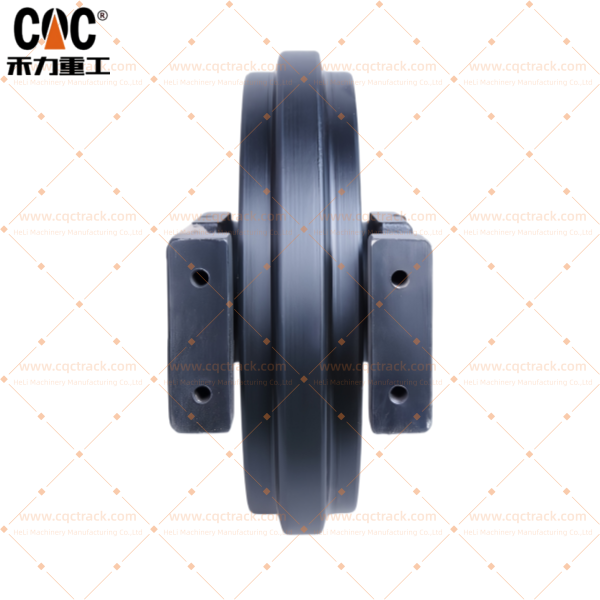
1. Product Identification and Application Coverage
1.1 Component Nomenclature and Functional Overview
A front idler assembly—technically designated as a track idler, guide wheel, idler group, or front idler wheel—is a critical passive undercarriage component mounted at the front of the excavator‘s track frame, opposite the rear-mounted drive sprocket. Unlike the drive sprocket, which is an active component that propels the machine, the front idler is a passive component that rotates freely around a stationary shaft as the track chain moves. However, its functional importance within the mini excavator chassis equals or exceeds that of the drive sprocket for several reasons:
- Track Chain Guidance: The front idler is the primary component responsible for maintaining proper track chain alignment as the chain travels around the front of the undercarriage. The idler’s precision-machined flanges prevent lateral chain movement, ensuring that the track remains centered on the undercarriage frame during forward travel, reverse travel, and turning operations. In compact chassis configurations, where space constraints limit undercarriage width, precise track guidance is particularly critical for preventing derailment in confined job sites.
- Track Tension Management: The idler assembly interfaces directly with the track tensioning system—typically a grease-filled recoil spring and tension cylinder assembly—to maintain optimal track chain tension across varying operating conditions. Proper tension is essential for preventing chain derailment, minimizing vibration, maximizing component service life in the compact chassis format, and ensuring consistent track contact for machine stability. Industry sources confirm that the idler’s splined connection to the shaft provides more bearing area and better torque transfer, increasing reliability and matching idler life with that of other lower works components.
- Frontal Load Support: The idler wheel supports the front portion of the excavator‘s operating weight, transferring loads from the track frame through the idler shaft and bearing system to the track chain and ultimately to the ground surface. For the 5–6 ton mini excavator class, the idler must accommodate the machine’s full frontal weight during dozing, grading, and traversing uneven terrain while maintaining structural integrity under continuous cyclic loading.
- Shock Load Absorption: When the excavator encounters obstacles such as rocks, curbs, or uneven ground, the front idler—working in conjunction with the recoil spring assembly—absorbs impact loads that would otherwise be transmitted directly to the undercarriage frame and upper structure. This shock absorption function is particularly important in urban construction and utility applications where operators frequently traverse mixed terrain conditions with abrupt elevation changes and debris.
A genuine front idler reduces bearing stress up to 50% to decrease bearing loads and increase component life. Heavy-duty rock guards protect against damage from dirt and debris. The rotating shaft within stationary bushings produces less contact stress and wear, while a longer crawler system life increases change-out intervals, reducing employee exposure to safety risks from system change-outs and component replacement.
1.2 OEM Part Numbers and Compatible Komatsu Excavator Models
The four idler assemblies documented in this analysis correspond to precise Komatsu OEM engineering specifications, offering direct interchangeability without requiring modifications to the track frame, track adjuster assembly, or track chain components. The table below provides comprehensive cross-reference data:
| OEM Part Number | Primary Compatible Komatsu Models | Excavator Class | Description |
|---|---|---|---|
| 22M-30-00960 | PC45MR, PC55, PC55MR, PC55MR-2, PC55MR-3, PC55MR-5 | 4.5–5.5 ton | Front idler assembly; PC45MR and PC55 series compatible |
| 20T-30-72112 | PC55, PC55MR, PC55MR-2, PC55MR-3, PC55MR-5 | 5–5.5 ton | Heavy-duty front idler assembly; extended-duty specification |
| 20T-30-72110 | PC55, PC55MR, PC55MR-2, PC55MR-3, PC55MR-5 | 5–5.5 ton | Front idler assembly; standard specification |
| 20T-30-72111 | PC55, PC55MR, PC55MR-2, PC55MR-3, PC55MR-5 | 5–5.5 ton | Front idler assembly; alternative specification |
The 22M-30-00960 part number is documented for Komatsu PC45MR excavators as well as PC55 series machines, confirming cross-platform compatibility within the Komatsu compact excavator product line. Industry sources indicate that the 22M-30-00260, 22M-30-00960, and related rollers are heavy-duty industrial equipment commonly used in construction, mining, and road-building projects.
The PC45MR is a compact hydraulic excavator designed for versatility and efficiency in various construction and landscaping applications, operating in the 4–5 ton class. The PC55MR series—including the PC55MR-2, PC55MR-3, and PC55MR-5 variants—operates in the 5–5.5 ton class. Industry sources confirm that Komatsu models that commonly require idler replacements include the PC40, PC200, PC300, PC400, and PC55MR, with the importance of verifying compatibility by checking OEM numbers.
Industry sources also list PC55 among the compatible models for Komatsu front idler assemblies, alongside PC20-7, PC30, PC30-3, PC30-5, PC30-6, PC40-7, PC45, and PC45-2. These idlers are applicable to a wide range of Komatsu excavator models from the compact PC20-7 through the full-size PC200-8 and beyond, demonstrating the engineering consistency across the Komatsu product line.
The PC55 series features a robust build for stability on uneven terrain, a powerful engine for strong traction, and a fast, effective digging system that enhances operating efficiency.
1.3 Component Architecture and Assembly Composition
A complete Komatsu PC55 front idler assembly consists of multiple precision-engineered subcomponents, each manufactured to exacting tolerances for the mini excavator chassis format:
- Idler Wheel Body (Shell): The outer wheel component that contacts the track chain link rails. The idler wheel features precision-machined flanges that maintain lateral track alignment and a hardened tread surface that engages with the chain bushings. For mini excavator applications, the wheel body diameter is proportionally smaller than larger excavator classes, requiring precise dimensional control for proper track engagement. Made from round steel, the idler shell is cast from special steel to ensure optimal wear characteristics.
- Shaft (Axle): The stationary central component that mounts to the track frame via the idler bracket or yoke. The shaft incorporates precision-ground bearing journals and sealing surfaces. Made from round steel, the idler main pin shaft will be hardened by mid-frequency induction hardening heat treatment to ensure its hardness. The splined connection between idler and shaft provides more bearing area and better torque transfer, increasing reliability and matching idler life with that of other lower works components.
- Bearing System: Hardened steel bushings or anti-friction bearings that enable smooth rotation of the idler wheel body around the stationary shaft while supporting the machine‘s frontal loads. The bearing system must accommodate the lower rotational speeds but higher relative load per contact area characteristic of mini excavator undercarriages. The rotating shaft within stationary bushings produces less contact stress and wear.
- Sealing System: High-durability floating seals incorporating rubber O-rings and metal-faced sealing elements that prevent lubricant leakage and contamination ingress from mud, dust, water, and abrasive particles. The sealing system must resist ingress of fine debris common in urban construction and landscaping environments. A genuine front idler incorporates heavy-duty rock guards that protect against damage from dirt and debris. Industry sources confirm that Komatsu idlers utilize standard high-sealing floating oil seals that are waterproof and dustproof, ensuring long-term stability of internal lubrication.
- Lubrication Charge: Grease-based lubricant that maintains the bearing system under proper lubrication conditions throughout the service life. Dedicated lube injectors supply lubricant to critical wear surfaces, and the sealed system requires no field lubrication for sealed idler configurations, reducing maintenance requirements for fleet operators.
- Idler Bracket/Yoke: The mounting structure that connects the idler shaft to the track frame and interfaces with the track adjuster recoil spring assembly. For mini excavator chassis, the bracket design must accommodate the reduced frame width while maintaining structural integrity under operational loads.
2. Komatsu PC55 Excavator Specifications and Undercarriage Parameters
2.1 PC55 Series Technical Specifications
The Komatsu PC55 series represents the upper range of the mini excavator class, offering substantial digging performance in a compact package suitable for confined job sites. The table below provides key technical specifications for the PC55 series:
| Parameter | PC55MR-3 (2010-2017) | PC55MR-5 (2017-2019) | PC55MR-5M (2017-2019) |
|---|---|---|---|
| Operating Weight | 5,160 kg (11,376 lbs) | 5,280 kg (11,640 lbs) | 5,280 kg (11,640 lbs) |
| Transport Length | 4.3 m | 5.55 m | 5.55 m |
| Transport Width | 1.96 m | 1.96 m | 1.96 m |
| Transport Height | 2.59 m | 2.59 m | 2.59 m |
| Track Width | 400 mm | 400 mm | 400 mm |
| Engine Model | 4D88E-6 | 4D88E-6 | 4D88E-6 |
| Engine Power | 38.2 HP (28.5 kW) | 29.5 kW (39.5 HP) | 29.5 kW |
| Bucket Capacity | 0.055–0.18 m³ | 0.055–0.18 m³ | 0.055–0.18 m³ |
| Max Digging Depth | 3.8 m | 3.77 m | 3.77 m |
| Max Reach Horizontal | 6.1 m | 6.075 m | 6.075 m |
| Tear-out Force | — | 39 kN | 39 kN |
| Ground Pressure | 4.4 psi | — | — |
| Drawbar Pull | 3,978 kg (8,770 lbs) | — | — |
| Track Rollers per Side | 4 | 4 | 4 |
| Carrier Rollers per Side | 1 | 1 | 1 |
| Shoe Size | 400 mm (16 in) | 400 mm | 400 mm |
| Track Gauge | 1.56 m | — | — |
Data sources:
2.2 Undercarriage Architecture
The Komatsu PC55 undercarriage features a robust track system designed for stability and traction across diverse ground conditions:
- Track Chain Pitch: Industry sources indicate that Komatsu PC55 models require 350mm-wide tracks with specific tensile strength requirements, and it is essential to verify track pitch (172mm/203mm/216mm) matches sprocket teeth spacing. For the PC55MR-3, the shoe size is 400 mm (16 in) with a track gauge of 1.56 m.
- Track Configuration: The undercarriage incorporates four track rollers per side supporting the machine weight, one carrier roller per side supporting the upper track return section, a front idler assembly with integrated track adjuster, and a rear-mounted drive sprocket powered by the hydraulic travel motor.
- Ground Pressure: The PC55MR-3 operates with a ground pressure of 4.4 psi, providing excellent flotation on soft ground conditions while maintaining sufficient traction for excavation operations.
2.3 PC45MR Compatibility
The 22M-30-00960 idler assembly is also compatible with the Komatsu PC45MR excavator. The PC45MR is a compact hydraulic excavator designed for precision and versatility in small-scale construction, landscaping, and urban projects, with a bucket capacity of approximately 0.12 m³. This cross-platform compatibility makes the 22M-30-00960 idler a valuable inventory item for fleet operators managing multiple Komatsu compact excavator models.
3. Metallurgical Composition and Heat Treatment Engineering
3.1 Material Grade Specifications
CQC TRACK manufactures Komatsu cross-reference front idlers using premium alloy steel grades selected for their specific mechanical properties in compact excavator undercarriage applications. The primary material grades employed include:
40Mn2 Alloy Steel: A chromium-manganese alloy offering an optimal balance of surface hardenability, core toughness, and cost-effectiveness for 5–6 ton class excavator applications. This material responds well to induction heat treatment, achieving uniform case hardness profiles with minimal distortion. Industry sources indicate that Komatsu idlers are manufactured using 40Mn2 material as a primary grade.
50Mn Alloy Steel: A premium-grade manganese steel offering superior wear resistance and surface hardness characteristics. Industry sources confirm that Komatsu PC55 front idler assemblies are manufactured using 50Mn material, achieving HRC 52–58 surface hardness. The 50Mn grade provides the highest level of wear resistance for demanding applications.
Special Cast Steel: For the idler shell, special cast steel is used to achieve the required wear resistance and impact toughness characteristics. The lathing process is able to ensure the idler boundary dimension, and the material selection directly influences the component‘s service life in abrasive environments.
The material grade selection directly determines the idler’s service life in abrasive environments. For steel parts like idlers, the quality difference between OEM and aftermarket is largely about material grade and heat treatment. These can be measured and verified with hardness tests and metallurgical analysis.
3.2 Forging vs. Casting: Engineering Considerations
The manufacturing method—forging versus casting—significantly influences idler performance and service life in mini excavator applications:
Forged Idlers: The forging process refines the steel‘s internal grain structure, eliminates porosity, and aligns the grain flow with the component’s primary stress paths. The result is superior mechanical properties including higher impact strength, better fatigue resistance, and greater resistance to catastrophic failure under shock loads. For premium-grade idlers, forged construction is specified.
Cast Idlers: Casting allows for complex geometries and is generally more cost-effective for production volumes. The idler shell is cast from special steel, with the lathing process ensuring precise boundary dimensions. For standard-duty applications where cost optimization is prioritized, cast construction provides acceptable performance with proper material selection and heat treatment.
Industry sources indicate that Komatsu idlers utilize both manufacturing techniques, with the specific method depending on the application and quality grade required. The technique can be either forging or casting depending on the specific part number and customer requirements.
3.3 Heat Treatment Parameters and Hardness Profiles
Heat treatment is the single most critical manufacturing operation determining front idler service life in mini excavator applications. The heat treatment process—primarily quenching and tempering—transforms steel at the molecular level, achieving a precise balance between hardness and toughness. For undercarriage components, this balance determines how long a part can endure before fatigue or deformation occurs.
The quenching process is where steel‘s real strength begins. The component is heated to a critical temperature (typically around 850–900°C), where its crystalline structure transforms into austenite. It is then rapidly cooled—usually by immersion in water or oil. This sudden temperature drop locks carbon atoms in place, forming a very hard but brittle microstructure known as martensite. This creates the hard, wear-resistant surface essential for idler treads and flanges.
While quenching provides hardness, it also introduces brittleness. Tempering is the crucial follow-up step that relieves internal stresses and restores ductility. The component is reheated to a lower, controlled temperature (typically between 150–500°C) and held for a specific period before slow cooling. This process slightly reduces extreme hardness but significantly improves toughness, impact resistance, and flexibility. The result is an ideal combination—a hardened, wear-resistant surface and a strong, flexible core—perfect for idlers that must withstand dynamic loads and shocks.
The specific heat treatment parameters for Komatsu PC55 front idlers are as follows:
| Parameter | Specification |
|---|---|
| Surface Hardness (Tread & Flanges) | HRC 52–58 |
| Case Depth | 8–12 mm |
| Core Hardness | HRC 28+ |
| Tempering Temperature | 180–200°C |
| Heat Treatment Method | Induction hardening with tempering |
Industry sources confirm that Komatsu PC55 idlers achieve surface hardness of HRC 52–58 with case depth of 8–12 mm. The idler main pin shaft is hardened by mid-frequency induction hardening heat treatment to ensure its hardness, achieving consistent quality and stability.
3.4 Quality Control and Consistency
Effective heat treatment demands strict quality control. Manufacturers must continuously monitor temperature uniformity, soaking time, cooling rate, and metallographic structure to ensure the process meets performance requirements. Ignoring these parameters—or relying on inconsistent heat treatment—can drastically shorten component lifespan. Even minor temperature deviations during quenching or tempering can lead to uneven hardness, causing premature wear, cracking, or dimensional instability.
Components produced with advanced alloys and heat treatments undergo rigorous testing to ensure uniform hardness, impact resistance, and fatigue strength. This level of quality reduces the likelihood of unexpected failures and ensures machines operate at peak performance for longer periods.
4. Manufacturing Process Engineering
4.1 Manufacturing Techniques
CQC TRACK employs advanced manufacturing techniques for Komatsu cross-reference front idler production. The manufacturing process integrates multiple specialized operations:
Casting and Forging: Idler components are produced using either casting or forging techniques depending on the specific part number and quality grade required. Industry sources confirm that Komatsu idlers are manufactured using 50Mn/40Mn2 material through forging/casting processes. Premium-grade idlers are produced through forging processes using 50Mn steel, while standard-grade idlers may utilize casting techniques.
CNC Machining: Precision CNC machining of all critical surfaces ensures dimensional accuracy to OEM specifications. The finishing process produces a smooth surface that reduces friction and extends seal life. The lathing process is able to ensure the idler boundary dimension, guaranteeing perfect fit onto the track frame.
Heat Treatment: Computer-controlled induction hardening and tempering systems achieve deep, uniform case hardness profiles of HRC 52–58 with case depth of 8–12 mm. The idler main pin shaft is hardened by mid-frequency induction hardening heat treatment to ensure its hardness.
Assembly: Dust-free assembly environments ensure proper seal installation, bearing clearance, and lubricant charging. Dedicated lube injectors supply lubricant to critical wear surfaces, and the splined connection between idler and shaft is precisely matched for optimal torque transfer.
4.2 Integrated Production Workflow
CQC TRACK‘s manufacturing prowess is built on complete vertical integration and controlled sequential processes:
- Material Sourcing: Utilization of premium 40Mn2 and 50Mn alloy steels through strategic supply partnerships, with full material certification and traceability.
- Casting and Forging Capabilities: Both casting and forging processes employed depending on application requirements and quality grade, with in-house quality control at every stage.
- CNC Machining Centers: Precision machining of all critical surfaces to ISO 2768-mK tolerances, ensuring exact dimensional compliance with OEM specifications.
- Advanced Heat Treatment Lines: Computer-controlled induction hardening and tempering furnaces achieving deep, uniform case hardness profiles of HRC 52–58 with 8–12 mm case depth.
- Assembly and Testing: Dust-free assembly environments with dynamic rotation testing on every finished idler.
- Anti-Corrosion Coating: Industrial-grade painting systems providing long-term rust protection, available in black, yellow, or customized colors to meet customer specifications.
4.3 Supply Chain Advantages
CQC TRACK‘s strategic location in Quanzhou, Fujian Province—China’s premier industrial cluster for heavy machinery manufacturing—provides exceptional supply chain advantages:
- Proximity to Major Ports: Access to Xiamen and Fuzhou international ports enables efficient export logistics with competitive ocean freight rates to destinations worldwide.
- Industrial Ecosystem: The Quanzhou region hosts multiple specialized undercarriage manufacturers, creating a robust supply chain for raw materials, components, and manufacturing services.
- Manufacturing Capacity: Supply ability for idler assemblies supports volume orders for rental fleet operators and equipment dealers, with production capacity of up to 10,000 pieces per month for undercarriage components.
- Fast Delivery: Lead times of 7–30 days depending on order volume and destination, with flexible payment terms including T/T and L/C.
5. Sealing System and Bearing Technology
5.1 Floating Seal Configuration
Front idlers for mini excavator applications are equipped with high-durability floating seals that prevent contamination ingress while retaining lubricant throughout the service life. The sealing system incorporates premium-grade rubber O-rings and metal-faced seals designed to withstand the moderate impact and contamination exposure encountered in construction and utility applications:
- Metal-Faced Seal Rings: Hardened steel sealing rings with precision-lapped faces that provide the primary sealing interface, preventing lubricant leakage and contamination ingress. Industry sources confirm that Komatsu idlers utilize standard high-sealing floating oil seals that are waterproof and dustproof, ensuring the long-term stability of the internal lubrication.
- Rubber O-Rings: Elastomeric O-rings that provide the compressive force maintaining metal-faced seal contact, while also accommodating minor shaft-to-bore misalignments.
- Seal Housing: Precision-machined cavity that positions the sealing elements correctly relative to the shaft and idler wheel body, ensuring optimal seal compression and alignment.
The sealing system must resist ingress of abrasive materials common in construction environments—including soil, sand, dust, and moisture—which would otherwise accelerate bearing wear and cause premature failure. Heavy-duty rock guards protect against damage from dirt and debris. Dedicated lube injectors supply lubricant to critical wear surfaces, extending component service life.
5.2 Bearing System Design
Each front idler incorporates a bearing system designed for low-friction rotation and extended service life under continuous operation. Two primary bearing configurations are employed depending on the specific part number and application:
Hardened Steel Bushing Configuration: The idler wheel rotates on hardened steel bushings running on the heat-treated shaft journal surfaces. This configuration offers high load-carrying capacity, resistance to shock loading, and tolerance to marginal lubrication conditions. The rotating shaft within stationary bushings produces less contact stress and wear.
Anti-Friction Bearing Configuration: Some front idler assemblies utilize anti-friction bearings (tapered roller bearings) for reduced rotational friction and extended service intervals. Industry sources indicate that the inner shaft support adopts a double-row roller bearing structure design for enhanced load capacity and operational stability.
The bearing surfaces are finished to precise surface roughness specifications that promote lubricant film retention while minimizing friction during rotation. The splined connection between idler and shaft provides more bearing area and better torque transfer, increasing reliability and matching idler life with that of other lower works components.
5.3 Lubrication Retention
Front idlers are lubricated at the time of manufacture with a precise grease charge that maintains the bearing system under proper lubrication conditions throughout the service life. The sealed system requires no field lubrication (for sealed idler configurations), eliminating the need for regular greasing and reducing maintenance requirements. Key lubrication specifications include:
- Lubricant Type: High-quality lithium-based grease with extreme pressure (EP) additives
- Lubricant Volume: Optimized for the specific bearing configuration and seal design
- Lubrication Retention: The floating seal system maintains lubricant retention even under pressure fluctuations and thermal cycling
- Lube Injection: Dedicated lube injectors supply lubricant to critical wear surfaces
6. Quality Assurance and Testing Protocols
6.1 ISO 9001:2015 Certified Manufacturing
CQC TRACK operates under ISO 9001:2015 certified quality management systems, with components traceable from raw material receipt through finished assembly. The quality management system encompasses all production stages:
- Material Certification: Incoming raw material certification verifying alloy composition and mechanical properties against industry standards, including mill test certificates for 40Mn2 and 50Mn steels.
- Dimensional Verification: Inspection of all critical dimensions using calibrated measurement equipment, including CMM (Coordinate Measuring Machine) and precision gauging.
- Heat Treatment Validation: Verification of hardness profiles and case depth using calibrated Rockwell hardness testers and metallographic examination. The HRC depth is specifically measured and documented.
- Seal System Validation: Verification of proper seal installation, bearing clearance, and lubricant charge.
- Final Testing: Dynamic rotation testing and seal integrity verification.
Industry sources confirm that Komatsu-compatible idlers are available with after-sales service including video technical support, ensuring proper installation and troubleshooting assistance.
6.2 Dynamic Rotation Testing
Each finished front idler is subjected to a dynamic rotation test that verifies:
- Concentricity: The idler wheel rotates without radial runout that would cause uneven track chain contact or vibration.
- Smoothness: The bearing system rotates freely without binding, noise, or resistance.
- Seal Integrity: The sealing system maintains proper lubricant retention with no leakage under rotational load.
- Balance: The idler assembly exhibits balanced rotation without vibration at operational speeds.
Any noise, resistance, or oil leakage is identified and corrected before approval for shipment.
6.3 Warranty and Service Life Expectations
Industry-standard warranty coverage for aftermarket front idlers typically ranges from 12 to 18 months depending on the manufacturer and application. For Komatsu PC55 front idlers manufactured by CQC TRACK, warranty periods are aligned with customer requirements and application severity. Expected service life for PC55 idlers ranges from 3,000 to 6,000 operating hours depending on ground conditions, operator practices, and maintenance schedules.
6.4 Anti-Corrosion Protection and Packaging
The idler surface is coated with anti-corrosion industrial paint, available in black, yellow, or customized colors to meet customer specifications. The coating protects the idler from rust and harsh environmental exposure during storage and field operations.
Finished idlers are wrapped in anti-rust film and packed into pallets or fumigated wooden crates suitable for international ocean freight. Each package is labeled with part number, dimensions, and quantity for easy handling and identification at destination ports and warehouses. Packaging meets international shipping standards for seafreight export from Chinese ports to destinations worldwide, with fumigated wooden crates complying with ISPM 15 phytosanitary regulations. Fast delivery is available within 30 days after contract confirmation.
7. Installation and Track Tensioning Procedures
7.1 Pre-Installation Preparation
Proper installation of a front idler assembly on a Komatsu PC55 excavator is critical to achieving expected service life. The following procedures should be followed:
- Site Preparation: Park the machine on level and firm ground. Engage the parking brake. Block the tracks securely to prevent unintended movement. Release track tension via the grease cylinder relief valve to allow removal of the track chain.
- Component Inspection: Before installation, inspect the idler bracket and track frame for wear, corrosion, or damage. Clean all mounting surfaces thoroughly, removing all debris, old gasket material, and corrosion.
- Idler Assembly Inspection: Inspect the new idler assembly for any shipping damage. Verify that the idler rotates freely by hand. Check seal integrity.
7.2 Idler Bracket and Tensioner Interface
The front idler mounts to the track frame via the idler bracket or yoke, which interfaces directly with the track adjuster assembly (recoil spring and grease cylinder). Key installation considerations include:
- Ensure that the idler bracket is properly aligned with the track frame guide surfaces.
- Verify that the recoil spring is properly seated and functioning correctly.
- Lubricate all sliding surfaces with appropriate grease before assembly.
- For idlers with splined shaft connections, ensure proper alignment before seating.
- Install the idler shaft retaining hardware to specified torque values.
7.3 Track Tension Adjustment Procedure
After idler installation, proper track tension must be established according to Komatsu PC55 specifications. The Komatsu PC55MR-5 Operation and Maintenance Manual provides the following detailed procedure:
Step 1: Preparation
Perform check and adjustment on a level and firm ground. Run the engine at low idle, then move the machine forward for a distance equal to the track length on ground, and slowly stop the machine.
Step 2: Measurement
Place a wooden block (3) which reaches from the idler (1) to the carrier roller (2) on the track. Measure the maximum deflection (a) between the under-surface of the wooden block and the top surface of the track.
Step 3: Standard Range Verification
If deflection (a) is in the standard range of 10 to 30 mm (0.4 to 1.2 in), the track tension is correct. If the deflection is out of the standard range, adjust it into the standard range.
Step 4: Increasing Track Tension
To increase track tension, pump grease through the grease fitting (4) using a grease pump. Grease can be pumped in until the distance (S) from the idler support to the track frame becomes 0 mm (0 in). If the track tension is still loose after pumping grease to the maximum, the pins and bushings are excessively worn. In this case, consult your Komatsu distributor to turn the bushing 180° or replace it.
Step 5: Verification
After adjustment, run the engine at low idle, move the machine slowly forward by an amount equal to the length of track on ground, then check the track tension again. If the tension is not correct, adjust it again.
7.4 Post-Installation Verification
After 2–4 hours of operation, re-check track tension as the new components settle into their operational positions. Re-torque any idler mounting hardware as specified in the Komatsu service manual to account for initial seating and thermal expansion.
7.5 Critical Tensioning Considerations
The following operational considerations are essential for maximizing undercarriage component life:
- Underfoot Conditions: Adjust track tension based on the underfoot conditions in which the machine is working. Added track tension increases both the load and the wear on all mating components of the undercarriage.
- Wear Consequences: Improperly adjusted track can result in problems and wear on other components. Tight track increases loads, which advances wear on rollers, idlers, sprockets, and chain bushings.
- Regular Monitoring: The wear of pins and bushings of the undercarriage depends on the working condition and soil condition. Check the track tension occasionally and keep it in the standard range.
8. Wear Diagnosis and Replacement Criteria
8.1 Primary Wear Indicators
For equipment dealers, rental fleet operators, and end users managing Komatsu PC55 excavators, early identification of front idler wear is essential to prevent secondary damage to track chains, bottom rollers, and track adjuster assemblies. The following wear indicators should be monitored:
Tread Surface Wear: The idler tread surface (the rolling contact area) wears progressively over time. When the tread surface exhibits significant flat spots or wear beyond approximately 2–3 mm below the original diameter, replacement is recommended. Industry sources indicate that worn or damaged tracks reduce stability and increase stress on rollers and idlers.
Flange Wear: The integral guide flanges are subject to abrasive wear from track chain contact. Flange thickness reduction beyond 30% of original indicates immediate replacement is required.
Seal Leakage: Visible lubricant leakage around the seal housing indicates seal failure. Continued operation with failed seals will result in bearing failure due to contamination ingress.
Abnormal Noise: Grinding, squealing, or clicking sounds during track rotation may indicate bearing failure, seal failure, or foreign object damage.
Uneven Wear Pattern: If one side of the idler shows significantly more wear than the other, this may indicate misalignment between the idler and the track chain or issues with the track frame alignment.
Track Tension Irregularities: If track tension cannot be maintained within the standard range of 10–30 mm deflection even after proper adjustment, idler wear or track adjuster failure may be the cause.
8.2 Replacement Interval Planning
A well-maintained idler directly reduces long-term operational costs. When replacing the track chain, always inspect and likely replace the idlers for balanced wear. The economic rationale is straightforward: installing a new track chain on a worn idler will accelerate wear on the new chain‘s bushings and link rails, significantly reducing overall system life. Conversely, installing a new idler on a worn chain will cause accelerated tread and flange wear and premature idler failure.
For fleet operators, the recommended replacement strategy is to replace the idler and track chain as a matched set whenever either component reaches the end of its service life. Industry best practices recommend replacing wear parts in sets to ensure even wear and prevent premature failure.
9. Regional Market Applications
9.1 South America: Urban Construction and Infrastructure Development
The South American construction market presents growing demand for compact excavator components, with operations concentrated in Brazilian infrastructure projects (São Paulo, Rio de Janeiro), Chilean urban development (Santiago, Valparaíso), Peruvian construction markets (Lima), and Argentinean infrastructure development. The region‘s heavy machinery market is characterized by high demand for 5–6 ton excavators for utility work, residential construction, and site preparation.
For South American customers, CQC TRACK’s Komatsu cross-reference front idlers offer OEM-equivalent quality at competitive pricing, with efficient logistics to Latin American destinations including Brazil (Santos, Rio de Janeiro ports), Chile (Valparaíso, San Antonio ports), Peru (Callao port), Colombia (Buenaventura, Cartagena ports), and Mexico (Veracruz, Manzanillo ports). The company welcomes you to build cooperation and generate a brilliant long-term partnership together.
9.2 Australia: Residential Construction, Rental Fleet, and Light Infrastructure
The Australian construction and rental equipment market demands aftermarket components that meet or exceed OEM performance standards, with consistent supply availability. Australian operators seek parts fit for purpose, of OEM-equivalent quality or higher, with reliable supply chains and documented quality certifications. The Australian compact excavator market—including applications in Sydney, Melbourne, Brisbane, Perth, Adelaide, and regional centers—utilizes Komatsu PC55 excavators for residential construction, utility trenching, landscaping, and site preparation.
At ITR Pacific, a full range of quality aftermarket parts are available to suit the Komatsu PC55MR-2 Mini Excavator, with fast Australia-wide delivery or pickup available from branches in Brisbane, Sydney, Melbourne, Adelaide, Perth, Kalgoorlie, and Mackay. VemaTrack also provides undercarriage components for Komatsu PC55 machines, including sprockets, rubber tracks, chains, bottom and top rollers, and track shoes.
CQC TRACK‘s manufacturing processes align with these requirements through ISO 9001:2015 certification, comprehensive testing protocols, and full component traceability.
9.3 Europe: Urban Construction and Utility Work
The European market requires undercarriage components to comply with relevant EU directives and safety standards. EN 474-12:2006/A1:2008 applies to cable excavators and their undercarriage systems, establishing essential health and safety requirements that CE marking confirms. Germany’s construction industry (Berlin, Munich, Hamburg, Frankfurt), France‘s infrastructure sector (Paris, Lyon, Marseille), the United Kingdom’s utility and residential construction markets (London, Manchester, Birmingham), and Scandinavia‘s construction industry (Stockholm, Oslo, Copenhagen, Helsinki) represent major application zones for Komatsu PC55 excavators.
The PC45/55MR-5 short tail delivers optimum performance and digging speed even in confined spaces where traditional machines cannot work: yards, road works, demolition sites, sewerage, and similar applications. The rugged and very stable design guarantees maximum safety and offers complete operator confidence in any working conditions.
CQC TRACK maintains technical documentation and quality records that support CE compliance declarations for European customers.
9.4 Russia and Central Asia: Growing Compact Equipment Market
Following the realignment of global supply chains, Russian and Central Asian construction operators increasingly source heavy equipment components from Chinese manufacturers. Russia‘s urban development projects (Moscow, St. Petersburg, Kazan, Yekaterinburg), Kazakhstan’s infrastructure growth (Astana, Almaty, Shymkent), Uzbekistan‘s construction sector (Tashkent, Samarkand), and Mongolia’s construction and mining support operations (Ulaanbaatar) represent growing markets for Komatsu compact excavator components.
For customers in Russia, Kazakhstan, Uzbekistan, and Mongolia, CQC TRACK provides reliable supply through established export channels, with packaging suitable for rail and overland transport across Central Asian routes. The company‘s manufacturing capacity supports volume orders for fleet operations requiring regular undercarriage replacement schedules.
9.5 Service Center Network Strategy
CQC TRACK’s strategic objective is to establish, directly or through authorized distributors, a well-integrated network of service centers in major construction equipment markets worldwide that provide complete specialized undercarriage maintenance service. These service centers employ properly trained professionals with the right expertise and tools, backed by the best parts availability to enable machines to be up and running quickly and reliably.
10. Sourcing Considerations for Procurement Professionals
10.1 Cross-Reference Verification
Before purchasing aftermarket undercarriage components, procurement professionals should verify compatibility using the machine‘s serial number and the specific OEM part number from the Komatsu parts catalog. The part numbers documented in this analysis—22M-30-00960, 20T-30-72112, 20T-30-72110, and 20T-30-72111—serve as primary OEM references for direct cross-reference ordering.
The 22M-30-00960 part number has documented compatibility with Komatsu PC45MR and PC55 series excavators. The 20T-30-72112 part number is referenced in industry parts databases for PC55 applications.
10.2 Quality Documentation Requirements
When sourcing front idlers for construction applications, request supplier quality documentation including:
- ISO 9001:2015 certification
- Dimensional inspection reports
- Metallurgical test certifications (material grade verification: 40Mn2 or 50Mn)
- Heat treatment records (hardness profiles: HRC 52–58, case depth: 8–12 mm)
- Mill test certificates for raw material
- Seal system specifications and type
- Bearing type and configuration details
- Warranty documentation (12–18 months typical)
Reputable manufacturers maintain full traceability from raw material to finished assembly, enabling verification of material grade, heat treatment parameters, and dimensional compliance. Industry sources confirm that after-sales service including video technical support is available from qualified suppliers.
10.3 Supply Chain and Lead Times
CQC TRACK maintains finished goods inventory for high-demand part numbers including the PC55 idler assemblies, with lead times of 7–30 days depending on order volume and destination. Supply ability for idler assemblies is substantial, with production capacity of up to 10,000 pieces per month for undercarriage components. Minimum order quantities are negotiable, with sample quantities available for qualification testing. Payment terms include T/T and L/C.
10.4 Cost Optimization Through Aftermarket Sourcing
Undercarriage components can account for up to 50% of a machine‘s operating costs over its service life. For construction companies, rental fleet operators, and equipment dealers managing fleets of Komatsu compact excavators, sourcing OEM-equivalent aftermarket idlers from specialized manufacturers like CQC TRACK provides significant cost savings without compromising quality or reliability. The company’s vertically integrated manufacturing—encompassing material sourcing, heat treatment, machining, and assembly—eliminates multiple supply chain markups, enabling competitive pricing for volume buyers.
A genuine front idler provides greater track efficiency by increasing bearing area and lube distribution, with 50% less bearing stress reducing bearing loads and increasing component life. Longer crawler system life increases change-out intervals, reducing employee exposure to safety risks from system change-outs and component replacement.
11. Frequently Asked Questions for Equipment Dealers and Fleet Operators
Q1: What is the function of a front idler on a Komatsu PC55 excavator?
A front idler (also called a guide wheel or track idler) guides the track chain, maintains proper track tension in conjunction with the track adjuster assembly, supports the front portion of the machine‘s weight, and absorbs shock loads from uneven terrain. The splined connection between idler and shaft provides more bearing area and better torque transfer, increasing reliability and matching idler life with that of other lower works components.
Q2: How do I verify which idler part number my Komatsu excavator requires?
Verify using the machine’s serial number and the specific OEM part number from the Komatsu parts catalog. The four part numbers covered in this analysis—22M-30-00960, 20T-30-72112, 20T-30-72110, and 20T-30-72111—cover the PC55 and PC45MR model ranges. It is important to verify the compatibility of replacement parts by checking the OEM numbers.
Q3: What materials are used in CQC TRACK front idlers for Komatsu excavators?
CQC TRACK uses premium 40Mn2 and 50Mn alloy steel, induction-hardened to HRC 52–58 with case depth of 8–12 mm for optimal wear resistance. The idler main pin shaft is hardened by mid-frequency induction hardening heat treatment to ensure its hardness.
Q4: Are these idlers direct replacements for Komatsu OEM parts?
Yes, all front idlers manufactured by CQC TRACK are direct OEM cross-reference replacements, manufactured to Komatsu‘s original engineering specifications for dimensional accuracy and mechanical properties.
Q5: What quality certifications does CQC TRACK hold?
CQC TRACK operates under ISO 9001:2015 certified quality management systems with full component traceability from raw material through finished assembly. After-sales service including video technical support is provided.
Q6: What is the typical service life of a front idler in mini excavator applications?
Front idler service life in PC55 applications typically ranges from 3,000 to 6,000 operating hours, depending on ground conditions, operator practices, and maintenance schedules.
Q7: When should I replace my excavator’s front idler?
Replace the idler when the tread surface is worn more than 2–3 mm below original diameter, when flange thickness is reduced beyond 30% of original, when seal leakage is observed, or when abnormal noise is detected during operation. Worn or damaged tracks reduce stability and increase stress on rollers and idlers.
Q8: Should I replace the idler when I replace the track chain?
Yes. When replacing the track chain, always inspect and likely replace the idlers for balanced wear. Installing a new chain on a worn idler will rapidly accelerate chain bushing and link rail wear. Replace wear parts in sets to ensure even wear and prevent premature failure.
Q9: What is the correct track sag specification for Komatsu PC55 excavators?
Proper track sag for Komatsu PC55 excavators is 10–30 mm (0.4–1.2 in) measured as the maximum deflection between the under-surface of a wooden block placed from the idler to the carrier roller and the top surface of the track.
Q10: What is the lead time for volume orders of Komatsu PC55 idlers?
Lead times for volume orders of Komatsu PC55 front idlers typically range from 7–30 days depending on order volume and destination, with fast delivery within 30 days after contract confirmation. Supply ability is up to 10,000 pieces per month.
Q11: What warranty coverage is provided?
Industry-standard warranty coverage for aftermarket front idlers typically ranges from 12 to 18 months depending on the manufacturer and application.
Q12: Can these idlers be used on PC45MR excavators?
Yes, the 22M-30-00960 idler assembly is specifically documented for Komatsu PC45MR excavators as well as PC55 series machines. Industry sources list PC45 as a compatible model for Komatsu front idler assemblies.
12. Manufacturing Capability Overview: CQC TRACK (HELI MACHINERY MANUFACTURING CO., LTD.)
12.1 Corporate Profile
CQC TRACK (HELI MACHINERY MANUFACTURING CO., LTD.) has established itself as a premier undercarriage component manufacturer in the Quanzhou region, a key supply cluster for global earthmoving equipment. Rooted in the industrial hub of Quanzhou, Fujian Province—a region renowned for its concentration of mechanical manufacturing expertise and strategic access to major international ports including Xiamen and Fuzhou—the company serves the global market as a proficient OEM and ODM manufacturing partner.
The Quanzhou region hosts multiple specialized undercarriage manufacturers, creating a robust industrial ecosystem. Quanzhou Shengde Machinery Development Co., Ltd specializes in a diverse array of undercarriage components, including track roller assemblies, carrier roller assemblies, sprocket rims, idler assemblies, and track link assemblies. Fujian Jinjia Machinery Co., Ltd has been manufacturing since 1990, supplying undercarriage parts including track rollers, carrier rollers, idlers, sprockets, and track chains. Quanzhou Tengsheng Machinery Parts Co., Ltd has proven itself as a capable and trusted manufacturer in the undercarriage parts industry for excavators, bulldozers, and crawler cranes.
CQC TRACK’s evolution from a specialized parts workshop to its current status as a vertically integrated manufacturing powerhouse reflects a steadfast focus on the undercarriage niche, investing in advanced manufacturing assets and cultivating deep technical expertise in metallurgy and tribology specific to track systems.
The company manufactures a full range of Komatsu-compatible undercarriage parts, including track rollers, idlers, sprockets, track chains, track shoes, and complete undercarriage systems.
12.2 OEM and ODM Service Models
CQC TRACK operates two primary service models for international customers:
OEM Manufacturing: The company produces components to exact client specifications, drawings, and quality standards. The factory is adept at seamless integration into global supply chains, providing reliable volume production of idlers, rollers, sprockets, track links, and complete undercarriage systems for brands including Komatsu, Hitachi, Caterpillar, Volvo, Kobelco, Doosan, Hyundai, SANY, and others.
ODM Engineering: Leveraging extensive field experience, CQC TRACK collaborates with clients to develop, design, and validate improved or fully customized undercarriage solutions. The engineering team proactively addresses common failure modes, offering value-optimized designs that enhance performance and reduce total cost of ownership.
12.3 Integrated Production Workflow
The company‘s manufacturing prowess is built on complete vertical integration and controlled sequential processes:
- Material Sourcing: Utilization of premium 40Mn2 and 50Mn alloy steels through strategic supply partnerships, with full material certification and traceability.
- Casting and Forging Capabilities: Both casting and forging processes employed depending on application requirements and quality grade.
- CNC Machining Centers: Precision machining of all critical surfaces to ISO 2768-mK tolerances.
- Advanced Heat Treatment Lines: Computer-controlled induction hardening and tempering furnaces achieving deep, uniform case hardness profiles of HRC 52–58 with 8–12 mm case depth.
- Assembly and Testing: Dust-free assembly environments with dynamic rotation testing on every finished idler.
- Anti-Corrosion Coating: Industrial-grade painting systems providing long-term rust protection, available in black, yellow, or customized colors.
- Packaging and Logistics: Anti-rust film wrapping with pallet or fumigated wooden crate packing for international ocean freight, complying with ISPM 15 phytosanitary regulations.
12.4 Quality and Value Proposition
World-class quality with factory direct pricing, 35 years’ experience in excavator and bulldozer spare parts manufacturing, flexible payment terms including T/T and L/C, and fast delivery within 30 days after contract. The splined connection between idler and shaft increases reliability and matches idler life with that of other lower works components. Bearing blocks with bushings can be removed without breaking the track, simplifying maintenance and reducing downtime.
13. Conclusion
The four Komatsu OEM cross-reference front idler assemblies documented in this analysis—22M-30-00960, 20T-30-72112, 20T-30-72110, and 20T-30-72111—represent essential undercarriage components for PC55 and PC45MR series hydraulic crawler excavators deployed in urban construction, utility work, landscaping, residential development, and light infrastructure projects worldwide. As the primary track guidance and tension management component at the front of the undercarriage, the idler assembly plays a critical role in track chain alignment, load distribution, shock absorption, and overall undercarriage system longevity.
The Komatsu PC55 series, with operating weights of approximately 5.16–5.28 metric tons, track width of 400 mm, and four track rollers per side, represents a significant segment of the global mini excavator market. For these machines, the front idler must provide reliable service under demanding conditions while accommodating the space constraints of the compact chassis format.
CQC TRACK (HELI MACHINERY MANUFACTURING CO., LTD.) manufactures these idlers to meet or exceed OEM specifications through advanced casting and forging techniques, precision CNC machining, computer-controlled induction heat treatment achieving HRC 52–58 surface hardness with 8–12 mm case depth, and rigorous quality assurance protocols. The company‘s ISO 9001:2015 certified manufacturing processes, comprehensive testing protocols, and strategic position as a premier undercarriage component manufacturer in Quanzhou’s heavy machinery industrial cluster enable consistent supply to global markets.
For equipment dealers, rental fleet operators, and end users throughout South America, Australia, Europe, Russia, and Central Asia, these front idlers provide a reliable, cost-effective alternative to OEM parts without compromising on material quality, manufacturing precision, or service life. A genuine front idler reduces bearing stress up to 50%, provides greater track efficiency by increasing bearing area and lube distribution, and helps lower operating costs by extending crawler system life and minimizing unplanned downtime.
For fleet managers and maintenance supervisors, implementing a proactive idler inspection and replacement schedule—including regular tread wear measurement, flange geometry verification, seal integrity checks, track tension verification to the 10–30 mm standard range, and coordinated idler-and-chain replacement—represents the most effective strategy for maximizing undercarriage system life and minimizing unplanned downtime.
CQC TRACK warmly welcomes you to build cooperation and generate a brilliant long-term partnership together.
This technical publication is intended for engineering and procurement professionals in the construction, rental, and light infrastructure industries. All specifications are subject to verification against current OEM documentation. Original spare part numbers are for comparison purposes only. For current pricing, lead times, and technical support, contact CQC TRACK directly.
Products categories
-

CAT 3408242-5400649 E375 E385 E390 E395 Guide W...
-

XCMG 414101964 XE700 Track Guide Wheel or Track...
-
China Manufacture New Product Sell zy200 Bulldo...
-

Hundai E1812004 R200 R200LC HX220 Track Excavat...
-

Crawler excavator parts ZAX450 ZAX670 ZAX870 tr...
-

LIUGONG 14C0434 14C0434C1 CLG906F NEW Track Idl...


