
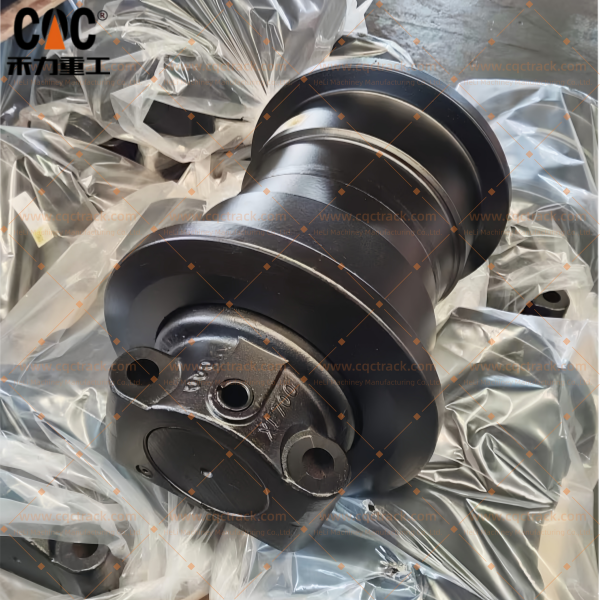
XCMG XE700 414102568/ 414101971 Track Lower Roller Assy/ cqctrack – Heavy -duty tracked chassis component manufacturing expert, the first choice for complex mining environments


Why Mining Operations Worldwide Standardize on CQC Track’s 414102568 & 414101971 Lower Rollers for XCMG XE700
By Jack, Heavy-Duty Tracked Chassis Component Manufacturing Expert, CQC Track
When an XCMG XE700 crawls through a South African platinum decline or scales a Chilean copper bench, its entire weight and torque concentrate into a handful of track lower rollers. Part numbers 414102568 and 414101971 are not just catalog entries — they are dynamic load-bearing pivots that determine whether the machine keeps stripping overburden or stands idle. For exactly this reason, an increasing number of mine maintenance planners and OEM service dealers across six continents no longer treat these assemblies as commodities. They source them from CQC Track, a specialist where the complete manufacturing value chain, from molten alloy to sealed assembly, resides under one quality system.
“I’ve spent my career analyzing roller failures in the field — spalled treads, collapsed seals, seized shafts. In every case, the root cause traces back to a break in the manufacturing chain. A forging from one supplier, heat treatment from another, machining somewhere else. CQC Track closes that accountability gap. We pour the steel, forge the shell, cut the metal, harden the wear surfaces, and assemble the finished roller inside our own gates. That integrated control is what transforms a standard replacement part into a mining-grade asset.”
— Jack, Senior Undercarriage Engineer, CQC Track
Full-Spectrum In-House Manufacturing: From Raw Blank to Finished Assy
The OEM manufacturing capacity at CQC Track begins with raw material engineering and ends with automated final inspection. Our dedicated technical team — foundrymen, forging specialists, CNC programmers, heat treat metallurgists, and assembly technicians — operates a synchronized production line built around these interconnected stages:
1. Custom Steel Formulation & Blank Production
Instead of purchasing generic round bar, we design proprietary low-alloy steels with controlled additions of chromium, molybdenum, and manganese. The liquid metal is degassed and continuously cast into blooms, then transferred while still above recrystallization temperature to our forging and casting bays. This thermal continuity reduces micro-segregation and ensures a uniform starting microstructure for each roller body.
2. Hot-Die Forging & Precision Casting
Roller shells for 414102568 and 414101971 are primarily produced through closed-die hot forging. Multi-ram presses shape the steel in three dimensions, aligning the grain flow around the shaft bore and along the tread profile — a deliberate orientation that multiplies fatigue resistance under repeated bending and contact stress. Where design complexity demands it, our foundry uses vacuum-assisted casting to produce flange hubs and seal housings with zero internal shrinkage, verified by X-ray inspection on every foundry lot.
3. Advanced CNC Machining & Surface Integrity
Post-forging blanks enter our climate-controlled machining center. We use twin-spindle turning and boring mills that complete inner bearing seats, seal grooves, and outer tread profiles in a single clamping setup, eliminating cumulative alignment errors. Critical sealing surfaces are superfinished to an Ra value below 0.3 µm, creating a mirror-like interface for the duo-cone floating seals. Every journal is then magnetically particle-inspected for sub-surface discontinuities before heat treatment.
4. Induction Hardening & Deep Case Depth Engineering
Rather than relying on generic hardening parameters, our metallurgy team designs a multi-frequency induction scan cycle for each roller diameter. This produces an optimized hardness profile — typically 56–60 HRC on the tread surface with a gradual transition to a tough core above 35 HRC. Real-time infrared monitoring verifies the thermal pattern on every roller, eliminating the risk of localized soft bands that initiate pitting in abrasive wet mining conditions.
5. Clean-Room Sealed Assembly
Assemblies come together in a positive-pressure clean room. Duo-cone floating seals are installed using vacuum suction tools to prevent contamination. Premium lithium-complex extreme-pressure grease fills all bearing cavities through automatic metered dosing. Every assembled roller then passes a robotic rotational torque test (to detect seal drag anomalies) and a helium leak test, ensuring zero ingress pathways for water and fine abrasive particles.
6. Protective Finishing & Packing
Finally, a multi-layer epoxy-polyurethane coating system — tested to over 1,000 hours of salt spray resistance — is applied, and each roller is individually packaged in marine-grade crating with vibration-absorbing saddles, ready for long-haul container shipment to remote mine sites.
This complete industrial chain — casting/forging, machining, heat treating, assembly, and surface protection — represents our interpretation of genuine OEM capability. It also gives us the flexibility to supply components under customer-branded part numbers and packaging, making CQC Track a strategic ODM partner for regional distributors and mining groups seeking to consolidate their undercarriage supply.
Associated Undercarriage Components for Complete Track Frame Overhauls
A lower roller rarely operates in isolation. When a mining fleet undergoes an undercarriage rebuild, CQC Track supports the entire XCMG XE700 tracked chassis with matched-spec components, available on a single purchase order to reduce logistics complexity:
- Lower Roller Assembly (Single Flange) – 414102568
- Lower Roller Assembly – 414101971
- Carrier Roller Assembly – 414102569 Full OEM interchangeability (contact with host machine serial number for precise part number cross-reference)
- Front Idler Assembly – 414102566 – With induction-hardened tread, high-capacity spherical roller bearing pack, and tensioning yoke group
- Track Chain (Sealed & Lubricated) – Pin and bushing turning proof-tested; master pin and bushing supplied loose
- Drive Sprocket Rim / Segments –414102567 – Hobbing-cut tooth profiles, flame- or induction-hardened to match original hardness pattern
- Track Shoes – One-piece forged or rolled profile in multiple grouser heights for traction and cleanout optimization
All components are produced from the same material families and undergo coordinated heat treatment processes, ensuring uniform wear rates across the full track frame — a critical advantage when planning mid-life component swaps in high-abrasion mining applications.
Global Supply Footprint Serving Complex Mining Environments
CQC Track lower roller assemblies for XCMG XE700 are currently working under the following conditions:
- South America – Copper porphyry mines in Chile and Peru, iron ore in Brazil, gold in Colombia
- North America – Hard rock and oil sands operations in the United States and Canada
- Europe – Underground metal mines in Finland and Sweden, quarrying in Spain and Poland
- Africa – Deep-level gold and platinum mines in South Africa, copper-cobalt in the DRC and Zambia, gold in Ghana
- Russia & Central Asia – Open-pit coal in Kuzbass and Karaganda, base metals in Uzbekistan
- East & Central Asia – Quarrying and industrial minerals in South Korea, Mongolia, and Kazakhstan
- Southeast Asia – Nickel laterite operations in Indonesia and the Philippines, aggregate and cement raw material in Vietnam, Thailand, and Myanmar
- Oceania – Pilbara iron ore and Bowen Basin coal in Australia
Our regional stock hubs and authorized mining service partners provide on-ground technical inspection, wear measurement, and rapid parts replenishment — because in complex mining environments, the lowest cost roller is the one that arrives on time and lasts until the next planned shutdown.
To engineering and procurement teams looking for XCMG XE700 track lower roller assemblies (414102568 / 414101971) that match the manufacturing rigour expected in Tier-1 mining operations: contact Jack and the CQC Track technical group directly. Share your fleet serial numbers and site conditions, and we will return a tailored undercarriage support plan complete with metallurgical data packages, installation specifications, and mine-proven lifecycle references.
Products categories
-

ZOOMLION ZR380L Track Lower Roller Assembly (10...
-

HITACHI/EX3000-(9066272,A7635000M00)-track roll...
-

Lonking 60200008377 CDM6485 CDM6490 Track Botto...
-

CAT excavator undercarriage part 345/349 track/...
-

Komatsu PC500 SF/ Track Lower Roller Assembly (...
-

Shantui excavators /dozers(KT001-2) track rolle...


