
Caterpillar 6Y8168 CR6382 3004611 2424066 1753274 E365 E374 E375 E385 Track Upper Roller Assy / Track Carrier Roller Assembly / Heavy duty Excavator undercarriages Source factory and manufacturer / CQCTRACK


Caterpillar 6Y8168 CR6382 3004611 2424066 1753274 E365 E374 E375 E385 Track Upper Roller Assy / Track Carrier Roller Assembly / Heavy Duty Excavator Undercarriages – Source Factory and Manufacturer / CQCTRACK
by Jack
1. Executive Summary
The Caterpillar 6Y8168, CR6382, 3004611, 2424066, and 1753274 Track Carrier Roller Assemblies are mission-critical undercarriage components engineered for Caterpillar’s E-series large-class hydraulic excavators, including the E365, E374, E375, E385, E390, and E395F models. These track upper roller assemblies—also designated as top roller groups or carrier rollers—support the upper return run of the track chain, maintain proper track sag and tension, and guide the chain smoothly back to the drive sprocket.
Positioned along the top of the track frame, the carrier roller serves a fundamentally different function than the bottom track rollers. While bottom rollers bear the entire machine weight against the ground, carrier rollers support the upper strand of the track chain as it returns from the front idler to the rear drive sprocket. This guidance function is critical: a failed carrier roller that is not detected early will gouge the track links and create a cascade of damage through the entire undercarriage system.
For ultra-class excavators like the CAT E390 and E395F, the undercarriage is the foundation of productivity, bearing immense operational weight and dynamic stresses from mining, large-scale quarrying, and heavy construction. The failure of an upper roller in these applications leads to catastrophic track whip, increased risk of derailment, accelerated wear on the track chain and sprocket, and significant costly downtime.
CQCTRACK (operated by Heli Machinery Manufacturing Co., Ltd.) has established itself as a premier source manufacturer and global exporter of heavy-duty undercarriage parts for mining, construction, and quarrying equipment. As a vertically integrated source factory—not merely a consolidator or trading company—CQCTRACK delivers OEM-quality replacement components with full process traceability from raw material chemistry to final assembly certification. This technical exposition provides a comprehensive engineering analysis of the Caterpillar track carrier roller assemblies referenced above, encompassing company profile, product characteristics, advanced manufacturing processes, OEM and ODM capabilities, non-standard customization for severe operating conditions, and global supply chain coverage.
All manufacturers’ names, part numbers, trademarks, and registered trademarks are used for reference and compatibility identification purposes only.
2. Source Manufacturer: CQCTRACK (Heli Machinery Manufacturing Co., Ltd.)
2.1 Corporate Profile and Strategic Positioning
CQCTRACK, operating under the legal entity Heli Machinery Manufacturing Co., Ltd., is a specialized manufacturer and global exporter of heavy-duty undercarriage parts for mining, construction, and quarrying equipment. Heli Machinery has established itself as a premier source manufacturer of OEM-quality undercarriage components, bridging the gap between genuine OEM parts and inconsistent aftermarket alternatives. With a steadfast focus on undercarriage engineering, the company has developed deep technical expertise in metallurgy and tribology specific to track systems.
The company’s core business covers excavator and bulldozer undercarriage parts, including track rollers, carrier rollers, sprockets, idlers, track chain assemblies, and track shoes. Heli Machinery’s manufacturing facility is an ISO 9001:2015 certified facility with CQC (China Quality Certification) product certification, ensuring consistent quality management and continuous improvement.
2.2 Brand Philosophy: CQCTRACK
The CQCTRACK brand symbolizes three core engineering principles: Quality, Precision, and Durability—the foundational requirements for any undercarriage component operating in heavy-duty mining environments. As a genuine source factory, CQCTRACK maintains complete in-house production workflows, including forging, CNC machining, advanced heat treatment, and assembly lines. This vertical integration ensures quality control at every stage and eliminates intermediate supply chain markups, enabling direct-to-customer pricing without compromising quality.
2.3 Certifications and Quality Management
CQCTRACK operates an ISO 9001:2015 certified facility with CQC product certification, validating that the company’s quality management systems meet international standards. The CQC (China Quality Certification) mark provides third-party validation that products comply with relevant quality, safety, and performance requirements, safeguarding consumer interests and improving product quality.
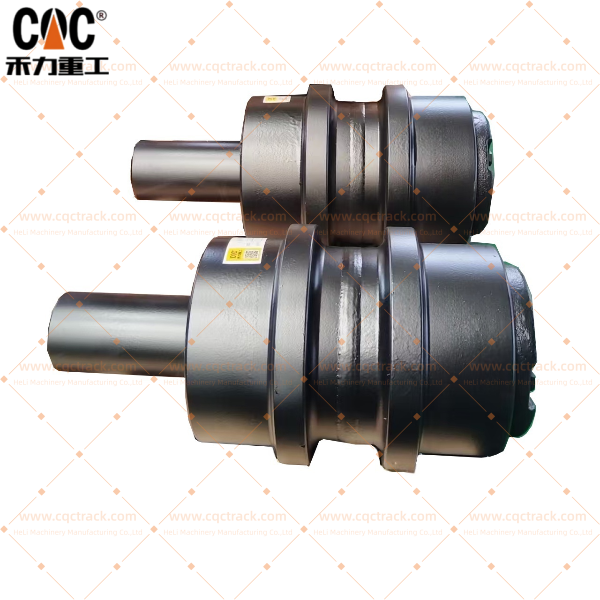
3. Product Characteristics: Caterpillar Track Carrier Roller Assemblies
3.1 Functional Definition and Mechanical Role
The Track Carrier Roller Assembly (also known as the Top Roller Group or Upper Roller Assembly) is a vital component of the excavator undercarriage system. Positioned along the top of the track frame, its primary functions are to:
- Support the Weight of the Upper Track Chain: The carrier roller supports the return run of the track chain, preventing excessive sag that would cause the chain to contact the track frame or other components.
- Maintain Proper Track Sag and Tension: By providing a smooth, low-friction surface for the returning track chain, the carrier roller helps maintain proper track tension throughout the chain’s full rotation.
- Guide the Chain Smoothly Back to the Drive Sprocket: The carrier roller ensures proper alignment of the track chain as it returns from the front idler to the rear drive sprocket, preventing derailment and minimizing asymmetric wear.
3.2 Reference Part Numbers and Interchangeability
The following OEM part numbers are fully interchangeable and cross-referenced for the E365, E374, E375, E385, E390, and E395F excavator platforms:
| OEM Part Number | CQCTRACK Equivalency | Primary Machine Models | Component Engineering Classification |
|---|---|---|---|
| 6Y8168 | Direct OEM Replacement | CAT E365, E374, E375, E385, E385C | Track Carrier Roller Assembly |
| CR6382 | Direct OEM Replacement | CAT E365, E374, E375, E385 | Track Carrier Roller Assembly |
| 3004611 | Direct OEM Replacement | CAT E390, E395F | Track Upper Roller Assembly / Top Roller Group |
| 2424066 | Direct OEM Replacement | CAT E390, E395F (alternative reference) | Track Upper Roller Assembly / Top Roller Group |
| 1753274 | Direct OEM Replacement | CAT E385C, E390 | Track Carrier Roller Assembly |
The HELI upper roller assembly is engineered to be a form, fit, and function replacement for these specific Caterpillar models, matching all critical dimensions, mounting configurations, and performance specifications of the genuine CAT parts.
3.3 Target Machine Models
These heavy-duty carrier roller assemblies are specifically designed for the following Caterpillar excavator models, renowned for their application in mining and heavy infrastructure projects:
- CAT E365 Series Hydraulic Excavator — A heavy-duty excavator in the 65-ton class, the E365 is built for large-scale earthmoving and quarrying operations. The carrier roller supports the upper track chain under continuous heavy-duty cycles.
- CAT E374 Series Hydraulic Excavator — A 74-tonne large excavator with 10% more swing torque than the 374F it replaces, twice the structural durability, and 20% lower maintenance costs. The 374 can load up to 33 trucks per hour with 36-tonne (40-ton) capacity.
- CAT E375 Series Hydraulic Excavator — Positioned in the 75–80 ton class, the E375 is designed for heavy digging duties and bulk material handling, featuring a reinforced heavy-duty design suited for the most demanding operations.
- CAT E385 Series Hydraulic Excavator — Operating in the 80–90 ton class, the E385 is widely deployed in mining and large-scale quarrying for overburden removal and ore extraction. The carrier roller must withstand extreme cyclic loading in these high-production environments.
- CAT E390 Series and E395F Hydraulic Excavator — Ultra-class excavators operating in the 90+ ton class, used in the most severe mining applications worldwide. The undercarriage is strengthened to provide excellent reliability and durability when working on rocky ground or blasted rock.
3.4 Component Anatomy
The CATERPILLAR track carrier roller assembly is a sealed, lubricated component. Its performance is determined by the synergistic interaction of several precision-engineered subsystems:
Roller Shell and Flange System: The roller body is precision-forged from micro-alloyed boron steel or equivalent high-grade materials. The outer shell—the contact surface for the track chain—is induction-hardened to achieve optimal wear resistance while maintaining core toughness. Flanges (where incorporated) guide the track chain and prevent lateral movement off the roller path. Carrier rollers may feature single-flange or double-flange designs depending on the specific machine configuration.
Roller Shaft: The central shaft fits into the mounting bosses on the track frame. Precision-machined to tight tolerances (IT7-IT8), the shaft ensures proper alignment and concentricity of the roller assembly.
Roller Bearings: High-capacity sealed bearings allow the roller to spin freely around the shaft. These bearings are designed to accommodate both radial loads (from track chain weight) and axial loads (from track alignment forces).
Sealing System: Critical multi-lip seals—often labyrinth and/or lip seal configurations—protect the bearings from contaminants (dirt, water, mud) and retain lubricating grease. Seal failure is the most common cause of premature roller failure, as failed seals allow contaminants to destroy the bearings.
3.5 Technical Specifications
| Specification Parameter | CQCTRACK Standard | Industry Reference |
|---|---|---|
| Base Material | 35MnB, 50Mn, or micro-alloyed boron steel | GB/T, ISO 683-1 |
| Production Process | Precision forging (premium) / Casting (value) | Closed-die forging |
| Surface Hardness (Roller Shell) | HRC 52–58 | ISO 6508-1 |
| Case Hardening Depth | 8–12 mm | Induction hardening |
| Shaft Material | 45# steel or equivalent alloy | GB/T |
| Shaft Surface Hardness | HRC 50–56 | ISO 6508-1 |
| Sealing System | Multi-lip labyrinth / lip seal | Factory-sealed, lubricated |
| Bearing Type | High-capacity sealed roller bearing | Maintenance-free design |
| Dimensional Tolerance | ISO 2768-mK | CNC machining standard |
These material properties ensure that the carrier roller maintains its geometric integrity under the extreme cyclic loading characteristic of mining and heavy construction operations, delivering extended service life in the most severe operating conditions.
4. Advanced Manufacturing Process
4.1 Precision Forging – The Foundation of Durability
CQCTRACK’s manufacturing process integrates advanced metallurgy, precision machining, and controlled heat treatment to ensure each carrier roller meets rigorous performance standards. The production workflow comprises five distinct stages.
Stage 1: Material Selection and Spectrographic Analysis
CQCTRACK utilizes premium alloy steels including 35MnB, 50Mn, and micro-alloyed boron steel grades. These materials are selected for their excellent hardenability, ensuring deep, consistent case hardness while maintaining a shock-absorbent core. Spectrographic analysis verifies material chemistry for every batch, ensuring compliance with ISO 683-1 specifications.
Stage 2: Precision Die Forging
The process begins with precision die forging of the roller blank. This hot-forging operation refines the grain structure, creating a continuous fiber flow that follows the component contour. Forging:
- Aligns metal grain flow with component contours, maximizing strength in directions of principal stress
- Eliminates internal porosity and shrinkage defects characteristic of castings
- Dramatically enhances fatigue strength and impact resistance compared to cast or machined-from-bar alternatives
Stage 3: CNC Machining and Surface Finishing
The forged blanks are processed through Computer Numerical Control (CNC) lathes and milling centers to achieve critical dimensions. Key machining operations include:
- Tread and Flange Machining: The roller shell is machined to precise tread diameter and flange geometry specifications
- Shaft Machining: The central shaft is precision-ground to achieve tight bearing seat tolerances
- Bore and Mounting Surface Machining: Critical mounting surfaces are held to tight tolerances (IT7-IT8) for perfect alignment with track frame mounting brackets
- Dimensional Verification: CNC inspection ensures dimensional accuracy to ISO 2768-mK standards
Stage 4: Advanced Heat Treatment
CQCTRACK’s dedicated facility features computer-controlled induction hardening and tempering furnaces. The company specializes in achieving deep, uniform case hardness profiles across critical wear surfaces:
- Induction Hardening: Applied to the roller shell tread and flange wear surfaces, achieving surface hardness of HRC 52–58 with case depths of 8–12 mm
- Through-Hardening (Alternative): For specific configurations where uniform hardness throughout the cross-section is required
- Tempering: Controlled tempering relieves internal stresses while maintaining optimal hardness
Stage 5: Assembly and Sealing
The final assembly stage incorporates:
- Bearing Press-Fit: Precision press-fit of high-capacity sealed bearings onto the roller shaft
- Seal Installation: Installation of multi-lip labyrinth and/or lip seals to protect bearings from contaminants
- Lubricant Injection: Factory-sealed, pre-lubricated design ensures trouble-free operation from first use
- Final Inspection: 100% dimensional, hardness, and seal integrity testing prior to packaging
4.2 Why Forging Beats Casting for Heavy-Duty Carrier Rollers
| Characteristic | Forged Roller (CQCTRACK Premium) | Cast Roller (Value Grade) |
|---|---|---|
| Grain Structure | Directional grain flow along component contours | Isotropic (uniform) |
| Internal Defects | None (porosity and shrinkage eliminated) | Potential porosity and shrinkage cavities |
| Impact Toughness | Superior (higher Charpy values) | Standard |
| Fatigue Strength | Excellent, optimized for cyclic loading | Good but lower than forged |
| Surface Hardness | HRC 52–58 | HRC 48–55 |
| Case Depth | 8–12 mm | 4–8 mm |
| Service Life | Extended (optimized for mining applications) | Shorter, suitable for lighter applications |
| Cost | Higher (premium quality) | Lower |
For the extreme demands of CAT E365, E374, E375, E385, and E390 applications in mining and quarrying, forged carrier rollers are the standard, as they deliver the structural integrity required for continuous heavy-duty operation.
4.3 Quality Control and Non-Destructive Testing
Every component undergoes a stringent quality assurance process:
- Dimensional Checks: Verifying all critical dimensions against OEM specifications
- Hardness Testing: Rockwell HRC surface and core hardness verification
- Case Depth Measurement: Microhardness traverse from surface to verify case depth (8–12 mm minimum)
- Non-Destructive Testing (NDT): Magnetic Particle Inspection (MPI) to ensure flawless performance and detect any surface or subsurface cracks
- Seal Integrity Testing: Pressure testing to verify seal performance and lubricant retention
5. OEM and ODM Manufacturing Capabilities
5.1 OEM Manufacturing – Precision Replication
CQCTRACK operates as a proficient OEM (Original Equipment Manufacturer) partner, producing components to exact client specifications, drawings, and quality standards. The company’s factory is adept at seamless integration into global supply chains, providing reliable volume production of carrier rollers, bottom rollers, idlers, sprockets, and track links.
OEM Service Features:
- Exact Specification Compliance: Components manufactured to customer-provided drawings, including all dimensional tolerances, material grades, and heat treatment requirements
- Custom Labeling and Packaging: OEM branding and packaging options available
- Volume Production Capability: Scalable manufacturing capacity for large fleet orders
- Quality Traceability: Full documentation from raw material certificates to final inspection reports
5.2 ODM Engineering – Custom Design and Innovation
Leveraging extensive field experience, CQCTRACK collaborates with clients to develop, design, and validate improved or fully customized undercarriage solutions. The engineering team proactively addresses common failure modes, offering value-optimized designs that enhance performance and total cost of ownership (TCO).
ODM Service Features:
- Application-Driven Engineering: Designs tailored to specific operating conditions, ground types, and duty cycles
- Failure Mode Analysis: Proactive identification and mitigation of common wear and failure mechanisms
- Material Optimization: Selection of premium alloys (35MnB, 50Mn, micro-alloyed boron steel) based on application severity
- Design Validation: Prototype testing and field validation prior to volume production
- Value-Added Design Features: Enhanced sealing systems, optimized lubrication paths, and wear-synchronized geometries
CQCTRACK’s ODM capability is grounded in deep technical expertise in metallurgy and tribology specific to track systems, developed through years of specialization in the undercarriage niche.
5.3 Compatibility with Major OEM Platforms
CQCTRACK’s product portfolio includes compatible components for major brands including Caterpillar, Komatsu, Hitachi, Kobelco, and others. For Caterpillar applications specifically, CQCTRACK manufactures undercarriage components for a wide range of excavator models from the E200B series through the E395F ultra-class machines, ensuring broad cross-platform support for global fleet operators.
6. Non-Standard Customization for Severe Operating Conditions
6.1 Engineering Solutions for Extreme Environments
The CAT E365, E374, E375, E385, and E390 excavators are deployed across some of the world’s most challenging operating environments—from the abrasive iron ore mines of Western Australia to the frozen tundra of Russian mining operations, from the high-altitude Andean copper mines to the humid tropical mines of Africa and South America. CQCTRACK’s non-standard customization capabilities address the unique demands of each environment.
6.2 Customized Heat Treatment Profiles
Different operating conditions require different hardness-depth profiles:
| Operating Environment | Recommended Specification | Engineering Rationale |
|---|---|---|
| Extreme abrasion (iron ore, silica-rich soils) | HRC 55–58 surface, 10–12 mm case depth | Maximum wear resistance for high-abrasion conditions |
| High-impact (blasted rock, demolition) | HRC 50–54 surface, 8–10 mm case depth with increased core toughness | Optimized impact resistance prevents fracture under shock loading |
| Mixed conditions (general mining and construction) | HRC 52–56 surface, 8–10 mm case depth | Balanced performance for extended service life across varied conditions |
| Low-temperature operation (Arctic, Siberia) | Low-temperature alloy variant with HRC 52–56 | Maintains toughness at -40°C |
| High-temperature operation (tropical mining) | Heat-stabilized alloy | Maintains hardness at elevated temperatures |
6.3 Custom Flange Configurations
CQCTRACK can modify carrier roller flange geometries to accommodate:
- Single-flange designs for standard track guidance applications
- Double-flange designs for enhanced lateral track control in severe terrain
- Custom flange heights and angles for specific track chain configurations
- Reinforced flange sections for high-impact environments
6.4 Specialized Sealing Systems
For extreme-duty applications requiring extended maintenance intervals, CQCTRACK offers:
- Enhanced labyrinth seal configurations for maximum contaminant exclusion
- Multi-lip seal systems with redundant sealing elements
- Heavy-duty seal materials for high-temperature or chemically aggressive environments
- Pressure-compensated seal designs for deep-water fording applications
6.5 Custom Mounting Interfaces
For machines with non-standard track frame configurations, CQCTRACK can engineer carrier rollers with:
- Modified mounting bolt patterns and thread specifications
- Custom shaft lengths and diameters
- Special pilot surface dimensions
- Integrated mounting features for specific track frame designs
6.6 Pre-Lubricated and Sealed Configurations
CQCTRACK’s carrier rollers are factory-sealed and pre-lubricated, serviced as a unit. This design ensures:
- Trouble-free operation from first use without field lubrication requirements
- Extended maintenance intervals (2,000–4,000 hours typical service life)
- Reduced contamination risk from improper field lubrication practices
7. Global Supply Chain and Regional Market Coverage
CQCTRACK serves as a global exporter of heavy-duty undercarriage parts, with a diverse international clientele spanning the world’s most active mining and construction regions. The company’s product portfolio and distribution network cover the following key markets.
7.1 South America
South America’s mining sector—particularly copper mining in Chile’s Atacama Desert, copper and gold in Peru, iron ore in Brazil, and coal in Colombia—represents significant demand for CAT E365, E374, E375, and E385 carrier rollers. The extreme abrasive conditions of the Atacama Desert require carrier rollers with maximum case hardness depth for extended wear life.
Key Supply Channels: Regional distributors across Brazil, Chile, Peru, Argentina, and Colombia supply aftermarket undercarriage components to mining operations. CQCTRACK products reach South American customers through established distribution partnerships.
7.2 Africa (including South Africa)
Mining operations across South Africa (platinum, gold, chrome), Ghana (gold), Democratic Republic of Congo (copper, cobalt), and Zambia (copper) rely heavily on Caterpillar excavators for overburden removal and ore extraction. The CAT E385 and E390 are widely deployed in African open-pit mining operations.
Key Supply Channels: ESP Africa supplies aftermarket replacement parts suitable for Caterpillar throughout South Africa. CQCTRACK’s products serve the African mining sector through regional distribution networks.
7.3 Europe
The European market demands high-quality undercarriage components with full traceability and compliance with EU standards. CAT E-series excavators are used across Europe in quarrying, large-scale infrastructure projects, and demolition applications.
Key Supply Channels: BIA Group operates as a multinational distributor of Caterpillar equipment and parts across more than 20 European countries. CQCTRACK components reach European customers through established aftermarket distribution channels.
7.4 Central Asia and Russia
The mining and infrastructure development sectors across Kazakhstan (copper, uranium), Uzbekistan (gold), Mongolia (coal, copper), and Russia (coal, iron ore, gold) require heavy-duty undercarriage components capable of withstanding extreme temperature ranges from -40°C to +40°C.
Key Supply Channels: Caterpillar’s extensive dealer network across Russia and the CIS countries provides parts supply, while CQCTRACK offers cost-effective aftermarket alternatives. VemaTrack maintains Caterpillar spare parts in stock worldwide.
7.5 Korea and Japan
Japan maintains stringent quality standards for undercarriage components. CQCTRACK’s OEM-equivalent components are positioned as cost-effective alternatives for fleet operators seeking to optimize maintenance budgets. The South Korean market, with its robust construction and shipbuilding industries, represents significant demand for CAT excavator undercarriage components.
Key Supply Channels: Regional distributors in Japan and South Korea supply aftermarket undercarriage components to construction and industrial operations.
7.6 Australia
Australia’s mining sector—particularly iron ore mining in Western Australia’s Pilbara region, coal mining in Queensland and New South Wales, and gold mining across multiple states—represents one of the world’s most demanding operating environments for CAT excavators. The extreme abrasive conditions of Australian iron ore mining require carrier rollers with maximum hardness penetration and wear resistance.
Key Supply Channels: ITR Pacific is an Australian leading supplier of new complete undercarriage parts for excavators, manufacturing and supplying a large range of aftermarket replacement parts suitable for Caterpillar equipment. Trackspares Australia provides high-quality non-genuine parts at competitive prices for Caterpillar excavators.
7.7 Americas (North and Central America)
The North American market (United States and Canada) has a large installed base of Caterpillar excavators operating in mining (Wyoming, Montana, Alberta oil sands), quarrying, and large-scale civil construction. The aftermarket supply chain is highly developed across the Americas.
Key Supply Channels: FridayParts serves the US market with Caterpillar components engineered to precise specifications. AGA Parts (Brooklyn, NY) supplies genuine and aftermarket spare parts for Caterpillar equipment throughout North America. Boltz Equipment Parts provides a large selection of heavy equipment undercarriage parts and assemblies across the Americas.
7.8 Summary of Global Distribution
| Region | Key Applications | Primary Supply Channels |
|---|---|---|
| South America | Copper mining (Chile/Peru), iron ore (Brazil) | Regional distributors, CQCTRACK direct |
| Africa | Platinum, gold, copper, cobalt mining | ESP Africa, regional networks |
| Europe | Quarrying, infrastructure, demolition | BIA Group, regional distributors |
| Central Asia/Russia | Coal, copper, gold mining | Caterpillar dealer network, VemaTrack |
| Korea/Japan | Construction, shipbuilding | Regional distributors |
| Australia | Iron ore, coal mining | ITR Pacific, Trackspares |
| Americas | Mining, quarrying, construction | FridayParts, AGA Parts, Boltz Equipment |
8. Installation and Maintenance
8.1 Proper Installation Procedures
Proper installation of the Caterpillar track carrier roller assembly requires adherence to Caterpillar’s field assembly instructions as detailed in the Caterpillar Service Information System (SIS) and shop manuals.
The weight of a track carrier roller varies by model: for CAT E374/E375 applications, the track carrier roller weight is approximately 52 kg (115 lb). For larger models, weights may exceed 190 kg (419 lb), requiring mechanical lifting equipment and two personnel for safe handling.
The general installation procedure includes:
- Component Inspection: Clean all parts and inspect for dirt, damage, dents, and burrs before assembly
- Mounting Position: Position the carrier roller on the track roller frame mounting bracket
- Bolt Torque: Tighten mounting bolts to Caterpillar-specified torque values for the specific machine model
- Alignment Verification: Verify proper alignment of the carrier roller with the track chain return run
8.2 Wear Inspection and Replacement Thresholds
Regular inspection is essential for maximizing carrier roller service life. Top (carrier) rollers typically fail within 2,000–4,000 hours of operation, and a failed top roller that is not caught early will gouge the track links and create a cascade of damage through the rest of the undercarriage system.
Signs a Carrier Roller Assembly Needs Replacement:
- Visible excessive wear or scoring on the outer shell
- Significant play or wobble when the roller is pried
- The roller does not spin freely (seized or very stiff)
- Visible grease leakage or contamination around the seals
- Unusual grinding or squealing noises from the undercarriage
- Abnormal track chain wear patterns
Seal Failure Indicators:
- Grease leaking out from the seal area
- Dirt or mud entering the seal area
- Bearing failure resulting in roller seizing or grinding
8.3 Preventive Maintenance Recommendations
To achieve maximum service life from carrier rollers in heavy-duty applications:
- Regular Cleaning: Remove packed material from the carrier roller and track chain interface. Accumulated debris accelerates abrasive wear and can cause seal damage.
- Visual Inspection: Conduct daily visual inspections for grease leakage, unusual wear patterns, or damage.
- Rotation Check: Periodically verify that the carrier roller spins freely without grinding or resistance.
- Track Tension Maintenance: Maintain proper track tension as specified in the Caterpillar shop manual. Incorrect track tension accelerates carrier roller wear.
- Track Chain Replacement Timing: Replace the track chain before bushing wear creates misalignment that would accelerate carrier roller wear.
9. Quality Assurance and Certification Framework
9.1 ISO 9001:2015 Certification
CQCTRACK’s manufacturing facility maintains ISO 9001:2015 certification, ensuring consistent quality management, continuous improvement, and documented process control across all manufacturing operations.
9.2 CQC Product Certification
CQC (China Quality Certification) provides third-party validation that CQCTRACK’s carrier roller assemblies comply with relevant quality, safety, and performance requirements. The CQC certification framework focuses on indicators that directly reflect product quality, safeguarding consumer interests and enhancing product quality.
9.3 Quality Assurance Documentation
CQCTRACK provides the following documentation with each carrier roller assembly shipment:
- Material test reports (MTRs) with chemical composition analysis
- Hardness test certificates (Rockwell HRC surface and core)
- Case depth measurement records
- Dimensional inspection reports
- Non-destructive testing (NDT) reports (magnetic particle inspection)
- Certificate of conformance to applicable standards (ISO, GB/T)
- CQC certification documentation (where applicable)
- ISO 9001:2015 quality management system certificate
10. Conclusion
The Caterpillar 6Y8168, CR6382, 3004611, 2424066, and 1753274 Track Carrier Roller Assemblies are mission-critical undercarriage components engineered for CAT E365, E374, E375, E385, E390, and E395F series hydraulic excavators. Positioned along the top of the track frame, these carrier rollers support the upper return run of the track chain, maintain proper track sag and tension, and guide the chain smoothly back to the drive sprocket. The failure of a carrier roller leads to catastrophic track whip, increased risk of derailment, accelerated wear on the track chain and sprocket, and significant costly downtime.
CQCTRACK (Heli Machinery Manufacturing Co., Ltd.), as a vertically integrated source manufacturer and global exporter of heavy-duty undercarriage parts, delivers carrier roller assemblies that meet or exceed OEM performance specifications through advanced metallurgy, precision closed-die forging, computer-controlled induction hardening achieving surface hardness of HRC 52–58 with case depths of 8–12 mm, and rigorous quality control protocols including ISO 9001:2015 certification, CQC product certification, and non-destructive testing.
The company’s OEM and ODM manufacturing capabilities enable production of components to exact client specifications, custom engineering for severe operating conditions, and value-optimized designs that enhance total cost of ownership. Non-standard customization options—including specialized heat treatment profiles, custom flange configurations, enhanced sealing systems, and modified mounting interfaces—ensure that CQCTRACK can address the unique demands of any operating environment, from the extreme abrasion of Australian iron ore mines to the high-impact conditions of blasted rock quarries and the low-temperature challenges of Arctic mining operations.
With a global supply chain covering South America, Africa, Europe, Central Asia, Russia, Korea, Japan, Australia, and the Americas, CQCTRACK serves as a strategic sourcing partner for procurement professionals, fleet maintenance engineers, and equipment managers seeking reliable, cost-effective alternatives to OEM undercarriage components for Caterpillar E-series excavators operating in the most challenging conditions on earth.
This technical exposition was authored by Jack. All content is original and intended for professional engineering reference. All manufacturers’ names, images, symbols, descriptions, and numbers are used for reference and compatibility identification purposes only. Specifications and supplier information are subject to change without notice.
Last Updated: April 2025
Products categories
-

Komatsu 2083000320 20730K1200 81E520031 PC300-6...
-
pc200-8 excavator assembly top carrier roller 1...
-

Takeuchi-(TK7000,05162-04080) TB175 TB180 excav...
-

SUMITOMO CASE KBA1141 VC4143A0 SH300 SH330 SH35...
-

ZOOMLION ZE700/ ZE750 1031400167 Track Carrier...
-

MINI excavator OEM customization-spare parts/cu...


