
Caterpillar 7T3402RC E325RC Forged Bucket Tooth / Heavy duty EXC Bucket Teeth Manufacturer and Supplier / HELI Dsword


Precision Ground Engagement Engineering for Caterpillar E325RC Excavators: A Definitive Technical Analysis of the Forged Bucket Tooth Assembly (Part Number 7T3402RC) and the Manufacturing Excellence of HELI Dsword
Author: Jack
Date: April 5, 2026
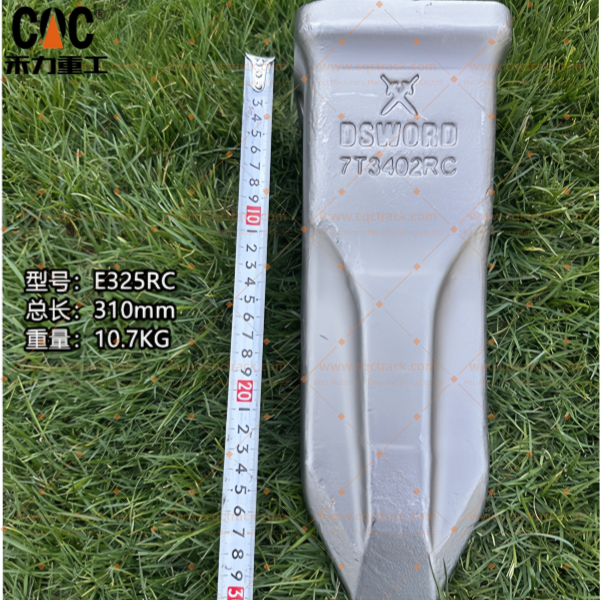
1. Technical Overview: The Critical Role of Forged Bucket Teeth in Heavy Excavation
The bucket tooth—also referred to as the tooth point, rock tooth, or ground engaging tool (GET)—is the primary interface between an excavator and the material being excavated. As the most heavily worn component in any earthmoving operation, the bucket tooth directly determines penetration efficiency, material retention, bucket protection, and ultimately, the productivity and operating cost of the entire machine. Unlike undercarriage components such as rollers or sprockets that support and propel the machine, the bucket tooth is a sacrificial wear part designed to be replaced frequently—but its design, metallurgy, and manufacturing quality have an outsized impact on overall equipment effectiveness.
For operators of Caterpillar E325RC excavators—a reduced-radius 23–28 ton class machine widely deployed in confined-space construction, urban demolition, quarrying, and infrastructure development—the reliability and performance of the bucket tooth assembly directly affect digging productivity, bucket protection, fuel efficiency, and total cost of ownership. Industry data consistently demonstrates that GET replacement costs represent a significant portion of consumable expenses, making informed procurement decisions essential for optimizing operating costs.
This publication delivers a comprehensive technical examination of the Caterpillar OEM part number 7T3402RC, which represents the forged rock chisel bucket tooth assembly for the CAT J400 tooth system—the standard GET system for the E325RC and a broad range of Caterpillar excavators. Particular focus is placed on HELI Dsword (HELI MACHINERY MANUFACTURING CO., LTD.), a vertically integrated manufacturer and specialist in forged ground engaging tools, and why its position as a source factory matters for global procurement professionals seeking OEM-quality bucket teeth at competitive price points.
2. The Caterpillar E325RC Platform: Engineering for Confined-Space Heavy Duty
2.1 Reduced-Rradius Design and Operational Applications
The Caterpillar E325RC is a reduced-radius (RC) variant within the Cat 300-series excavator family, specifically engineered to deliver maximum digging performance in space-constrained environments where standard excavators cannot maneuver effectively. The RC designation indicates a reduced tail swing radius—typically achieved through a compact counterweight design and optimized upper structure geometry—enabling the machine to operate safely and efficiently in urban construction sites, tunnel projects, road widening, demolition zones, and other confined spaces.
The E325RC shares the same robust undercarriage and hydraulic architecture as the standard 325 model but with a reduced rear overhang that minimizes the risk of contact with adjacent structures, vehicles, or personnel. This design makes the E325RC particularly suitable for:
- Urban construction and infrastructure renewal where worksite boundaries are restricted
- Demolition and recycling where maneuverability around standing structures is essential
- Quarry and mining support where bench edges and haul roads limit swing clearance
- Trenching and utility installation along existing roadways and building lines
- Highway and bridge construction where multiple machines operate in close proximity
2.2 Machine Specifications
The Caterpillar 325 series excavator, which includes the E325RC variant, operates with the following verified specifications:
| Parameter | Specification | Source |
|---|---|---|
| Operating Weight (Standard) | 22,500–28,500 kg (approximately 49,600–62,800 lb) depending on configuration | |
| Net Power (ISO 9249) | 128.5–140 kW (172–190 hp) | |
| Maximum Digging Depth | 6,700–8,440 mm (22–28 ft) | |
| Bucket Capacity (Standard) | 0.80–1.30 m³ (1.05–1.70 yd³) | |
| Transport Width (Undercarriage) | Approximately 2.8 m |
The machine features standard CAT Grade with 2D, Grade Assist, Lift Assist, and Payload technologies—all standard equipment from the factory that help boost operator efficiencies in grading, lifting, and loading applications. The advanced hydraulic system delivers precise control for both standard excavation and attachment operations, including hammer, shear, and pulverizer applications common in demolition and recycling work.
2.3 GET System Compatibility
The E325RC is equipped with Caterpillar‘s J-series bucket and tooth adapter system, which uses a standardized interface for tooth points across multiple machine sizes. The 7T3402RC tooth is designed specifically for the J400 adapter system, a medium-to-heavy-duty GET platform widely deployed on 20–35 ton class Caterpillar excavators including the 320, 322, 325, 329, and 330 series.
The J400 system features:
- Adapter weldment: A robust, cast or fabricated steel adapter welded to the bucket cutting edge
- Tooth point: The replaceable wear component (7T3402RC) that interfaces with the adapter
- Retention system: A 7T3408 pin and 8E8409 sleeved retainer that secures the tooth to the adapter
This modular design enables rapid field replacement of worn teeth without special tools or welding equipment, minimizing machine downtime and reducing labor costs.
3. Part Number 7T3402RC: Identification and Functional Architecture
3.1 OEM Part Number and Application
The Caterpillar 7T3402RC Forged Rock Bucket Tooth is a precision-engineered ground engaging tool specifically designed for the CAT J400 tooth system, which is standard equipment on the E325RC and a broad range of 20–35 ton class Caterpillar excavators. The “RC” suffix in the part number designates the rock chisel profile—a specific tooth geometry optimized for penetration and material breakage in rocky, compacted, or highly abrasive materials. The “RC” variant is one of several profiles available for the J400 system, alongside TL (Tiger Long), RP (Rock Penetration), E (Extra), R (Rock), SYL (Super Long), P (Penetration), and PT (Penetration Tiger) configurations.
The 7T3402RC tooth is also manufactured under the alternative designation 7T-3402RC in some supplier catalogs, with the same dimensional and material specifications. The tooth is designed to fit CAT J400 series adapters using a 7T3408 retaining pin and an 8E8409 sleeved retainer system.
3.2 Functional Responsibilities
The 7T3402RC bucket tooth assembly performs three mission-critical functions that directly impact excavation efficiency and bucket longevity:
1. Material Penetration and Fracture: As the primary point of contact between the excavator and the material being excavated, the tooth‘s chisel-shaped profile concentrates the machine’s hydraulic force into a narrow contact zone, initiating fracture in rock, breaking compacted soil, and shearing through dense materials. The rock chisel design provides exceptional digging power and precision, allowing for a strong grip on materials and making it ideal for excavating tasks such as breaking up rock, stone, and hard soils. The tooth‘s streamlined geometry reduces drag resistance, improving fuel efficiency and cycle times.
2. Bucket Protection: The tooth serves as a sacrificial wear component that shields the bucket lip, cutting edge, and adapter system from direct contact with abrasive materials. By absorbing the majority of abrasive wear and impact forces, the tooth preserves the structural integrity of the more expensive bucket assembly, extending its service life significantly. The design ensures optimal load retention and effective material scooping.
3. Retention and Power Transfer: The tooth is securely mounted to the adapter using a pin-and-retainer retention system that ensures positive locking under all digging conditions. The precision-machined mounting interfaces (the bore and locking groove) guarantee a secure, rattle-free fit with the adapter, minimizing stress concentrations, preventing harmful movement that accelerates wear on both the tooth and adapter, and ensuring efficient power transfer from the hydraulic system to the material.
3.3 Dimensional Specifications
Based on verified supplier data, the 7T3402RC tooth conforms to the following dimensional specifications:
| Parameter | Specification | Source |
|---|---|---|
| Overall Length (A) | 313 mm | |
| Overall Height (B) | 126.50 mm | |
| Adapter End Width (D) | 117.10 mm | |
| Pocket Height | 86–90 mm | |
| Pocket Width | 91–95 mm | |
| Weight (Approximate) | 8.5–10.5 kg (19–23 lb) |
These dimensions ensure precise fitment with the CAT J400 adapter system, enabling seamless interchangeability with OEM components.
3.4 Retention System Compatibility
The 7T3402RC tooth is designed to work with the following retention components:
| Component | Part Number | Function |
|---|---|---|
| Retaining Pin | 7T3408 | Secures the tooth to the adapter; passes through aligned holes in tooth and adapter |
| Sleeved Retainer | 8E8409 | Provides positive locking mechanism; prevents pin movement during operation |
The pin-and-retainer system allows rapid field replacement without special tools, enabling operators to change worn teeth in minutes rather than hours, maximizing machine uptime and productivity.
4. Material Specifications and Heat Treatment Standards
4.1 Material Selection
Premium forged bucket teeth for Caterpillar excavators are manufactured from high-grade alloy steels selected for their exceptional combination of surface hardness, core toughness, and impact resistance. The primary material specified for the 7T3402RC tooth is 35MnB alloy steel—a boron-alloyed medium-carbon manganese steel formulated specifically for ground engaging tools.
35MnB steel offers the following advantages for bucket tooth applications:
| Property | Characteristic | Engineering Significance |
|---|---|---|
| Boron Addition | Increases hardenability | Enables deep, uniform case hardening while maintaining tough core |
| Manganese Content | 0.9–1.2% | Improves strength and wear resistance; promotes fine grain structure |
| Carbon Content | 0.32–0.39% | Provides balance of hardness and toughness after heat treatment |
| Silicon Content | 0.17–0.37% | Improves strength and deoxidation |
Alternative premium grades employed for heavy-duty GET applications include:
| Material Grade | Characteristics | Typical Hardness | Application | |
|---|---|---|---|---|
| 35MnB | Boron-alloyed medium-carbon steel; excellent hardenability and toughness | HRC 48–55 | Standard heavy-duty excavation, rock digging | |
| Proprietary Low-Alloy Boron Steel | Developed boron-based or low-alloy steels specifically formulated for heat treatment response | HRC 45–50 | Premium mining and severe excavation | |
| High-Strength Cast Steel (LIS®) | Highly wear-resistant cast steel according to German quality standards | HRC 46–52 | Alternative manufacturing method; premium impact toughness |
The use of boron as a micro-alloying element significantly enhances the steel‘s response to heat treatment, enabling the achievement of deep, uniform hardness profiles that extend service life in abrasive environments.
4.2 Heat Treatment Specifications
The performance of a forged bucket tooth depends critically on its heat treatment profile, which creates a gradient hardness structure optimized for both wear resistance and impact toughness. HELI Dsword’s manufacturing process for forged bucket teeth employs a precision heat treatment protocol that includes quenching and tempering to achieve an ideal balance of extreme surface hardness for wear resistance and a tough, ductile core for shock absorption.
| Parameter | Specification | Engineering Significance | |
|---|---|---|---|
| Surface Hardness | HRC 52–58 (forging); 46–52 (cast variants) | Maximum resistance to abrasive wear from soil and rock contact | |
| Hardened Depth | 8–12 mm (maintaining HRC 45 minimum) | Uniform case depth prevents rapid wear-through under continuous operation | |
| Core Toughness | Impact ≥20J at 25°C | Maintains toughness to absorb impact loads without brittle fracture | |
| Tensile Strength | ≥1,400 Rm-N/mm² (≥203,000 psi) | Ensures structural integrity under high tensile and bending loads | |
| Hardness (Cast Variants) | HB 470–520 or HRC 48–52 | Alternative specification for premium cast teeth |
The heat treatment process typically involves:
- Austenitizing: The forged tooth is heated to a precise temperature to transform the steel‘s microstructure
- Quenching: Rapid cooling locks the desired metallurgical structure in place
- Tempering: Controlled reheating to develop the optimal balance of hardness and toughness
This multi-stage process establishes a hardened outer surface for wear resistance, paired with a tough, ductile core to absorb high-impact shocks without brittle fracture under heavy loads.
4.3 Forging vs. Casting: Metallurgical Advantages
HELI Dsword specializes in closed-die forging for bucket tooth manufacturing, a process that offers distinct metallurgical advantages over conventional casting:
| Attribute | Forged Tooth (HELI Dsword) | Cast Tooth | Advantage |
|---|---|---|---|
| Grain Structure | Continuous, aligned grain flow following tooth contour | Random, isotropic grain structure | Forged teeth have 20-30% higher fatigue strength |
| Internal Defects | Eliminates voids, porosity, and inclusions | Potential for porosity, shrinkage cavities, and inclusions | Forged teeth have more consistent mechanical properties |
| Impact Resistance | Superior due to continuous grain flow | Lower due to potential stress risers from porosity | Forged teeth resist chipping and breakage under shock loads |
| Wear Life | Extended due to denser microstructure | Reduced due to potential localized soft spots | Forged teeth provide longer service life in abrasive materials |
| Dimensional Consistency | High; precision CNC finishing | Variable depending on casting quality | Forged teeth ensure perfect fit with adapter |
As HELI Dsword states in its product literature, the hot-forging process creates a continuous grain flow aligned with the tooth‘s contours, resulting in exceptional toughness and superior resistance to impact and abrasion, significantly reducing the risk of premature breakage under heavy loads.
5. HELI Dsword: A Specialist Manufacturer of Forged Ground Engaging Tools
5.1 Corporate Profile and Manufacturing Heritage
HELI Dsword, operating under HELI MACHINERY MANUFACTURING CO., LTD., is a vertically integrated manufacturer based in Quanzhou, China—a region recognized as a premier industrial cluster and key supply hub for global earthmoving equipment and GET components. With over two decades of manufacturing experience, HELI has established itself as one of the top three undercarriage component manufacturers in the Quanzhou region and a recognized leader in forged bucket tooth manufacturing.
The brand name HELI Dsword (also marketed under CQC TRACK for undercarriage components) represents a specialized focus on ground engaging tools and wear parts. As a specialist manufacturer focused solely on GET, HELI Dsword engineers its products to deliver optimal performance and durability under extreme abrasion and impact conditions.
5.2 Quality Certifications and Manufacturing Standards
HELI Dsword operates under a rigorous quality assurance framework, holding ISO 9001:2015 quality system recognition with component traceability from raw material through finished assembly. The company‘s manufacturing facility features:
- Spectrographic analysis for raw material verification at the mill
- Hardness testing (HRC/HB) for every production batch
- Metallographic analysis for microstructural verification
- Dimensional checks using precision measurement equipment
5.3 Manufacturing Capabilities: The HELI Forging Advantage
HELI Dsword’s manufacturing strength rests on a vertically integrated precision hot-forging process that produces GET components with superior mechanical properties:
| Process Stage | Capability Description | |
|---|---|---|
| Raw Material Selection | Proprietary medium-carbon, low-alloy steels with precise additions of Chromium (Cr), Molybdenum (Mo), and Boron (B) sourced from certified mills | |
| Precision Closed-Die Forging | High-tonnage precision closed-die forging aligns the steel‘s grain flow to the contour of the tooth, dramatically increasing strength, fatigue resistance, and impact toughness compared to cast alternatives | |
| Controlled Cooling & Heat Treatment | Computer-controlled quenching and tempering (Q&T) process establishes an ideal balance of extreme surface hardness for wear resistance and a tough, ductile core for shock absorption | |
| CNC Finish Machining | Critical mounting interfaces (bore and locking groove) are machined to exacting tolerances (IT8-IT9), guaranteeing a secure, rattle-free fit with the adapter | |
| Quality Inspection | Dimensional checks, hardness testing, metallographic analysis, and non-destructive testing (NDT) on select samples ensure consistency and internal integrity |
5.4 OEM and ODM Service Model
HELI Dsword operates a dual service model that accommodates both standardized replacement parts and customized engineering solutions:
- OEM Manufacturing: Production of GET components to exact client specifications, drawings, and quality standards. The factory is equipped for seamless integration into global supply chains, providing reliable volume production of forged bucket teeth, ripper teeth, adapters, and retainers.
- ODM Engineering: Collaborative development, design, and validation of improved or fully customized GET solutions. Leveraging extensive field experience and deep technical expertise in metallurgy and tribology specific to ground engaging tools, the engineering team proactively addresses common failure modes—including chipping, breakage, and uneven wear—offering value-optimized designs that enhance performance and reduce total cost of ownership.
5.5 Caterpillar Product Portfolio
HELI Dsword manufactures a comprehensive range of forged GET components for Caterpillar excavators, dozers, and loaders across multiple GET systems. Key components include:
| Component | Caterpillar Part Number / System | Application | |
|---|---|---|---|
| Forged Rock Bucket Tooth | 7T3402RC (J400 system) | E325RC, 320B, 322C, 325B, 325D, 329D, 330L series | |
| Forged Bucket Tooth | 6I8802RC (J800/E390RC system) | J800 system; large excavators and loaders | |
| Forged Bucket Tooth | 6Y3552RC | D11 bulldozer; mining and major excavation | |
| Forged Ripper Tooth | 6Y3552TL | D11 bulldozer ripper system | |
| Forged Bucket Tooth | 209-70-54210RC/TL | Komatsu PC600/PC650 |
HELI Dsword‘s extensive CAT product portfolio demonstrates the company’s engineering capability and manufacturing expertise across multiple GET platforms, confirming its position as a leading supplier of forged bucket teeth for Caterpillar equipment.
5.6 Manufacturing Excellence: A Dedicated GET Facility
As a specialist manufacturer, HELI Dsword‘s manufacturing ecosystem is vertically integrated and focused exclusively on GET production:
- Vertical Integration: From raw material analysis through final inspection, HELI Dsword controls every stage of the manufacturing process
- Focused Engineering: All engineering resources are dedicated to optimizing GET design, metallurgy, and manufacturing for maximum wear life
- Continuous Improvement: Ongoing research and development into advanced wear materials, including carbide-enhanced wear zones and specialized alloy formulations
- Batch Traceability: Every production batch is documented and traceable, enabling rapid root-cause analysis and quality improvement
6. Performance Validation and Field Testing
6.1 Mechanical Property Verification
HELI Dsword’s 7T3402RC forged bucket teeth undergo rigorous mechanical testing to verify compliance with OEM-equivalent specifications:
| Test | Specification | Method | |
|---|---|---|---|
| Surface Hardness | HRC 52–58 | Rockwell hardness tester | |
| Hardened Depth | 8–12 mm maintaining HRC 45 minimum | Microhardness profiling | |
| Impact Toughness | ≥20J at 25°C | Charpy V-notch impact test | |
| Tensile Strength | ≥1,400 MPa | Tensile test | |
| Dimensional Accuracy | IT8-IT9 tolerance class | CMM inspection | |
| Internal Integrity | NDT (select samples) | Magnetic particle or ultrasonic inspection |
6.2 Field Performance Expectations
Under normal quarrying, construction, and demolition conditions, a quality forged bucket tooth meeting HRC 52–58 surface hardness specifications with 8–12 mm case depth can achieve 300–600 operating hours in abrasive rock materials before requiring replacement—representing a 20-30% extension over cast alternatives in comparable applications.
In severe applications with highly abrasive materials (silica content > 30%) and continuous operation, service life may be reduced to 150–300 operating hours, though forged teeth consistently outperform cast alternatives due to their denser microstructure and continuous grain flow.
For optimal bucket and GET life, always inspect teeth regularly for wear and replace when the tooth profile has worn beyond the manufacturer‘s recommended limit (typically when the wear indicator is exposed or the tooth has lost more than 50% of its original length). Running excessively worn teeth exposes the adapter and bucket cutting edge to direct abrasion, dramatically increasing repair costs and machine downtime.
7. Installation, Maintenance, and Service Life Optimization
7.1 Pre-Installation Verification
Before installing a new 7T3402RC bucket tooth, verify the following critical parameters:
- Adapter condition — Inspect the J400 adapter for wear, cracks, or deformation; worn adapters prevent proper tooth retention
- Retention system — Verify availability of new 7T3408 pin and 8E8409 sleeved retainer; reuse of old pins or retainers is not recommended
- Pocket dimensions — Confirm that the adapter pocket accepts the tooth‘s mounting shank without excessive play (86–90 mm pocket height, 91–95 mm pocket width)
- Bucket condition — Inspect the bucket cutting edge for wear; a worn cutting edge compromises GET performance
7.2 Installation Procedure Summary
Replacing a bucket tooth is a straightforward field procedure:
- Remove worn tooth: Use a hammer and punch to drive out the retaining pin (7T3408) from the adapter. Remove the sleeved retainer (8E8409) and discard both along with the worn tooth.
- Clean adapter pocket: Remove all debris, dirt, and accumulated material from the adapter‘s mounting pocket to ensure proper seating of the new tooth.
- Install new tooth: Position the new 7T3402RC tooth onto the adapter‘s mounting shank, ensuring full engagement of the tooth’s bore with the adapter.
- Install retention components: Insert the new sleeved retainer (8E8409) into the aligned holes of the tooth and adapter, followed by the new retaining pin (7T3408).
- Verify retention: Use a hammer to seat the pin fully, ensuring the retainer is properly compressed and the tooth is secure with no lateral movement.
- Check operation: Operate the machine at low speed and inspect the tooth for proper retention and absence of rattling or movement.
Tools needed: Hammer, punch, safety glasses, gloves. No welding or special equipment is required.
7.3 Maintenance Schedule
| Interval | Action |
|---|---|
| Every operating shift (severe rock conditions) | Visual inspection for wear, damage, or loose teeth |
| Every 8–10 operating hours (normal conditions) | Visual inspection of GET components |
| At wear indicator exposure | Replace tooth immediately; do not operate with worn teeth |
| At each tooth replacement | Inspect adapter for wear; replace adapter if wear exceeds 20% of original dimension |
7.4 Failure Modes and Troubleshooting
| Symptom | Likely Cause | Recommended Action |
|---|---|---|
| Premature tooth breakage | Brittle fracture from impact overload or improper heat treatment | Verify hardness specifications; replace with forged tooth for improved impact resistance |
| Rapid wear (less than 50% of expected life) | Insufficient surface hardness or abrasive material exceeding design parameters | Upgrade to premium forged tooth; consider carbide-enhanced wear zone option |
| Loose tooth / rattling | Worn adapter pocket or damaged retention components | Replace adapter if pocket is worn; always use new pins and retainers with each tooth replacement |
| Uneven wear pattern | Misaligned tooth geometry or improper digging technique | Verify tooth profile matches application; adjust operator technique if pattern persists |
8. Factory-Direct Sourcing: Competitive Advantages
8.1 Supply Chain Value Proposition
Sourcing the Caterpillar 7T3402RC forged bucket tooth directly from a source factory and specialist manufacturer such as HELI Dsword offers distinct advantages over multi-tier distribution channels:
| Sourcing Channel | Advantages | Disadvantages |
|---|---|---|
| Factory Direct (HELI Dsword) | Lower cost (eliminates distributor markups), shorter lead times, direct technical support, traceable quality control, ISO 9001:2015 certified processes | Minimum order quantities may apply |
| Regional Distributor | Local inventory, smaller minimum orders | Higher price (multiple markups), limited technical support |
| OEM Dealer | Guaranteed exact specification | Premium pricing (typically 40–60% higher), long lead times for non-stocked items |
HELI Dsword operates as an integrated source factory and manufacturer, eliminating intermediary markups while maintaining strict adherence to original equipment specifications. The “source factory” designation indicates that HELI Dsword is the original producer of these components, not a reseller or distributor, ensuring full control over quality, pricing, and supply chain transparency.
8.2 Lead Times and Logistics
For the Caterpillar 7T3402RC forged bucket tooth, typical factory-direct lead times are:
- Stocked items: 5–10 business days (ready stock)
- Manufactured to order: 20–25 days after contract confirmation
- Express delivery: Available for urgent requirements
Standard shipping is FOB from Xiamen port, China, with door-to-door logistics available through established freight forwarding partnerships. The Quanzhou region‘s status as a premier industrial cluster for heavy machinery manufacturing ensures efficient logistics infrastructure and competitive freight rates.
8.3 Estimated Cost Comparison
| Component | OEM Price Range (Est.) | HELI Dsword Factory Price (Est.) | Estimated Savings | |
|---|---|---|---|---|
| Forged Bucket Tooth (7T3402RC) | $55–65 | $35–50 | 30–40% |
9. Conclusion
For operators of Caterpillar E325RC excavators deployed in confined-space construction, urban demolition, quarrying, and infrastructure development—a 23–28 ton reduced-radius machine with daily production demands—the forged rock chisel bucket tooth represented by part number 7T3402RC is a mission-critical GET component whose performance directly affects digging productivity, bucket protection, fuel efficiency, and operating costs. As the primary interface between the excavator and the material being excavated, the 7T3402RC tooth‘s design, metallurgy, and manufacturing quality have an outsized impact on overall equipment effectiveness.
HELI Dsword distinguishes itself as a specialist manufacturer that combines over two decades of metallurgical expertise, vertical integration of precision closed-die forging and controlled heat treatment processes, and a focused OEM/ODM service model to deliver forged bucket teeth that perform reliably under the most demanding excavation conditions. As a recognized leader in forged GET manufacturing, HELI Dsword has established itself as a premier supplier of high-performance bucket teeth for Caterpillar equipment across multiple size classes and applications.
With material specifications including premium 35MnB and proprietary boron-alloyed steels; closed-die forging for continuous grain flow and superior impact resistance; precision heat treatment achieving HRC 52–58 surface hardness with 8–12 mm case depth and ≥20J impact toughness; ISO 9001:2015 quality certification; and comprehensive mechanical testing including hardness profiling, tensile verification, and dimensional validation, HELI Dsword provides fleet owners and procurement professionals with engineered solutions that meet or exceed OEM specifications at competitive price points.
By sourcing the Caterpillar 7T3402RC forged bucket tooth directly from the factory, construction and excavation operations gain access to consistent quality, direct technical support, competitive pricing (30–40% savings versus OEM), and transparent supply chain logistics—factors that collectively optimize total cost of ownership and maximize machine productivity in the world‘s most demanding excavation environments.
Author: Jack
Specializing in heavy equipment ground engaging tools, excavation productivity optimization, and global sourcing strategies for construction equipment fleets.
Disclaimer: This publication is original content created for informational and technical reference purposes. All product numbers, brand names, and manufacturer references are used for identification and cross-reference only. Always verify compatibility with your machine‘s serial number and bucket adapter configuration before ordering. Installation procedures summarized from industry standards are provided for reference; consult the complete original equipment documentation before performing any maintenance. Warranty information is representative and subject to confirmation with the manufacturer at the time of purchase. Bucket teeth are sacrificial wear components; regular inspection and timely replacement are essential for optimal machine performance and bucket protection.
Products categories
-

CATERPILLAR CAT390TL / E390TL / E395TL / J800 T...
-
China Supplier DH220 27131217 Bucket Tooth Of E...
-
DH300RC 2713-1219RC Bucket Teeth
-
Cat345rc 9w8552rc John Deere 400 Bucket Teeth
-

VOLVO-EC210RC/14530544RC Bucket Teeth Kppime-Do...
-

HYUNDAI R225-9RC Rock Bucket Teeth (61Q631310RC...


