
KOMATSU KM2503 21N3000120 21N3000121 21N3000122 21N3000123 PC1250 Tack Roller Assembly / Heavy duty Mining EXC Crawler Undercarriage Part Source Factory and Manufacturer / cqctrack


Technical White Paper: KOMATSU PC1250 Heavy-Duty Mining Excavator Track Bottom Roller Assembly
Reference Numbers: KM2503, 21N3000120, 21N3000121, 21N3000122, 21N3000123
Source Manufacturer: HELI Machinery Manufacturing Co., Ltd. (CQCTRACK)
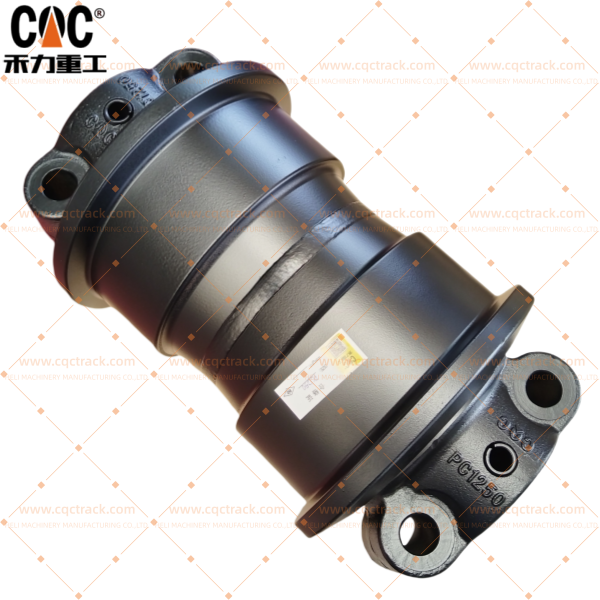
1. Executive Summary: Engineering the Foundation of Ultra-Class Mining Mobility
In the domain of ultra-class hydraulic excavators, the undercarriage represents the critical interface between machine capability and operational availability. For the KOMATSU PC1250—a machine that routinely operates at the limits of mechanical endurance in open-pit mining, heavy civil construction, and large-scale quarrying—the integrity of every undercarriage component directly correlates to production uptime, safety, and total cost of ownership .
The Track Bottom Roller Assembly (alternatively designated as Upper Track Roller or Return Roller) bearing reference numbers KM2503, 21N3000120, 21N3000121, 21N3000122, 21N3000123 constitutes a precision-engineered component family specifically developed for the KOMATSU PC1250 series. Manufactured by HELI Machinery Manufacturing Co., Ltd., operating under the CQCTRACK brand, these assemblies are designed not merely as replacement parts but as engineered solutions that address the specific failure modes and operational demands encountered in severe-service applications .
This document provides a comprehensive technical exposition of this component family, detailing the engineering philosophy, material science, manufacturing protocols, and quality assurance frameworks that distinguish these assemblies from conventional aftermarket offerings.
2. Product Identification and Cross-Reference Matrix
Accurate component identification is the foundational step in procurement for ultra-class mining equipment. The following matrix establishes the interrelationship between the various reference numbers and their application context.
| Specification Parameter | Details |
|---|---|
| OEM Reference Numbers | KM2503, 21N3000120, 21N3000121, 21N3000122, 21N3000123 |
| Cross-Reference Equivalents | 21N3000130, 21N3000131, KM2419 (functionally interchangeable variants within the same product family) |
| Component Type | Track Carrier Roller Assembly / Upper Track Roller Group / Return Roller |
| Primary Application | KOMATSU PC1250-6, PC1250-7, and related ultra-class hydraulic excavators |
| Manufacturing Origin | HELI Machinery Manufacturing Co., Ltd. (CQCTRACK) – Specialized heavy-duty undercarriage component manufacturer |
| Engineering Classification | Severe-Duty Mining Grade – Designed for 100+ metric ton operating weight class |
3. Functional Role in the Undercarriage System
Understanding the operational function of the carrier roller assembly is essential for appreciating the engineering decisions that govern its design, material selection, and manufacturing processes.
3.1 Primary Operational Functions
Within the track chassis architecture of the KOMATSU PC1250, the lower roller assembly performs three critical functions that collectively ensure undercarriage system integrity :
- Bottom Track Chain Support: Positioned along the top flange of the track frame, carrier rollers bear the static and dynamic weight of the track chain’s return run. This support prevents excessive sag that would otherwise increase parasitic drag and accelerate wear on the track links and bushings.
- Track Tension Management: By supporting the upper strand at strategic intervals, the carrier rollers maintain proper track sag geometry. This directly influences the tension dynamics transmitted to the track tensioner and recoil spring assembly, contributing to consistent ground contact pressure and stable machine operation.
- Lateral Guidance and Alignment: The double-flange design of the carrier roller engages with the track link assembly to maintain precise lateral alignment of the return run. This guiding function prevents track derailment during turns and mitigates edge-loading that can accelerate wear on both the track chain and the roller flanges.
3.2 System Integration Context
The Bottom roller operates in concert with the following undercarriage components to form an integrated wear system :
- Track Chain Assembly: The carrier roller running surface contacts the track link backs, with the flanges engaging the link side faces
- Upper Track Rollers (Bottom Rollers): Support the machine’s full operating weight on the lower strand
- Track Idler Wheel: Provides forward guidance and interfaces with the track tensioning mechanism
- Drive Sprocket: Transmits rotational torque from the final drive to the track chain
4. Technical Deconstruction: The Anatomy of the KM2503 Carrier Roller Assembly
The performance of a carrier roller in mining applications is determined by the synergistic integration of its constituent subsystems. The following deconstruction details the engineering specifications implemented in the HELI CQCTRACK manufacturing process.
4.1 Roller Body and Flange System: Forged for Abrasion Resistance
The roller body represents the primary wear interface and must simultaneously exhibit extreme surface hardness for abrasion resistance and sufficient core toughness for impact absorption .
Material Selection:
- The roller body is forged from a proprietary micro-alloyed boron steel formulation (e.g., 40MnB or 50Mn grade)
- Forging parameters are controlled to align the metallic grain flow with the component’s geometric contour, creating an anisotropic structure with superior impact strength compared to cast alternatives
- This forged construction is critical for the PC1250 class, where impact loads from mining operations can exceed 200% of static operating weight
Flange Engineering:
- The assembly features a double-flange guidance system precision-machined to exacting profiles
- Flange geometry is optimized to interface precisely with the KOMATSU PC1250 track link counterparts
- Flange thickness and angle are engineered to minimize friction during turns while maintaining positive lateral constraint
Differential Heat Treatment Protocol:
The roller undergoes a controlled induction hardening process that creates a graduated hardness profile :
| Parameter | Specification | Engineering Significance |
|---|---|---|
| Surface Hardness | 58 – 62 HRC | Glass-hard wear layer resists abrasion from silica, ore, and rock fines |
| Effective Case Depth | 8 – 12 mm | Deep hardened zone ensures retained hardness throughout the wear life |
| Core Toughness | 35 – 40 HRC | Ductile core absorbs impact loads, preventing spalling and structural failure |
| Flange Hardening | Full-profile induction treatment | Lateral wear surfaces receive equivalent hardness for extended guidance life |
4.2 Shaft Metallurgy and Bearing Configuration
The stationary shaft and rotating bearing system must accommodate continuous rotational motion while supporting radial loads that vary dynamically during digging, traveling, and turning operations.
Shaft Engineering:
- Fabricated from high-tensile 40Cr or 20CrMnTi alloy steel
- Bearing journals are precision-ground to a mirror-like surface finish (Ra ≤ 0.4 μm) to minimize friction on sealing interfaces
- Induction-hardened or plasma-nitrided surfaces resist fretting corrosion and wear from rotational contact
Bearing System:
- Utilizes high-capacity double-row tapered roller bearings or heavy-duty sintered bronze bushings, depending on the specific variant within the KM2503 family
- Bearings are selected for enhanced dynamic load ratings appropriate to the PC1250′s operating weight and duty cycle
- Precision spacer sleeves ensure correct internal alignment and preload, eliminating axial play under operational conditions
4.3 Advanced Sealing Architecture
The single most critical determinant of carrier roller service life in mining applications is the integrity of its sealing system. Contamination ingress—particularly from silica sand, pulverized ore, and metallic fines—is the root cause of over 90% of undercarriage component failures .
HELI CQCTRACK employs a multi-stage, pressure-adaptive sealing architecture specifically engineered for severe-service environments:
| Stage | Component | Function |
|---|---|---|
| Stage 1 | Labyrinth Passage | Complex geometry centrifugally ejects large particulate matter (mud, coarse sand) through centrifugal force during rotation |
| Stage 2 | Grease-Purged Chamber | Positive pressure from lubricant packing creates an active barrier against contaminant migration |
| Stage 3 | Floating Wear Ring | Precision-machined metal ring acts as a sacrificial barrier, protecting primary seal from physical damage |
| Stage 4 | Dual-Element Radial Lip Seal | Primary barrier manufactured from HNBR or FKM elastomer, energized by constant-force garter spring for continuous shaft contact |
The complete sealed cavity is pre-filled with high-viscosity, shear-stable lithium-complex grease containing solid lubricant additives (molybdenum disulfide) for boundary lubrication protection under extreme pressures.
5. Manufacturing Capabilities: HELI CQCTRACK as a Source Manufacturer
HELI Machinery Manufacturing Co., Ltd. (CQCTRACK) operates as a vertically integrated manufacturer, distinguishing itself from parts distributors and trading companies through direct control over the entire production value chain .
5.1 Vertical Integration Architecture
| Production Stage | In-House Capability |
|---|---|
| Material Sourcing | Direct procurement from certified steel mills with spectrochemical analysis verification |
| Forging | Large-tonnage forging presses with controlled grain flow optimization |
| Machining | Multi-axis CNC turning centers and grinding equipment with micron-level precision |
| Heat Treatment | Computer-controlled induction hardening and carburizing furnaces with digital process logging |
| Assembly | Clean-room assembly with torque-controlled fastening and seal installation |
| Testing | In-house dimensional, hardness, and seal integrity validation |
5.2 Quality Assurance Framework
The CQCTRACK quality system incorporates mandatory inspection gates that ensure batch-to-batch consistency and full traceability:
Incoming Material Validation:
- Spectrochemical analysis verifies chemical composition against certified specifications
- Hardness and grain structure verification through metallographic examination
In-Process Controls:
- 100% dimensional inspection of critical features (roller OD, flange width, bore concentricity, seal gland profiles)
- Real-time monitoring of induction hardening parameters with digital record retention
Final Assembly Validation:
- Rotational torque analysis verifies bearing preload and freedom of movement
- Seal pressure testing validates contamination exclusion capability
- Random destructive testing for hardness profile verification
Traceability Systems:
- 24+ months of digital retention for material certifications, heat treatment logs, and inspection reports
- Production lot traceability enables root cause analysis and warranty validation
6. Application Engineering and Maintenance Integration
6.1 Operational Best Practices for PC1250 Undercarriage
The service life of carrier rollers is influenced by operational parameters that maintenance managers can optimize :
Track Tension Management:
- Maintain track sag within KOMATSU-specified tolerances for the PC1250
- Excessive tension increases bearing load and accelerates roller wear
- Insufficient tension permits track slap and misalignment that edge-loads flanges
Travel Surface Considerations:
- Minimize continuous travel on sharp-edged rock benches
- Avoid high-speed travel on degraded surfaces where track slap is amplified
- Plan travel paths to reduce exposure to standing water and slurry that compromise seals
Inspection Protocol:
- Visual inspection of seal integrity at daily intervals
- Rotational check during service intervals (roller should rotate freely without binding)
- Flange thickness measurement during scheduled undercarriage inspections
- Comparison of wear patterns across all carrier rollers on both sides of the machine
6.2 Replacement Strategy Recommendations
For mining operations managing PC1250 fleets, a proactive replacement strategy yields optimal total cost of ownership:
| Consideration | Recommendation |
|---|---|
| Replacement Grouping | Replace all carrier rollers on a given side simultaneously to maintain consistent track geometry |
| System Synchronization | Coordinate carrier roller replacement with track chain, sprocket, and idler replacement to ensure harmonic wear across all components |
| Failure Mode Prevention | Replace proactively before catastrophic failure to avoid collateral damage to track frame and tensioner components |
| Warranty Documentation | Maintain installation records and retain original packaging for warranty traceability |
7. Value Proposition for Mining Operations
7.1 Economic Rationale for Source Manufacturer Selection
Procurement of undercarriage components from a dedicated manufacturer like HELI CQCTRACK offers distinct advantages over both OEM and generic aftermarket channels:
| Factor | OEM Sourcing | Generic Aftermarket | HELI CQCTRACK |
|---|---|---|---|
| Cost Structure | Premium pricing with distributor markup | Variable, often lower initial cost | Competitive, direct manufacturer pricing |
| Quality Control | High, but often no direct traceability | Inconsistent; supplier chain variable | Vertically integrated with full traceability |
| Technical Support | Limited to distributor network | Typically none | Direct engineering access for failure analysis |
| Supply Chain Stability | Subject to OEM production schedules | Variable; sourcing-dependent | Direct manufacturer control with predictable lead times |
| Application Engineering | Standardized to baseline specifications | Replicated without engineering validation | Mining-duty optimized with validated enhancements |
7.2 Total Cost of Ownership Analysis
For PC1250-class machines operating at 5,000+ hours annually in mining applications, the total cost of ownership advantages of quality-sourced carrier rollers manifest through :
- Extended service intervals reducing maintenance labor costs
- Prevention of collateral damage to track frames and tensioner systems
- Reduced unplanned downtime from catastrophic roller failure
- Predictable wear cycles enabling scheduled maintenance planning
- Elimination of warranty disputes through documented traceability
8. Conclusion: Engineering Confidence for Ultra-Class Mining Operations
The KOMATSU KM2503 / 21N3000120-21N3000123 Track Roller Assembly family, as manufactured by HELI Machinery Manufacturing Co., Ltd. (CQCTRACK), represents a convergence of advanced material science, precision manufacturing, and application-specific engineering. Developed for the rigorous demands of PC1250-class excavators operating in open-pit mining, quarrying, and heavy construction, these assemblies incorporate:
- Forged steel construction with controlled grain flow for superior impact resistance
- Deep-case induction hardening providing extended wear life through differential hardness profiles
- Multi-stage sealing architecture engineered to exclude the abrasive contaminants that cause premature failure in mining environments
- Vertically integrated manufacturing ensuring full traceability and batch-to-batch consistency
- Certified quality systems providing documented validation of materials, processes, and final assembly
For fleet managers, maintenance engineers, and procurement specialists responsible for maximizing the availability and cost-effectiveness of KOMATSU PC1250 mining excavators, sourcing these carrier roller assemblies from a specialized manufacturer offers a demonstrable path to optimized total cost of ownership, reduced unplanned downtime, and enhanced operational safety.
Appendix: Technical Specifications Summary
| Specification | Detail |
|---|---|
| Component Type | Track Bootom Roller Assembly (Lower Roller) |
| Reference Numbers | KM2503, 21N3000120, 21N3000121, 21N3000122, 21N3000123 |
| Compatible Equipment | KOMATSU PC1250-6, PC1250-7,PC1250-8 |
| Construction | Forged alloy steel with deep-case induction hardening |
| Surface Hardness | 58–62 HRC (running surface and flanges) |
| Case Depth | 8–12 mm effective depth |
| Sealing System | Multi-stage labyrinth with floating wear ring and dual-element radial lip seal |
| Lubrication | Pre-filled high-viscosity lithium-complex grease with MoS₂ additives |
| Manufacturer | HELI Machinery Manufacturing Co., Ltd. (CQCTRACK) |
This document is intended as a technical reference for qualified maintenance professionals and procurement specialists. Specifications are subject to continuous improvement and should be verified with the manufacturer for specific application requirements.
Products categories
-

HYUNDAI 81QE11010 R1250 Track Botoom Roller Ass...
-

Doosan Excavator 200104-00017A Dx55 Dx60 Track ...
-

KOMATSU excavator/PC300-8 DOUBLE FLANGE track r...
-

Track Roller Bottom Roller Lower Roller For Min...
-

KOBELCO 24100N7039F3 24100N8642F2 72216674 SK45...
-

CAT 1787293,1524182,1231379 E345 Track Roller A...


