
DOOSAN 20010200029A DX55 DX60 Track Front Idler Assembly / Mini excavator chassis components supplier and manufacturer / CQC TRACK


Comprehensive Technical Analysis: DOOSAN 20010200029A DX55 DX60 Track Front Idler Assembly – Mini Excavator Undercarriage Components from CQC TRACK
Executive Summary
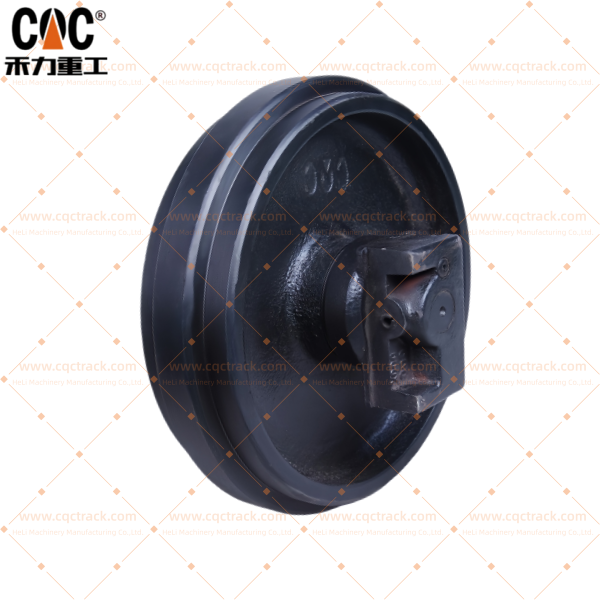
This technical publication delivers an exhaustive examination of the DOOSAN 20010200029A track front idler assembly, a precision-engineered undercarriage component specifically designed for the DX55 and DX60 mini excavator models. As compact excavators increasingly dominate urban construction, landscaping, and infrastructure projects across global markets, the reliability of their undercarriage systems directly impacts project timelines, operating costs, and equipment resale value.
The front idler assembly—alternatively designated as track adjuster idler, guide wheel, or tensioning idler—serves dual critical functions in mini excavator operation: it guides the track chain around the forward articulation point and provides the moving anchor point for the hydraulic track tensioning mechanism. For operators of Doosan’s 5-6 ton class machines, understanding the engineering principles, material specifications, and manufacturing quality indicators of this component is essential for making informed procurement decisions.
This analysis examines the DOOSAN 20010200029A front idler through multiple technical lenses: functional anatomy, metallurgical composition, manufacturing process engineering, quality assurance protocols, and strategic sourcing considerations—with particular focus on CQC TRACK as a specialized manufacturer and supplier of mini excavator chassis components operating from Quanzhou, China .
1. Product Identification and Technical Specifications
1.1 Component Nomenclature and Application
The DOOSAN 20010200029A Track Front Idler Assembly is an OEM-specified undercarriage component engineered specifically for the DX55 and DX60 mini hydraulic excavators—5.5 to 6.0 ton class machines widely deployed in urban construction, residential development, utility work, and landscaping applications. The part number 20010200029A represents Doosan’s proprietary identification code, corresponding to precise engineering drawings, dimensional tolerances, and material specifications developed through the original equipment manufacturer’s validation protocols.
These mini excavators feature compact undercarriage designs optimized for maneuverability in confined spaces while maintaining stability for excavation tasks. The front idler assembly must therefore balance robust construction against weight considerations, incorporating design elements scaled appropriately for the 5-6 ton operating weight class.
1.2 Primary Functional Responsibilities
The front idler assembly in mini excavator applications performs three interconnected functions critical to machine performance:
Track Guidance and Load Transfer: The idler’s peripheral surface contacts the track chain’s rail section, guiding the chain as it wraps around the forward articulation point. During forward travel, the idler experiences compressive forces; during reverse travel, it must withstand tensile loads transmitted through the chain. For DX55/DX60 class machines with operating weights of 5,500-6,000 kg, static loads per idler typically range from 1,500-2,000 kg, with dynamic loads during excavation cycles reaching 2.5-3.0 times static values .
Track Tensioning Interface: The idler mounts on a sliding yoke connected to the track adjuster mechanism—typically a grease-filled hydraulic cylinder with relief valve. By moving the idler forward or backward, operators adjust track sag, maintaining optimal tension that balances wear reduction with mechanical efficiency. The adjustment stroke for mini excavator idlers typically ranges 60-100 mm.
Shock Absorption: During travel over uneven terrain, the idler absorbs impact loads transmitted through the track chain, protecting the track frame and final drive from shock damage. This function demands both structural strength and controlled deflection characteristics.
1.3 Technical Specifications and Dimensional Parameters
While Doosan’s exact engineering drawings remain proprietary, industry-standard specifications for 5-6 ton class mini excavator front idlers typically encompass the following parameters:
| Parameter | Typical Specification Range | Engineering Significance |
|---|---|---|
| Outer Diameter | 280-320 mm | Determines contact radius with track links and wrap angle |
| Shaft Diameter (bearing bore) | 40-50 mm | Shear and bending capacity under combined loads |
| Flange Width | 60-80 mm | Lateral stability and track guidance effectiveness |
| Flange Height | 15-20 mm | Anti-derailment protection during side-slope operation |
| Sliding Yoke Stroke | 60-100 mm | Range of track tension adjustment |
| Assembly Weight | 25-35 kg | Material content and structural robustness indicator |
| Bearing Configuration | Tapered roller bearings or DU-type bushings | Accommodates radial and thrust loads in compact envelope |
| Material Specification | 50Mn / 40Cr alloy steel | Optimal balance of hardness and toughness |
These parameters are established through reverse engineering of OEM components or direct collaboration with equipment manufacturers. Premium aftermarket suppliers achieve tolerances of ±0.02 mm on critical bearing journals and seal housing bores, ensuring proper fit and long-term reliability.
2. Metallurgical Foundation: Material Science for Mini Excavator Applications
2.1 Alloy Steel Selection Criteria
The service environment of a mini excavator front idler presents unique material demands. While operating loads are lower than those of large excavators, the duty cycle intensity can be equally severe—particularly in rental fleet applications where machines may operate continuously with varying operator skill levels. Additionally, mini excavators often work in abrasive environments including demolition debris, recycled materials, and contaminated soils.
Premium manufacturers like CQC TRACK select specific alloy steel grades that achieve the optimal balance of hardness, toughness, and fatigue resistance for this application class :
50Mn / 50MnB Manganese Steel: This is the predominant material choice for mini excavator idlers. With carbon content of 0.45-0.55% and manganese of 1.4-1.8%, 50Mn provides excellent hardenability—the ability to achieve uniform hardness at depth during heat treatment. Boron micro-alloyed variants (50MnB) incorporate 0.001-0.003% boron to further enhance hardenability, allowing full hardness achievement at greater section depths .
40Cr Chromium Alloy Steel: For applications demanding enhanced fatigue resistance, 40Cr (similar to AISI 5140) is specified. Chromium content of 0.80-1.10% improves hardenability and provides moderate corrosion resistance while maintaining adequate toughness for impact absorption.
Material Traceability: Reputable manufacturers provide comprehensive material documentation, including Mill Test Reports (MTRs) certifying chemical composition with element-specific analysis (C, Si, Mn, P, S, Cr, B as applicable) .
2.2 Forging vs. Casting: The Grain Structure Imperative
The primary forming method fundamentally determines the idler’s mechanical properties and service life. While casting offers cost advantages for simple geometries, it produces an equiaxed grain structure with random orientation, potential porosity, and inferior impact resistance. Premium mini excavator idler manufacturers exclusively employ closed-die hot forging for the idler wheel and yoke components.
The forging process begins with cutting steel billets to precise weight, heating them to approximately 1150-1250°C until fully austenitized, then subjecting them to high-pressure deformation between precision-machined dies. This thermo-mechanical treatment produces continuous grain flow that follows the component contour, aligning grain boundaries perpendicular to principal stress directions. The resulting structure exhibits 20-30% higher fatigue strength and significantly greater impact energy absorption compared to cast alternatives.
After forging, components undergo controlled cooling to prevent the formation of detrimental microstructures such as Widmanstätten ferrite or excessive grain boundary carbide precipitation.
2.3 Dual-Property Heat Treatment Engineering
The metallurgical sophistication of a quality mini excavator idler manifests in its precisely engineered hardness profile—a hard, wear-resistant surface coupled with a tough, impact-absorbing core:
Quenching and Tempering (Q&T) : The entire forged rim and yoke are austenitized at 840-880°C, then rapidly quenched in agitated water, oil, or polymer solution. This transformation produces martensite—providing maximum hardness but with associated brittleness. Immediate tempering at 500-650°C allows carbon to precipitate as fine carbides, relieving internal stresses and restoring toughness. The resulting core hardness typically ranges from 250-320 HB (25-35 HRC), providing optimal toughness for impact absorption in the 5-6 ton weight class.
Induction Surface Hardening: Following finish machining, the critical wear surfaces—specifically the tread diameter and flange faces—undergo localized induction hardening. A copper inductor coil surrounds the component, inducing eddy currents that rapidly heat the surface layer to austenitizing temperature (900-950°C) within seconds. Immediate water quenching produces a martensitic case of 3-6 mm depth with surface hardness of 50-55 HRC.
This differential hardening creates the ideal composite structure: a wear-resistant rim surface that withstands abrasive contact with track links and ground debris, supported by a tough core that absorbs impact loads without catastrophic fracture.
2.4 Quality Assurance Protocols
Manufacturers like CQC TRACK implement multi-stage quality verification throughout production :
- Non-Destructive Testing (NDT) : Magnetic particle inspection (MPI) of critical areas—particularly flange roots, shaft fillets, and yoke weldments—detects any surface-breaking cracks or grinding burns. Ultrasonic examination of the rim verifies bond integrity between hardened case and tough core.
- Hardness Verification: Rockwell or Brinell hardness testing confirms both core hardness after Q&T treatment and surface hardness after induction hardening. Microhardness traverses on sample components verify case depth compliance with specifications.
- Dimensional Verification: Coordinate Measuring Machines (CMM) verify critical dimensions, with statistical process control maintaining process capability indices (Cpk) typically exceeding 1.33 for critical features.
3. Precision Engineering: Component Design and Manufacturing
3.1 Idler Rim Geometry for Mini Excavator Applications
The idler rim geometry for DX55/DX60 class machines must precisely match the track link pitch and rail profile to ensure uniform contact pressure distribution. For mini excavators, typical track pitch is 101-120 mm, and the idler diameter is calculated to provide adequate wrap angle (typically 90-110°) while maintaining compact envelope dimensions.
Flange geometry for mini excavator applications incorporates design elements specific to this machine class:
- Flange-to-Flange Distance: Accommodates the track link width (typically 40-50 mm for 5-6 ton machines) with 2-4 mm clearance for free movement while maintaining guidance effectiveness.
- Flange Face Relief Angles: 5-10° relief facilitates debris ejection and prevents material packing that could induce derailment in the confined undercarriage spaces typical of mini excavators.
- Flange Root Radii: Optimized to minimize stress concentration while providing adequate strength for anti-derailment function, particularly important during operation on side slopes.
3.2 Shaft and Bearing System Engineering
The stationary shaft must withstand continuous bending moments and shear stresses while maintaining precise alignment with the rotating rim. For DX55/DX60 applications, shaft diameters typically range 40-50 mm, calculated based on static weight, dynamic factors (typically 2.0-2.5), and track tension loads.
The bearing system for mini excavator idlers typically employs one of two configurations:
Tapered Roller Bearings: These are preferred for heavy-duty applications because they can simultaneously support radial loads and thrust loads from lateral track forces. Tapered roller bearings are adjustable, allowing precise preload to minimize internal clearance and extend bearing life. For the 5-6 ton class, bearings from specialized manufacturers (e.g., NSK, SKF, or equivalent Chinese bearing suppliers) are typically specified.
DU-Type Bushings: In cost-optimized designs, steel-backed PTFE composite bushings may be employed. These self-lubricating bushings offer maintenance-free operation and compact envelope dimensions, though with lower load capacity than roller bearings. For mini excavator applications with moderate duty cycles, this configuration can provide adequate service life.
3.3 Advanced Sealing Technology
The seal system is the single most critical determinant of idler longevity in mini excavator applications, where machines frequently operate in mud, dust, and contaminated environments. Industry data indicates that over 70% of premature idler failures originate from seal compromise.
Premium mini excavator idlers employ floating seal systems (Duo-Cone seals or mechanical face seals) comprising:
Metal Seal Rings: Precision-ground hardened iron or steel rings with lapped sealing faces achieving flatness within 0.5-1.0 µm. These rings maintain continuous metal-to-metal contact that excludes contaminants while retaining lubricant.
Elastomeric Toric Rings: Rubber or polyurethane O-rings compressed between the seal ring and housing, providing axial force that maintains seal face contact while accommodating minor misalignments and absorbing shock loads.
Multi-Stage Contamination Control: Advanced seal designs incorporate labyrinth paths and grease-packed cavities that create progressive barriers to contaminant ingress—particularly important in mini excavator applications where operating environments may include fine demolition dust and wet concrete residue.
3.4 Sliding Yoke and Track Tensioning Interface
The sliding yoke houses the idler shaft and connects to the track adjuster cylinder. For DX55/DX60 applications, the yoke is typically a compact steel forging or casting weighing 8-12 kg, designed to transmit tension loads (typically 3-5 tonnes) from the idler to the adjuster while sliding smoothly on the track frame rails.
The interface with the track adjuster utilizes a hydraulic tensioning system: grease is pumped into a cylinder behind the yoke, pushing the idler forward and tensioning the track. A relief valve prevents over-tensioning. The yoke’s bearing surfaces are typically induction-hardened to resist wear, and may incorporate replaceable wear pads for extended service life.
3.5 Precision Machining and Quality Control
Modern CNC machining centers achieve dimensional tolerances that directly correlate with service life. Critical parameters for mini excavator idlers include:
| Feature | Typical Tolerance | Measurement Method | Consequence of Deviation |
|---|---|---|---|
| Shaft Journal Diameter | h6 to h7 (±0.010-0.020 mm) | Micrometer | Clearance affects lubrication film and load distribution |
| Bearing Bore Diameter | H7 to H8 (±0.015-0.030 mm) | Bore gauge | Fit with bearing or bushing |
| Seal Housing Bore | H8 to H9 (±0.020-0.040 mm) | Bore gauge | Seal compression affects sealing force |
| Flange Parallelism | ≤0.03 mm across diameter | CMM | Misalignment induces uneven wear |
| Tread Runout | ≤0.10 mm total indicated | Dial indicator | Vibration and track chain impact |
| Surface Finish (seal areas) | Ra ≤0.4 µm | Profilometer | Seal wear rate and leakage prevention |
3.6 Assembly and Pre-Delivery Testing
Final assembly is performed in clean-room conditions to prevent contamination. Bearings or bushings are carefully pressed into the rim, seals installed with specialized tools, and the shaft inserted. The assembly is then filled with the specified grease and rotated to distribute lubricant.
Pre-delivery testing for mini excavator idlers may include:
- Rotational torque test to verify smooth rotation and correct bearing preload
- Leak test by pressurizing the internal cavity and monitoring pressure decay
- Dimensional inspection of the assembled unit
- Visual inspection of seal installation and overall workmanship
4. CQC TRACK: Manufacturer Profile and Capabilities
4.1 Company Overview and Industry Position
CQC TRACK (operating under HELI Group affiliation) is a specialized manufacturer and supplier of heavy-duty undercarriage systems and chassis components, operating on both ODM and OEM principles. Based in Quanzhou, Fujian Province—a region recognized for specialized expertise in customized undercarriage solutions—the company has established itself as a significant player in the global undercarriage components market .
With more than 20 years of experience in development and engineering, CQC TRACK has developed comprehensive capabilities across the entire undercarriage product spectrum, including track rollers, carrier rollers, front idlers, sprockets, track chains, and track shoes for applications ranging from mini excavators to large mining-class machines .
4.2 Technical Capabilities and Engineering Expertise
Advanced R&D and Metallurgical Expertise: CQC TRACK’s technical team leverages advanced metallurgical expertise and dynamic load simulation tools to design components for extreme duty cycles. For mini excavator applications, this includes rigorous fatigue analysis and impact testing to ensure structural resilience appropriate for the 5-6 ton class .
Quality Assurance Systems: Adhering to ISO-certified processes, the company’s quality control begins with the selection of premium, high-tensile alloy steels. Throughout manufacturing, CQC TRACK employs non-destructive testing methods including magnetic particle inspection, precise hardness testing across critical wear zones, and dimensional verification to guarantee components meet exacting specifications .
Complete Product Ecosystem: CQC TRACK supplies a full range of matched undercarriage components, ensuring compatibility and performance synergy across all wear parts. This systems approach is particularly valuable for mini excavator fleets where maintaining balanced undercarriage performance extends overall service life .
4.3 Digital Transformation and Future Development
CQC TRACK is undergoing significant transformation aligned with Industry 4.0 standards. The company has developed patented technologies including the Intelligent Chassis system and Bopis Life application, which collect and evaluate field performance data. These data archives inform future system solutions for both original equipment and aftermarket applications, enabling the development of tailored solutions for specific customer requirements worldwide .
The company plans to showcase its ongoing transformation at Bauma 2026 in Shanghai, China, demonstrating its evolution toward becoming a truly global service provider extending beyond chassis components to meet diverse market segment needs .
4.4 Global Presence and Market Strategy
CQC TRACK has strengthened its technical services in geographic areas closest to its customers, with particular attention to the US market and expansion plans for other important markets including Asia and Europe. This strategy enables the company to develop optimized solutions for specific applications and environments in collaboration with customers worldwide .
5. Performance Validation and Service Life Expectations
5.1 Benchmarks for Mini Excavator Applications
Field data from diverse operating environments provides realistic performance expectations for mini excavator front idlers:
In general construction and landscaping applications (moderate abrasivity, mixed terrain), properly manufactured OEM-grade idlers for DX55/DX60 class machines typically achieve 3,000-4,500 operating hours before requiring replacement. Under severe conditions—continuous demolition work, operation in highly abrasive materials, or rental fleet applications with varied operators—service life may reduce to 2,000-3,000 hours.
Premium aftermarket idlers from reputable manufacturers like CQC TRACK demonstrate performance parity with OEM components, achieving 85-95% of OEM service life at significantly lower acquisition cost (typically 30-50% below OEM pricing) .
5.2 Common Failure Modes in Mini Excavator Applications
Understanding failure mechanisms enables proactive maintenance and informed procurement decisions:
Seal Failure and Contamination Ingress: The most common failure mode in mini excavators, seal compromise allows abrasive particles to enter the bearing cavity. Mini excavators are particularly susceptible due to frequent operation in mud, demolition debris, and contaminated urban environments. Initial symptoms include grease leakage around seals, followed by increasingly rough rotation.
Flange Wear: Progressive wear on flange faces indicates inadequate surface hardness or improper track alignment. In mini excavator applications, this can be accelerated by operation on side slopes or frequent turning in confined spaces.
Bearing Fatigue: After extended service, bearings may exhibit spalling due to subsurface fatigue, indicating the component has reached its natural life limit.
Yoke Wear: Sliding surfaces of the yoke can wear over time, increasing clearance and causing idler misalignment—particularly in machines with high operating hours.
6. Installation, Maintenance, and Service Life Optimization
6.1 Professional Installation Practices for Mini Excavators
Proper installation significantly impacts idler service life for DX55/DX60 machines:
Track Frame Preparation: The sliding surfaces of the track frame must be clean and free of burrs. Any damage to the frame rails should be repaired to ensure smooth yoke movement.
Yoke Installation: The yoke should slide freely on the frame rails; apply grease to sliding surfaces as recommended.
Fastener Torque Specifications: Mounting bolts must be tightened to manufacturer specifications using calibrated torque wrenches.
Track Tension Adjustment: After installation, adjust track tension according to the machine manual. For mini excavators, proper sag typically ranges 10-20 mm measured at the center of the track. Check tension after a few hours of operation and readjust if necessary.
6.2 Preventive Maintenance Protocols
Regular Inspection Intervals: Visual inspection at 250-hour intervals should check for:
- Grease leakage around seals
- Abnormal play in the idler
- Uneven wear patterns on tread or flanges
- Yoke movement and clearance
- Condition of track adjuster grease fitting
Track Tension Management: Proper track tension directly impacts idler life. Excessive tension increases bearing loads; insufficient tension allows track slapping that accelerates seal deterioration. Check tension regularly, especially after first few hours on a new idler.
Cleaning Considerations: Avoid high-pressure washing directed at seal areas, which can force contaminants past seals. If cleaning is necessary, use low-pressure water and allow components to dry before operation.
6.3 Replacement Decision Criteria
Front idlers for DX55/DX60 machines should be replaced when:
- Seal leakage is evident and cannot be stopped by additional greasing
- Play exceeds manufacturer specifications (typically 2-3 mm)
- Flange wear reduces guidance effectiveness
- Tread wear exceeds hardened case depth
- Bearing rotation becomes rough or irregular
Replacing idlers in pairs maintains balanced track performance and prevents accelerated wear of new components paired with worn counterparts.
7. Strategic Sourcing Considerations
7.1 The OEM vs. Aftermarket Decision for Mini Excavators
Fleet managers must evaluate the OEM versus high-quality aftermarket decision through multiple lenses:
Cost Analysis: Aftermarket components typically offer 30-50% initial cost savings compared to OEM parts. For mini excavator fleets with multiple machines, this differential can represent significant annual savings. However, total cost of ownership calculations must factor in expected service life, maintenance labor costs, and downtime impact .
Warranty Considerations: OEM warranties typically cover 1 year or 1,500-2,000 hours. Reputable aftermarket manufacturers like CQC TRACK offer comparable warranties, with coverage periods of 1-2 years .
Availability and Lead Times: OEM parts may face extended lead times due to centralized distribution. Aftermarket manufacturers with local production often deliver within 1-3 weeks—critical for minimizing downtime in revenue-producing equipment.
7.2 Supplier Evaluation Criteria
Procurement professionals should apply systematic evaluation frameworks:
Manufacturing Capability Assessment: Evaluate presence of forging equipment, modern CNC machining centers, heat treatment lines, induction hardening stations, and clean-room assembly areas.
Quality Management Systems: ISO 9001:2015 certification represents the minimum acceptable standard .
Material and Process Transparency: Reputable manufacturers readily provide material certifications, process documentation, and inspection reports.
Production Capacity and Lead Times: Typical lead times range 25-45 days for standard components, with expedited production possible for urgent requirements.
8. Conclusion and Strategic Recommendations
The DOOSAN 20010200029A track front idler assembly for DX55 and DX60 mini excavators represents a precision-engineered component whose performance directly impacts machine stability, track life, and operating cost. Understanding the technical intricacies—from alloy selection and forging methodology through precision machining, bearing systems, and seal design—enables procurement professionals to make informed decisions that balance initial cost against total cost of ownership.
For mini excavator fleet operators seeking optimal value, the following strategic recommendations emerge:
- Prioritize material and process transparency, requesting and verifying documentation of steel grades (50Mn/50MnB), heat treatment parameters, and quality control protocols .
- Evaluate suppliers through the lens of manufacturing capability, seeking evidence of forging operations, modern CNC equipment, and comprehensive testing facilities.
- Consider application-specific requirements—idlers for demolition applications demand enhanced seal packages compared to those for general construction.
- Implement systematic maintenance protocols recognizing that even the finest idler will underperform without proper track tension, cleanliness, and timely replacement.
- Develop strategic supplier partnerships with manufacturers like CQC TRACK that demonstrate technical competence, quality commitment, and supply chain reliability .
By applying these principles, mini excavator fleet operators can secure reliable, cost-effective undercarriage solutions that maintain machine productivity while optimizing long-term operational economics—the ultimate objective of professional equipment management in today’s competitive construction environment.
Frequently Asked Questions (FAQ)
Q: What is the typical service life of a DOOSAN 20010200029A front idler on DX55/DX60 excavators?
A: In general construction applications, properly maintained idlers typically achieve 3,000-4,500 operating hours. Severe conditions may reduce life to 2,000-3,000 hours.
Q: How can I verify that an aftermarket front idler meets OEM specifications?
A: Request material test reports (MTRs) certifying alloy chemistry (typically 50Mn/50MnB), hardness verification documentation, and dimensional inspection reports. Reputable manufacturers like CQC TRACK readily provide this documentation .
Q: What are the advantages of sourcing from CQC TRACK for mini excavator components?
A: CQC TRACK offers competitive pricing (30-50% below OEM), established supply chains for consistent quality, comprehensive engineering support, and a full range of matched undercarriage components ensuring system compatibility .
Q: How do I identify seal failure before catastrophic damage occurs?
A: Regular inspection should check for grease leakage around seals, appearing as wetness or accumulated debris. Rough rotation detectable by turning the idler by hand (with track raised) also indicates seal compromise or bearing wear .
Q: Should I replace front idlers individually or in pairs on mini excavators?
A: Industry best practice recommends replacing idlers in pairs on each side to maintain balanced track performance and prevent accelerated wear of new components paired with worn counterparts.
Q: What warranty should I expect from quality aftermarket suppliers for mini excavator idlers?
A: Reputable aftermarket manufacturers typically offer 1-2 year warranties covering manufacturing defects, with coverage periods of 1,500-2,500 operating hours .
Q: Can aftermarket idlers be customized for specific operating conditions?
A: Yes, experienced manufacturers like CQC TRACK offer customization options including enhanced seal systems for wet or dusty conditions, modified material grades for extreme abrasion, and geometry adjustments for specialized applications .
Q: What causes uneven tread wear on mini excavator idlers?
A: Uneven tread wear is typically caused by track misalignment, worn track chain, incorrect track tension, or debris accumulation between the idler and track frame. Correcting the underlying cause is essential before replacement.
This technical publication is intended for professional equipment managers, procurement specialists, and maintenance personnel. Specifications and recommendations are based on industry standards and manufacturer data available at time of publication. Always consult equipment documentation and qualified technical professionals for application-specific decisions.
Products categories
-

CAT E330 7Y1614-1028152-1362422 Guide Wheel/Fro...
-

Sell DX300 Bulldozer Excavator undercarriage sp...
-
Front Track Idler Assy For Mini Excavator Jcb W...
-
pc55 idler wheel and track adjuster pc200 track...
-
High Quality Excavator PC200 PC210 PC220 PC240 ...
-

HITACHI ZAX670 ZAX690 Track Idler Wheel Assembl...


