
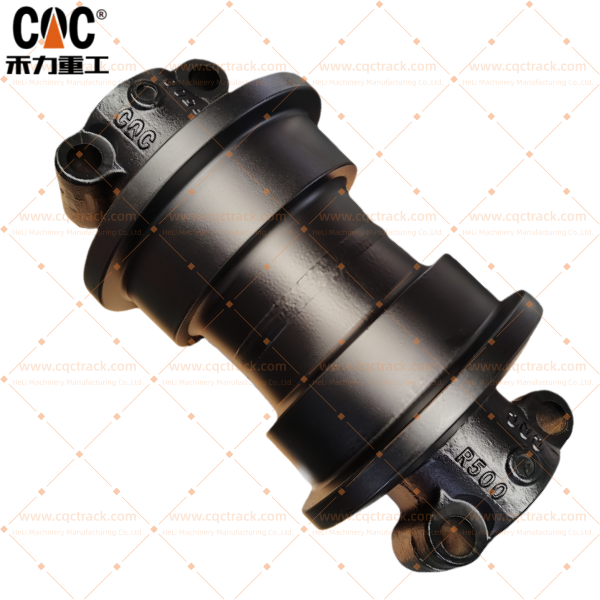
HYUNDAI 81QB11010 81E700631BG 81E700632BG 81E700633 81QB11050 R450 HX430 R500/HX480 HX520 R520 Undercarriages Track Roller Assembly Heavy duty crawler excavator spare part source manufacturer and factory / CQCTRACK


HYUNDAI R450/HX500 Series Track Roller Assembly—Heavy-Duty Crawler Excavator Undercarriage Engineering Analysis from Heli CQCTRACK
Document Identifier: TWP-CQCT-HYUNDAI-ROLLER-13
Issuing Body: Heli Machinery Manufacturing Co., Ltd. (CQCTRACK)
Target Models: HYUNDAI R450, HX430, R500, HX480, HX520, R520 Heavy-Duty Crawler Excavators
Component Portfolio: 81QB11010, 81E700631BG, 81E700632BG, 81E700633, 81QB11050
Machine Weight Class: 40 – 55 tons (dependent on configuration and application)
Publication Date: March 2026
Classification: Technical Engineering Specification / Heavy-Duty Crawler Excavator Spare Parts Sourcing Guide
1. Executive Summary: Heli CQCTRACK as the Professional Heavy-Duty Source Manufacturer for HYUNDAI R-Series Undercarriage Components
In the demanding realm of 40–55 ton class heavy-duty crawler excavator operations, the track roller assembly—alternatively designated as the track bottom roller or lower roller—represents a primary load-bearing element within the undercarriage system. This component performs the essential function of supporting the full machine weight, distributing ground-bearing pressure evenly across the track chain, guiding the track chain smoothly along the undercarriage frame, reducing friction between the track links and the undercarriage structure, and absorbing shocks from uneven terrain to enhance machine stability and operator comfort . For the HYUNDAI R450, HX430, R500, HX480, HX520, and R520 platforms—heavy-duty excavators widely deployed in mining, quarrying, heavy infrastructure, and large-scale earthmoving applications—the track roller assembly stands as a mission-critical component determining machine stability, track alignment, and overall undercarriage longevity.
Heli Machinery (CQCTRACK) has established itself as a premier professional heavy-duty crawler excavator spare part source manufacturer and factory, producing components for HYUNDAI R-series and compatible applications. As referenced in industry sourcing guides, CQCTRACK is recognized as a high-quality aftermarket manufacturer for heavy-duty undercarriage components, offering robust and cost-effective solutions . This technical white paper provides a comprehensive engineering deconstruction of the HYUNDAI 81QB11010, 81E700631BG, 81E700632BG, 81E700633, and 81QB11050 Track Roller Assemblies, specifically engineered for the 40-55 ton class excavator platforms and their variants.
By integrating rigorous material science (utilizing high-grade alloys such as 50Mn, 40MnB, and 42CrMo equivalent steels) , precision closed-die warm forging technologies with optimized grain flow , advanced heat treatment protocols achieving optimal hardness gradients (55-60 HRC surface with tough core, 8-12mm case depth) , multi-stage sealing architecture validated for extreme contamination , and ISO 9001:2015 certified manufacturing processes, Heli CQCTRACK delivers track roller assemblies that achieve documented performance parity with—and in specific metrics beyond—original equipment specifications.
For procurement specialists, fleet maintenance engineers, and equipment managers seeking to optimize total cost of ownership for their HYUNDAI R-series heavy-duty excavator fleets operating in severe mining and construction applications, this document serves as the definitive technical reference and sourcing guide.
2. Product Portfolio Identification and Cross-Reference Matrix
To ensure procurement accuracy and seamless integration into existing undercarriage systems, the following comprehensive identification matrix defines the complete component portfolio covered under this specification.
Table 1: Complete Part Number Interchangeability and Machine Application
| OEM Part Number | Heli CQCTRACK Equivalency | Primary Machine Application | Component Engineering Classification |
|---|---|---|---|
| 81QB11010 | Direct OEM Replacement | HYUNDAI R450, HX430 | Track Roller Assembly – Heavy-Duty Mining Grade |
| 81E700631BG | Direct OEM Replacement | HYUNDAI R500, HX480 | Track Roller Assembly – Heavy-Duty Mining Grade |
| 81E700632BG | Direct OEM Replacement | HYUNDAI R500, HX520 | Track Roller Assembly – Heavy-Duty Mining Grade |
| 81E700633 | Direct OEM Replacement | HYUNDAI HX520, R520 | Track Roller Assembly – Heavy-Duty Mining Grade |
| 81QB11050 | Direct OEM Replacement | HYUNDAI R520, HX520 Series | Track Roller Assembly – Heavy-Duty Mining Grade |
Component Classification: Track Roller Assembly / Track Bottom Roller / Lower Roller / Under Roller
Target Machines: HYUNDAI R450, HX430, R500, HX480, HX520, R520 Heavy-Duty Crawler Excavators
Operating Weight Range: 40,000 kg – 55,000 kg (dependent on configuration and year of manufacture)
Primary Functions:
- Support the machine’s weight and distribute load evenly across the track chain
- Guide the track chain smoothly along the undercarriage frame
- Reduce friction between the track links and the undercarriage structure
- Absorb shocks from uneven terrain, enhancing stability and operator comfort
Flange Configuration: Double-flange configuration for positive chain containment and lateral guidance under high side-load conditions typical in mining applications
Manufacturing Origin: Heli Machinery Manufacturing Co., Ltd. (Brand: CQCTRACK) – ISO 9001:2015 Certified Facility
Engineering Intent: Heavy-duty mining-grade replacement components engineered for 1:1 mechanical interchangeability without modification
2.1 System Integration within Undercarriage Assembly
The Track Roller Assembly does not function as an isolated component but constitutes a critical load-bearing element within an integrated undercarriage system :
- Undercarriage Architecture: The track rollers are mounted to the track roller frame (track frame) via shaft mounting brackets, positioned along the bottom of the undercarriage to support the machine weight and guide the track chain .
- Functional Context: These rollers carry a significant portion of the excavator’s operational weight, distributing ground-bearing pressure and ensuring machine stability during excavation, lifting, and travel operations .
- Flange Configuration: Double-flange configuration provides positive chain containment on both sides for maximum guidance under the high side-load conditions characteristic of mining applications .
- Mounting Configuration: The assembly features precision-machined mounting interfaces (shaft ends with bolt holes or mounting brackets) that secure the roller to the track frame.
3. Engineering Deconstruction: The Anatomy of Heli CQCTRACK HYUNDAI R450/HX500 Heavy-Duty Track Roller Assemblies
The performance longevity of any track roller assembly operating in heavy-duty mining applications is determined by the synergistic interaction of five critical engineering subsystems: the roller shell structure, shaft metallurgy, bearing system, sealing architecture, and lubrication regime . Heli CQCTRACK engineers each of these subsystems with precision appropriate for the 40–55 ton class excavator application in severe operating conditions.
3.1 Roller Shell Structure: Forged Metallurgy for Heavy-Duty Mining Applications
The roller shell forms the core structural element of the assembly, transmitting the full machine weight to the track chain while resisting abrasive wear from continuous ground contact and chain engagement .
3.1.1 Material Selection and Alloy Engineering
Heli CQCTRACK employs strategic material selection based on application requirements, utilizing high-grade alloy steels proven in demanding heavy-duty undercarriage applications:
- Primary Material Grade: 50Mn or 40MnB Manganese-Boron Alloy Steel—selected for exceptional hardenability and impact toughness characteristics essential for mining and heavy construction applications . These materials achieve the necessary wear-resistance and loading capacity through precision processing and special heat treatment techniques .
- Premium Grade Option: 42CrMo equivalent alloy steel (UTS: 950 MPa) for applications requiring enhanced strength and fatigue resistance .
- Alternative Specification: High-carbon, high-strength alloy steel (e.g., 40Mn2, 50Mn) via closed-die forging for superior impact resistance and exceptional fatigue strength compared to cast components .
- Manganese Function: Improves hardenability and tensile strength; ensures hardness penetration depth during quenching rather than forming a thin, brittle surface layer.
- Boron Micro-Alloying: Even in minute concentrations (parts per million), boron acts as a hardenability catalyst, significantly increasing the steel’s capacity to achieve a hard, martensitic structure upon quenching without inducing brittleness.
Table 2: Material Grade Comparison for Heavy-Duty Track Roller Applications
| Material Grade | Key Characteristics | Typical Application |
|---|---|---|
| 50Mn | Excellent wear resistance; good hardenability; cost-effective | Standard R450/HX430 applications |
| 40MnB | Boron-enhanced for superior hardenability; good impact toughness | Heavy-duty mining applications |
| 42CrMo | Chromium-molybdenum alloy; high strength-to-weight ratio; fatigue resistant | Premium/long-life mining applications |
| 40Mn2/50Mn | High-carbon alloy; superior impact resistance; exceptional fatigue strength | Mining-grade heavy-duty applications |
3.1.2 Warm Forging: The Superior Manufacturing Methodology
The manufacturing method fundamentally determines the internal grain structure and, consequently, the performance characteristics of the finished roller .
Warm Forging/Forged Construction (Heli CQCTRACK Standard):
- Process: Warm forging treatment (approximately 700-900°C) creates distinguishing inner material fiber flow distribution architecture, providing superior grain alignment .
- Grain Structure Engineering: The forging process aligns the grain flow to follow the contour of the roller, creating an anisotropic grain structure that exhibits superior fatigue resistance and impact strength . This optimized grain flow is critical for withstanding the cyclic loading inherent in heavy excavator operations.
- Internal Integrity: Eliminates internal voids, porosity, and micro-inclusions common in castings; produces a dense, continuous structure free from porosity and shrinkage .
- Performance Advantage: Superior impact strength and fatigue resistance for high-load, abrasive mining environments; maximum extent loading capacity with excellent anti-cracking effects . Forged rollers are preferred for high-load operations such as mining or heavy-duty excavators.
Cast Construction (Industry Alternative):
- Process: Molten steel poured into a mold and allowed to solidify.
- Structural Limitations: Granular, potentially porous structure with possible micro-voids and non-uniform grain orientation; minor flaws like inclusions or shrinkage cavities can occur.
- Performance Limitations: Lower tensile strength; more susceptible to cracking under high-stress cyclic loading.
- Application Suitability: Casting is ideal for lighter-duty machines where a balance between cost and performance is needed, but not recommended for 40-55 ton mining applications.
Table 3: Forged versus Cast Track Roller Comparison
| Feature | Forged Roller (Heli CQCTRACK) | Cast Roller |
|---|---|---|
| Manufacturing Process | Warm forging with grain flow alignment | Molten steel poured into mold |
| Internal Structure | Dense, refined, aligned grain flow | Granular, potentially porous, possible micro-voids |
| Grain Orientation | Follows roller contour for maximum strength | Random orientation |
| Strength & Durability | Superior impact and fatigue resistance | Lower tensile strength; cracking risk under high stress |
| Application Suitability | High-load, high-impact mining environments | Light-duty or low-impact applications |
| Lifecycle Value | Longer operational life; lower TCO | Shorter operational life; higher long-term cost |
3.1.3 Double-Flange Geometry Engineering
The roller flanges provide critical lateral guidance to the track chain, preventing derailment during turning maneuvers and maintaining proper chain alignment under the high side-load conditions typical in mining applications .
- Double-Flange Configuration: Provides positive chain containment on both sides for maximum guidance . The roller features precisely machined flanges on both sides that guide the inner edge of the track chain links, preventing lateral derailment and ensuring the track runs true along the entire undercarriage .
- Profile Precision: Flange profiles are machined to exacting tolerances (±0.1mm) to interface precisely with the track link counterparts, ensuring proper chain engagement and minimizing wear.
- Hardened Flange Surfaces: Flange sides receive the same induction hardening treatment as the running surface to resist wear from lateral link contact under high side-load conditions typical in mining applications.
3.2 Shaft Metallurgy and Surface Engineering
The stationary shaft transmits the full dynamic loads of the excavator from the roller shell to the track roller frame mounting brackets .
- Material Selection: The shaft is machined from high-tensile 40Cr, 42CrMo, or 20CrMnTi alloy steel, selected for its exceptional strength-to-weight ratio and fatigue resistance . These materials provide the necessary yield strength to withstand the bending moments imposed by the cantilevered roller configuration in 40–55 ton class applications.
- Heat Treatment: The shaft undergoes quenching and tempering (Q+T) heat treatment to achieve optimal core toughness and strength. Fabricated from quenched and tempered alloy steel (e.g., 42CrMo4) .
- Surface Engineering: Following CNC turning, the shaft is precision-ground to a mirror-like surface finish (Ra ≤ 0.4 μm) at all bearing and seal contact areas. The bearing journals are precision-ground and often treated with induction hardening or plasma nitriding to resist fretting corrosion and wear . Critical seal zones achieve surface hardness HRC 55-60 with hardened layer depth reaching 5-8mm.
- Diameter Optimization: Heli CQCTRACK engineers have optimized shaft diameters based on HYUNDAI R450/HX500 load calculations, ensuring adequate safety margins for mining duty cycles.
3.3 Bearing System: Heavy-Duty Rotational Interface
The bearing system enables smooth rotation of the roller shell about the stationary shaft under immense radial and some axial loads characteristic of mining operations .
- Bearing Type Selection: Heli CQCTRACK utilizes heavy-duty double-row tapered roller bearings specifically engineered to handle the extreme radial loads generated by the machine’s weight and dynamic forces. Double-row, heavy-duty tapered roller bearings are selected for their high radial load capacity and ability to manage moderate axial thrust loads .
- Bearing Configuration: Utilizes extra-large, double-row tapered roller bearings or spherical roller bearings with enhanced dynamic load ratings. These are pre-loaded and set to handle the extreme multi-directional forces of a mining excavator .
- Heat-Treated Races: All bearing races are manufactured from premium-grade steel with induction-hardened raceways to resist Brinelling (surface denting) under impact loads. The heat treatment extends through the critical load zone, ensuring long-term dimensional stability.
- Load Rating Validation: Each bearing configuration is validated to withstand the static and dynamic loads generated by the 40–55 ton excavator during digging, lifting, travel, and swing operations in mining environments. Safety factors exceed industry standards for heavy-duty applications.
- Internal Clearance Optimization: Bearings are selected with controlled internal clearances to accommodate thermal expansion during continuous operation while maintaining proper load distribution.
3.4 Sealing Architecture: Fortified Tribological Interface for Mining Environments
Industry data consistently demonstrates that over 90% of premature undercarriage failures originate from contamination ingress leading to bearing failure—a failure mode dramatically accelerated in mining environments. Seal integrity directly dictates the service life of the entire roller assembly . Heli CQCTRACK addresses this failure mode through a multi-stage sealing architecture validated for extreme contamination .
3.4.1 Multi-Layered, Cartridge-Type Seal System
Heli CQCTRACK engineers utilize a proprietary multi-stage sealing architecture designed for long life and perfect performance under any working condition :
- Primary Defense (Radial Lip Seal): A primary radial lip seal made of hydrogenated nitrile (HNBR) for high temperature and chemical resistance .
- Secondary Defense (Floating Face Seal): A secondary floating face seal or metal-to-metal labyrinth that forms a primary labyrinth seal, energized by toroidal rubber O-rings that provide a static seal .
- Tertiary Defense (External Slinger/Dust Lip): An external slinger and dust lip to deflect larger debris .
- Labyrinth Path: A complex, machined path that excludes abrasive contaminants (silica, mud, dust) from the bearing chamber .
3.4.2 Floating Oil Seal Specifications
- Material: Manufactured from high-grade alloy steel, achieving optimal hardness for wear resistance.
- Sealing Surface Precision: Working bright band roughness maintained at optimal levels for sealing performance.
3.4.3 O-Ring Material Engineering
- Standard Material: Nitrile rubber (NBR) providing excellent oil resistance and high temperature resistance .
- Operating Temperature Range: Suitable for diverse climatic conditions from -30°C to +130°C .
3.4.4 Seal Integrity Testing
Every Heli CQCTRACK roller assembly undergoes rigorous seal integrity validation:
- Leak Testing: Each assembled roller undergoes leak testing to guarantee reliable sealing performance .
- Pressure Decay Testing: Air pressure decay testing validates seal performance before lubrication—a critical validation for mining applications where contamination is extreme.
- Rotational Torque Testing: Performance testing includes rotational torque and run-out testing to ensure smooth operation and correct seal function .
3.5 Lubrication Engineering
- Lubrication Type: Designed as sealed and lubricated components requiring scheduled maintenance. Features a heavy-duty grease fitting for scheduled replenishment .
- Grease Type: Factory-filled with high-viscosity, shear-stable lithium complex EP (Extreme Pressure) grease containing solid lubricant additives (e.g., molybdenum disulfide) for boundary lubrication protection .
- Internal Oil Circulation System: The internal design promotes proper oil circulation to all bearing surfaces, ensuring consistent lubrication throughout the service life.
- Grease Relief Valve: Some designs may incorporate a grease relief valve to prevent seal damage from over-pressurization .
- Operating Temperature Range: -30°C to +130°C, suitable for diverse climatic conditions from arctic to desert mining environments.
3.6 Mounting Interface Engineering
The mounting interfaces (shaft ends) provide the critical connection to the excavator’s track roller frame.
- Mounting Bosses: The forged lugs at each end of the shaft that provide the bolting interface to securely attach the assembly to the excavator’s track frame.
- Shaft Mounting: The shaft is typically a press-fit or bolted flange design, securely fixed within the roller body to prevent rotation and ensure all torque is transferred through the bearings .
- Bolt Hole Precision: Mounting holes are drilled to exact center-to-center tolerances ensuring even load distribution.
- Surface Flatness: Maintained within 0.1mm to ensure proper seating against the track frame and prevent mounting stress.
4. Heavy-Duty Manufacturing Process Engineering
Heli CQCTRACK maintains vertical integration across the manufacturing value chain, eliminating variance introduced by subcontracted processes and ensuring consistent heavy-duty quality output suitable for HYUNDAI R450/HX500 mining applications. As a dedicated undercarriage component factory, CQCTRACK operates within the HELI Group ecosystem, providing the necessary infrastructure, R&D capability, and quality management systems for manufacturing world-class machinery parts .
4.1 Metallurgical Validation and Incoming Inspection
- Spectrochemical Analysis: Incoming steel billets undergo spectrochemical analysis to verify exact chemical composition—ensuring compliance with specifications for carbon, manganese, chromium, and boron content critical for hardenability .
- Ultrasonic Testing: Raw materials undergo ultrasonic inspection to detect any internal voids, inclusions, or discontinuities that could compromise structural integrity under mining loads.
- Grain Structure Verification: Metallurgical samples from forged components confirm proper grain flow alignment .
- Material Certification: Full traceability with chemical and mechanical test reports, including mill certificates for raw materials .
4.2 Precision Forging and Machining Sequence
The manufacturing process follows a carefully orchestrated sequence of operations with advanced international and domestic CNC machine tools as well as high/medium frequency heat treatment equipment:
4.2.1 Raw Material Preparation
- Steel billets are cut to precise dimensions based on roller size and weight requirements.
- Material traceability is established from the initial cutting stage.
4.2.2 Warm Forging
- Billets are heated to warm forging temperature (approximately 700-900°C).
- Closed-die forging under high-tonnage presses shapes the billet, creating distinguishing inner material fiber flow distribution architecture that follows the roller contour .
- Utilizes large-tonnage forging presses to achieve superior grain flow .
- Flash is trimmed, and the forged blank undergoes visual inspection.
4.2.3 Heat Treatment Process
Heli CQCTRACK employs a dual-stage heat treatment process to achieve optimal mechanical properties :
Stage 1: Quenching and Tempering (Q+T)
- Austenitizing: The roller body is heated to critical temperature (approximately 850-900°C) to transform the microstructure to austenite.
- Quenching: Rapid cooling in oil or polymer quenchant transforms the austenite to martensite—a hard, wear-resistant microstructure.
- Tempering: Controlled reheating to intermediate temperature (typically 400-600°C) relieves internal stresses while maintaining core toughness .
Stage 2: Induction Hardening / Medium Frequency Surface Quenching
- Selective Hardening: Critical wear surfaces undergo controlled Induction Hardening . Medium-frequency induction hardening creates a deep, consistently hard case on the running surface and flange flanks .
- Computer-Controlled Processing: Computer-controlled carburizing furnaces and tempering lines ensure consistent, deep case hardness . All parameters (power, frequency, traverse rate, quench flow) are digitally monitored.
- Achieved Specifications: Surface hardness 55-60 HRC with case depth 8-12mm .
4.2.4 Precision CNC Machining
- Rough Machining: The heat-treated blank is mounted on CNC vertical turning lathes for rough machining of basic dimensions.
- Outside Diameter Finishing: CNC (Computer Numerical Control) turning and boring centers are used to machine the roller’s outer diameter, flanges, and internal bore to tight tolerances (typically IT7-IT8) .
- Flange Profile Generation: Flange geometries are machined to exact specifications.
- Bore Machining: Internal bore is precision-machined for bearing and seal seating.
- Shaft Machining: The shaft is CNC turned and ground to final dimensions with surface finish Ra ≤ 0.4 μm at seal zones.
- Mounting Interface Machining: Mounting holes and surfaces are machined to tight tolerances.
4.2.5 Assembly Process
Assembly follows strict protocols to ensure component integrity :
- Component Cleaning: All parts are strictly inspected and cleaned before assembly in a clean-room environment .
- Bearing Installation: Bearings and seals are pressed into place .
- Seal Assembly: Floating oil seal rings are assembled in pairs; sealing surfaces are coated with grease; O-rings are installed without distortion.
- Shaft Insertion: The shaft is inserted with mating surfaces coated with engine oil.
- End Cover Installation: End covers are installed with proper torque.
- Axial Clearance Verification: Verified to ensure proper operation.
- Greasing: The unit is filled with a precise volume of grease .
- Rotational Check: The assembled roller should rotate smoothly with some resistance torque but no jamming.
4.2.6 Quality Assurance and Testing Protocol
- Dimensional Inspection: CMM (Coordinate Measuring Machine) verification of all critical dimensions .
- Hardness Testing: Rockwell and Brinell tests on specified surfaces .
- Non-Destructive Testing (NDT): Dye penetrant (DPI) or magnetic particle inspection (MPI) of all critical surfaces post-forging and machining .
- Performance Testing: Rotational torque testing and seal pressure testing on a sampling basis to validate assembly integrity .
- Running Test: Simulated load test to verify functionality and smooth rotation.
4.2.7 Surface Treatment and Coating
- Shot Blasting: Components undergo shot blasting to clean surfaces, provide stress relief, and improve paint adhesion .
- Paint Spraying: Application of high-adhesion, corrosion-resistant paint system (typically epoxy primer and polyurethane topcoat) .
- Color Options: Standard black or yellow, customizable per customer requirements.
4.2.8 Packaging
- Export Packaging: All products are securely packed using high-quality export cartons, reinforced wooden cases (fumigate seaworthy packing), or industry-standard palletized packaging to ensure maximum protection during transit.
Table 4: Hardness Specifications—HYUNDAI R450/HX520 Heavy-Duty Track Roller Assembly
| Component | Parameter | Specification | Test Method |
|---|---|---|---|
| Roller Shell | Surface Hardness (Running Surface) | 55 – 60 HRC (mining grade) | Rockwell hardness test |
| Roller Shell | Surface Hardness (Flange Flanks) | 55 – 60 HRC | Rockwell hardness test |
| Roller Shell | Core Hardness | 30 – 40 HRC | Brinell or Rockwell test |
| Roller Shell | Effective Case Depth | 8 – 12 mm minimum | Micro-hardness traverse |
| Shaft | Surface Hardness (Seal Zones) | HRC 55-60 | Rockwell hardness test |
| Shaft | Hardened Layer Depth | 5-8 mm | Micro-hardness traverse |
| Floating Oil Seal | Hardness | HRC 62-68 typical | Rockwell hardness test |
Engineering Rationale: The 55-60 HRC surface range provides optimal abrasion resistance against track chain bushings and ground debris in mining environments . The 8-12 mm case depth ensures that as the surface wears over thousands of operational hours in abrasive mining conditions, the newly exposed material maintains high hardness, preventing premature “wear-out” and extending service intervals. The tough core (30-40 HRC) absorbs shock loads, preventing spalling and structural failure under impact conditions characteristic of mining applications.
5. Application-Specific Engineering for HYUNDAI R450, HX430, R500, HX480, HX520, and R520 Excavators
5.1 HYUNDAI R450 and HX430 Platform Overview
The HYUNDAI R450 and HX430 crawler excavators represent 40-45 ton class heavy-duty platforms widely deployed in mining, quarrying, and heavy construction applications. Key specifications include:
- Operating Weight Range: 40,000 kg – 45,000 kg (dependent on configuration)
- Undercarriage Type: Heavy-duty mining configuration
- Application: Production quarrying, heavy infrastructure, mining support
5.2 HYUNDAI R500, HX480, HX520, and R520 Platform Overview
The R500, HX480, HX520, and R520 represent HYUNDAI’s 45-55 ton class heavy-duty excavator platforms with enhanced performance characteristics for severe mining applications:
- Operating Weight Range: 45,000 kg – 55,000 kg (dependent on configuration)
- Undercarriage Design: Mining-grade durability features
- Application: Production mining, heavy quarrying, large-scale earthmoving
5.3 Part Number Specific Engineering Considerations
Table 5: Application-Specific Engineering Features by Part Number
| Part Number | Primary Application | Engineering Distinctions |
|---|---|---|
| 81QB11010 | R450, HX430 | Forged 50Mn/40MnB construction; 55-60 HRC surface; 8-12 mm case depth; double-flange configuration |
| 81E700631BG | R500, HX480 | Enhanced heavy-duty design; premium material specification; optimized flange geometry |
| 81E700632BG | R500, HX520 | Mining-grade configuration; upgraded bearing pack; reinforced shaft design |
| 81E700633 | HX520, R520 | Heavy-duty configuration; advanced multi-stage sealing system |
| 81QB11050 | R520, HX520 series | Universal heavy-duty configuration; compatible with multiple applications |
5.4 Compatibility Verification Requirements
Before ordering, verify the following machine parameters to ensure correct roller selection:
- Machine Serial Number (for precise model year and configuration)
- Undercarriage type and roller position (double-flange configuration standard)
- Track shoe width and chain pitch
- Previous part number (if available for cross-reference)
A reliable parts supplier like CQCTRACK will use this information to look up the correct track roller assembly and ensure proper fitment .
6. Common Signs of Wear and Failure Mode Analysis
Understanding the mechanics of failure in 40–55 ton class excavator mining applications validates the engineering choices made in Heli CQCTRACK components and provides a roadmap for proactive maintenance.
6.1 Common Signs of Wear
According to industry technical literature, the following indicators signal that a track roller assembly requires inspection or replacement:
- Uneven wear on the roller surface – Indicates abnormal loading or misalignment
- Excessive play or wobbling – Suggests bearing wear or internal clearance issues
- Oil leakage – Indicates seal failure and contamination ingress
- Grinding or squeaking noises – Signifies inadequate lubrication or bearing damage
- Excessive track noise or vibration – Indicates potential roller failure
- Seized or stiff roller rotation – A seized roller will be visibly worn flat and cause accelerated track chain wear
- Visible cracks or damage – Structural integrity compromised
6.2 Primary Failure Mode Analysis
Table 6: Failure Mode Analysis and Heli CQCTRACK Engineering Countermeasures
| Failure Mode | Mechanism | Consequence | Heli CQCTRACK Solution |
|---|---|---|---|
| Seal Failure / Contamination Ingress | Abrasive particles (silica dust, mining fines) breach seal, contaminating bearing lubricant | Oil leakage, bearing wear, increased rotational resistance, eventual seizure | Multi-layered, cartridge-type seal system with HNBR radial lip seal, floating face seal, and external dust lip ; 100% leak testing; advanced contaminant exclusion |
| Wear Surface Degradation | Abrasion from track chain bushings and ground debris wears roller tread | Uneven wear on roller surface, reduced diameter, improper chain engagement | Deep-case induction hardening (8-12mm, 55-60 HRC) ; premium alloy selection (50Mn/40MnB/42CrMo) ; warm forging grain flow |
| Flange Wear | Lateral contact with track links wears flange profiles | Reduced guiding capability, increased derailment risk | Hardened flange surfaces (55-60 HRC); precision profile maintenance; double-flanged configuration for positive guidance |
| Bearing Fatigue | Cyclical loading leads to spalling of bearing races | Excessive play or wobbling, rough rotation, increased clearance, eventual bearing failure | Premium double-row tapered roller bearings ; extra-large bearings with enhanced dynamic load ratings ; proper pre-load settings; safety factors exceeding industry standards |
| Structural Fatigue/Cracking | Impact loads or material fatigue cause cracking | Catastrophic failure, track derailment, secondary component damage | Forged grain flow alignment ; NDT verification (MPI/DPI) ; tough core (30-40 HRC); anti-cracking effects from optimized heat treatment |
| Roller Seizure | Severe internal contamination or lubrication starvation | Catastrophic, localized wear on roller shell and track link; flat spot development | Multi-stage sealing system ; high-viscosity lithium complex EP grease with solid lubricant additives ; proper maintenance scheduling |
| Shaft Wear/Fretting | Micromotion between shaft and bearing inner race | Loss of proper fit, increased vibration, accelerated wear | Optimized shaft diameter; precision-ground surfaces (Ra ≤ 0.4 μm); induction-hardened seal zones (HRC 55-60, 5-8mm depth); quenched and tempered alloy steel (42CrMo4) |
7. Recommended Heavy-Duty Mining Maintenance Practices
To maximize service life of Heli CQCTRACK track roller assemblies in HYUNDAI R450/HX520 mining applications, the following maintenance practices are recommended :
7.1 Regular Inspection Protocol
- Inspection Interval: Inspect rollers at 250-hour intervals (more frequently in severe mining applications) for evidence of grease leakage, abnormal wear patterns, flat spots, or visible damage.
- Daily Visual Checks: Daily walk-around inspection should include checking for non-rotation, grease leakage (indicating seal compromise), and abnormal flange wear .
- Wear Measurement: Regular measurement of flange height and roller diameter against service limits is critical. Wear is measured on the roller outer diameter and flange thickness .
- Rotation Check: Ensure all rollers turn freely—a seized roller will be visibly worn flat and cause accelerated track chain wear. Any roller exhibiting restricted rotation should be replaced immediately.
7.2 Diagnostic Procedures
- Visual Inspection: Check for uneven wear on the roller surface, which may indicate abnormal loading or misalignment.
- Leak Detection: Inspect for oil leakage, which indicates seal failure.
- Auditory Inspection: Listen for grinding or squeaking noises during operation, which may signify inadequate lubrication or bearing damage.
- Play Verification: Check for excessive play or wobbling, which suggests bearing wear.
7.3 Preventive Maintenance
- Track Tension Management: Maintain track tension per HYUNDAI manufacturer specifications. Maintaining proper track tension and avoiding continuous travel on severe, sharp-edged rock are crucial to maximizing roller life . Incorrect tension is a primary cause of accelerated roller wear—too tight increases bearing and tread wear; too loose causes track slap and impact damage.
- Cleanliness Protocol: The design and sealing system must aggressively exclude abrasive particulates (silica, metallic dust) and moisture, which are the primary agents of premature wear and bearing failure in mining environments . Regularly clean debris and mud off the undercarriage to prevent accelerated seal damage. In mining applications, high-pressure washing should be performed regularly.
- Correct Lubrication: Features a heavy-duty grease fitting for scheduled replenishment . Utilization of the specified high-temperature, extreme-pressure (EP) lithium complex grease at recommended intervals . Over-greasing can damage seals, while under-greasing leads to insufficient lubrication and overheating.
- Alignment Check: Periodically verify proper roller alignment with the track frame. If rollers show uneven flange wear, this indicates misalignment requiring investigation.
7.4 Systematic Replacement Guidelines
- Replacement in Sets: Due to the severe operating environment, bottom rollers are typically replaced in sets per side . Replace worn rollers in matched sets on the same side for balanced load distribution and optimal undercarriage economy.
- Synchronized Replacement: For optimal undercarriage life and performance, their replacement should be synchronized with the wear state of the track chain, sprocket, and idler to prevent accelerated wear on new components .
- Replacement Threshold: Replace rollers when wear indicators suggest the hardened case depth has been consumed, typically when diameter reduction exceeds 8-12mm or flange height shows significant wear.
8. Technical Specifications Summary—HYUNDAI R450/HX500 Heavy-Duty Track Roller Assemblies
Table 7: Technical Specifications Summary—Heli CQCTRACK HYUNDAI R450/HX520 Track Rollers
| Parameter | Specification | Test Method / Notes |
|---|---|---|
| Material Grade | 50Mn / 40MnB Manganese-Boron Alloy Steel; 42CrMo equivalent optional | Spectrochemical analysis; mill test certificates |
| Manufacturing Process | Warm forging with grain flow alignment | Grain structure verification; distinguishing inner material fiber flow distribution architecture |
| Surface Hardness (Running Surface) | 55 – 60 HRC (mining grade) | Rockwell hardness test |
| Core Hardness | 30 – 40 HRC | Brinell or Rockwell test |
| Effective Case Depth | 8 – 12 mm minimum | Micro-hardness traverse |
| Shaft Surface Hardness (Seal Zones) | HRC 55-60 | Rockwell hardness test |
| Shaft Hardened Layer Depth | 5-8 mm | Micro-hardness traverse |
| Shaft Material | Quenched and tempered alloy steel (42CrMo4) | Tensile testing |
| Bearing Type | Heavy-duty double-row tapered roller bearings | Premium bearing selection; manages both radial and axial loads |
| Seal Type | Multi-layered, cartridge-type seal system with HNBR radial lip seal, floating face seal, and external dust lip | Advanced contaminant exclusion |
| Lubrication | High-viscosity, shear-stable lithium complex EP grease with solid lubricant additives (MoS2) | Heavy-duty grease fitting for scheduled replenishment ; -30°C to +130°C operating range |
| Flange Configuration | Double-flange for positive chain containment | Precision-machined profiles |
| Surface Finish (Shaft) | Ra ≤ 0.4 μm at seal zones | Profilometer measurement |
| Seal Integrity Test | Leak testing; pressure decay testing | 100% testing |
| Running Test | Simulated load test to verify functionality | Rotational torque and run-out testing |
| Non-Destructive Testing | Magnetic Particle Inspection (MPI) or Dye Penetrant Inspection (DPI) on critical surfaces | Sample basis per batch |
| Dimensional Tolerances | ±0.05 mm critical dimensions (IT7-IT8 grade) | CMM verification |
| Quality Management | ISO 9001:2015 | Third-party accredited framework |
| Paint Finish | Epoxy primer + polyurethane topcoat | High-adhesion, corrosion-resistant |
| Packaging | Reinforced wooden cases, palletized packaging | Fumigate seaworthy packing for international shipping |
| Typical Lifespan | 2000–4000 hours (dependent on operating conditions) | Reference range |
9. Heavy-Duty Sourcing and Logistics Support
Heli CQCTRACK supports global mining and heavy construction procurement operations with comprehensive logistics capabilities designed for the demanding schedules of heavy equipment operations:
- Manufacturer Identification: CQCTRACK operates as a dedicated undercarriage component factory within the HELI Group ecosystem. HELI is a globally recognized industrial conglomerate, providing the necessary infrastructure, R&D capability, and quality management systems for manufacturing world-class machinery parts .
- Value Proposition: Sourcing components from a factory like CQCTRACK offers a value-based alternative to genuine OEM parts. It combines direct-from-factory pricing with engineering that is tailored to withstand the demanding conditions for which HYUNDAI excavators are designed .
- Export Documentation: Full commercial invoices, packing lists, certificates of origin, and material test reports (EN 10204 3.1) provided with each shipment.
- Flexible Shipping Options:
- International sea freight (FCL/LCL) for cost-effective bulk transport to mining regions worldwide
- Air freight for urgent order fulfillment when mining operations face critical downtime
- Express courier (DHL, FedEx, UPS) for sample or emergency small-volume orders
- Port of Shipment: Xiamen, China (primary) with capability for other major ports based on customer requirements
- Lead Times: Standard production orders: 20-30 working days; stock items: 7-10 days for expedited shipping for mining emergency requirements
- Minimum Order Quantity: Flexible MOQ accommodating both trial orders and fleet-level bulk procurement for major mining enterprises
- Payment Terms: T/T (Telegraphic Transfer) standard; L/C (Letter of Credit) available for major mining contracts; other terms negotiable based on order volume and customer relationship
10. Conclusion: Heli CQCTRACK as the Professional Heavy-Duty Choice for HYUNDAI R450/HX520 Undercarriage Components
The Heli CQCTRACK manufacturing philosophy for the HYUNDAI 81QB11010, 81E700631BG, 81E700632BG, 81E700633, and 81QB11050 Track Roller Assemblies represents a definitive advancement in heavy-duty undercarriage technology. Through rigorous material selection (utilizing high-grade 50Mn/40MnB/42CrMo alloy steels) , precision warm forging with grain flow alignment , advanced induction heat treatment protocols achieving optimal 55-60 HRC surface hardness with 8-12 mm case depth , multi-layered cartridge-type seal systems validated for extreme mining contamination , and ISO 9001:2015 certified manufacturing processes, Heli CQCTRACK delivers track roller assemblies that achieve and exceed OEM-quality performance standards for the most demanding HYUNDAI R450, HX430, R500, HX480, HX520, and R520 heavy-duty excavator applications.
For the equipment manager or procurement specialist managing HYUNDAI R-series excavator fleets operating in mining, quarrying, heavy infrastructure, and large-scale earthmoving applications, the value proposition is clear: investing in Heli CQCTRACK heavy-duty track roller components means investing in maximized machine availability, minimized unplanned downtime, extended component life in abrasive mining environments, and predictable, optimized total cost of ownership.
These are not generic replacement parts—they are heavy-duty engineered solutions validated through certified manufacturing processes, backed by comprehensive material traceability, and designed from the ground up to meet the demands of global mining and heavy construction applications where component failure is not an option.
11. References and Engineering Resources
For additional technical information, application engineering support, or to discuss heavy-duty OEM/ODM requirements:
- Engineering Consultation: Heli CQCTRACK applications engineers available to discuss specific mining duty cycles and recommend optimal component specifications.
- Technical Drawings: Detailed 2D and 3D CAD models available upon request for engineering verification.
- Installation Manuals: Comprehensive installation instructions aligned with HYUNDAI service manual procedures available with each shipment.
- Material Certifications: Mill test reports and heat treatment certification available for each production batch .
- Fitment Support: Drawing or serial number verification available to confirm compatibility. A good supplier will have a compatibility chart and can cross-reference machine models .
For technical specifications, heavy-duty OEM/ODM inquiries, pricing, or to place an order:
Heli Machinery Manufacturing Co., Ltd. (CQCTRACK)
*ISO 9001:2015 Certified • Heavy-Duty Crawler Excavator Spare Part Source Manufacturer and Factory • Global Supplier Since 2002*
Contact: Jack (International Sales Director)
Web: www.cqctrack.com
Product Range: Track Roller Assemblies, Track Carrier Rollers, Front Idlers, Track Sprockets, Track Chains, and Complete Undercarriage Systems for 1T to 300T Excavators and Bulldozers
This technical document is provided for engineering and procurement reference. Specifications subject to change due to continuous product improvement for heavy-duty applications. All brand names and part numbers are referenced for cross-reference purposes only; Heli CQCTRACK is an independent professional manufacturer specializing in undercarriage components for mining, construction, and earthmoving applications. Always verify machine serial number and undercarriage configuration before ordering.
Products categories
-

KOMATAU 207-30-00521 PC350-8MO Track Roller Ass...
-

SDLG-E6730 undercarriage Track Bottom Roller As...
-

CATERPILLAR 6Y1824 CR6378 1091215 1373369 15241...
-

KOMATSU (209-30-00191 , KM2143) PC750 Track Rol...
-

SANY SSY009115264 SY750 Track Bottom Roller Ass...
-

VOLVO 14520148 14522943 14504091 5209256 485141...


