
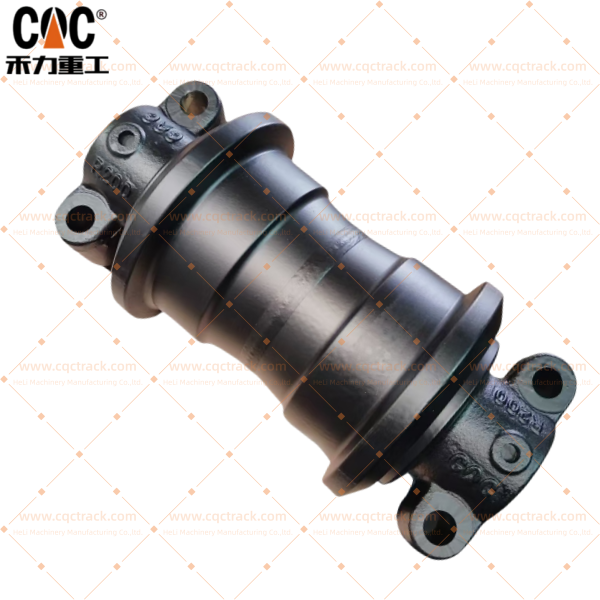
HYUNDAI 81N611010 / 81Q611011 / 81Q611051 / R210 R220-9 HX220 HX225 HX235 Track Lower Roller / Track Bottom Roller Assy manufactured by HELI CQCTRACK


Comprehensive Technical Specification: HYUNDAI 81N611010 / 81Q611011 / 81Q611051 R210 / R220-9 / HX Series Track Lower Roller (Bottom Roller) Assembly – Precision Undercarriage Engineering by HELI CQCTRACK
1. Executive Summary: The Foundation of Track System Reliability
The HYUNDAI 81N611010 / 81Q611011 / 81Q611051 Track Lower Roller Assembly, technically classified as the Track Bottom Roller or Track Roller, is a mission-critical load-bearing component engineered for the HYUNDAI R210, R220-9, HX220, HX225, and HX235 series mid-size crawler excavators. As a fundamental element of the track undercarriage system, this assembly supports the entire machine weight, guides the track chain along the ground contact path, and absorbs the immense dynamic and impact loads characteristic of construction, excavation, and material handling operations.
HELI – CQCTRACK, operating as a specialized source manufacturer of heavy-duty crawler excavator undercarriage components, produces these lower roller assemblies to meet and exceed rigorous Original Equipment Manufacturer (OEM) specifications. By leveraging vertical manufacturing integration—from raw material sourcing and closed-die forging to precision CNC machining and advanced heat treatment—CQCTRACK delivers components with unparalleled structural integrity, wear resistance, and seamless compatibility with HYUNDAI’s R210/HX series excavators. This document provides a comprehensive technical exposition of the assembly’s engineering philosophy, material metallurgy, manufacturing precision, and operational superiority, solidifying its status as the definitive choice for equipment owners demanding maximum uptime in demanding environments.
2. System Function & Operational Dynamics: The Load-Bearing Foundation
In the closed-loop undercarriage architecture of HYUNDAI’s 20-25 ton class excavators—including the legacy R210, R220-9, and the next-generation HX220, HX225, and HX235 models—the lower roller assembly (also termed track roller or bottom roller) is positioned along the bottom side of the track frame, riding directly on the track chain links. These components bear the full weight of the machine and perform three primary mechanical functions with precision:
- Primary Load-Bearing & Weight Distribution: The lower rollers support the total static and dynamic weight of the excavator, distributing immense loads from the mainframe through the track chain to the ground. Each roller assembly must withstand radial loads that fluctuate constantly during digging, lifting, and travel operations. The precision-machined contour of the roller engages with the track chain link, ensuring stable, low-friction travel along the track rail .
- Track Chain Guidance & Derailment Prevention: The integrally forged flanges on each roller serve as continuous rails that interface precisely with the inner surfaces of the track links. This provides positive lateral control of the track chain, preventing lateral displacement (de-tracking) during counter-rotation turns or operations on sloped terrains—a critical function for maintaining operational safety and preventing catastrophic downtime .
- Shock & Vibration Damping: As the machine traverses uneven terrain or encounters obstacles, the lower rollers absorb and mitigate impact loads, protecting the integrity of the entire undercarriage and upper structure. This damping function is essential for extending the service life of track chains, sprockets, and final drives by reducing shock transmission through the system .
3. Technical Specifications & Material Metallurgy: The Science of Durability
The operational lifespan of a lower roller for a 20-25 ton class excavator is dictated by advanced material science and precise thermal treatment. The HYUNDAI 81N611010/81Q611011/81Q611051 assemblies from HELI-CQCTRACK exemplify state-of-the-art metallurgical engineering for mid-size excavator applications.
3.1 Core Material Selection: Forged for Fortitude
- Roller Body Material: The roller body is forged from high-grade, wear-resistant alloy steel, specifically 40SiMnTi or 50Mn high-tensile, fine-grain alloy steel. These manganese-silicon alloys are selected for their exceptional toughness and dynamic work-hardening characteristics. When subjected to the continuous impact and rolling contact from the track chain, the surface of the material undergoes micro-structural densification, actually increasing its hardness and wear resistance in the field .
- Roller Shaft (Axle) Material: The stationary axle is fabricated from case-hardened alloy steel, typically 40Cr or 20CrMnTi. These chromium-based alloys provide superior fatigue limit, torsional strength, and resistance to bending under cyclic loads, ensuring the shaft maintains perfect geometric alignment throughout its service life .
3.2 Heat Treatment & Surface Engineering
Achieving the optimal balance between an abrasion-resistant surface and a tough, impact-absorbing core is achieved through a precise, multi-stage thermal process:
- Deep Induction Hardening: The outer raceway and flange contact surfaces undergo computer-controlled, deep-case induction hardening. For the R210/HX series rollers, this creates a metallurgically bonded, high-hardness case of 8-12mm depth, achieving a surface hardness of HRC 58-62—creating a virtually impenetrable barrier against abrasive wear from track bushings and debris while maintaining core ductility .
- Quenching & Tempering (QT): The core of the roller undergoes quenching and tempering to achieve a tough, ductile core of approximately HRC 38-42. This retained ductility is essential for absorbing shock loads without catastrophic cracking, ensuring the component yields elastically rather than fracturing plastically under impact .
- Precision Machining: Following heat treatment, precision CNC machining achieves tolerance levels within ±0.02mm on critical surfaces, including the journal for bearings and the wheel tread. The running surface achieves a fine ground finish to minimize friction with the track bushings and prevent micro-welding under extreme pressures .
3.3 Dimensional Precision & Quality Metrics
- OEM Interchangeability: Manufactured strictly according to HYUNDAI’s original engineering blueprints, guaranteeing direct, “bolt-on” replacement for part numbers 81N611010, 81Q611011, and 81Q611051 on the R210, R220-9, HX220, HX225, and HX235 models without modification.
- Critical Dimensions: All interface dimensions—shaft diameter, mounting configuration, overall width, and flange profile—are held to stringent tolerances (IT6-IT7 grade), with concentricity maintained within 0.03mm to ensure perfect track alignment .
4. Structural Anatomy: Deconstructing the HYUNDAI Lower Roller Assembly
The 81N611010 / 81Q611011 / 81Q611051 Lower Roller is a precision-engineered assembly consisting of several high-performance sub-components, each designed for a specific function in the demanding excavator environment.
| Component | Function | Engineering Specification |
|---|---|---|
| Roller Body | The rotating component that directly contacts and guides the track chain, supporting the machine’s weight. | Forged from 40SiMnTi/50Mn alloy steel; induction-hardened raceway and flanges to HRC 58-62 with 8-12mm case depth; precision-machined flange profile to ensure positive link engagement . |
| Roller Shaft (Axle) | The stationary, high-strength axle that mounts the assembly to the track frame brackets. | Case-hardened 40Cr or 20CrMnTi alloy steel; precision-ground bearing journals to mirror finish (Ra ≤ 0.4μm); engineered to withstand high radial loads without deflection . |
| Bearing System | Facilitates smooth, low-friction rotation of the roller body around the stationary shaft while supporting immense radial loads. | Utilizes heavy-duty double-row tapered roller bearings (tier-one supplier quality, e.g., SKF/NTN equivalent). This configuration provides exceptional radial and axial load capacity with precise internal clearance control (0.2-0.5mm endplay) . |
| Floating Seal System | The most critical component for longevity. A hermetic barrier that prevents ingress of abrasive contaminants (mud, sand, water) and retains lubricant. | Multi-stage, pressure-adaptive labyrinth seal system combining: (1) primary floating metal wear ring for gross abrasive deflection; (2) multi-lip HNBR or polyurethane contact seal; (3) grease-purged labyrinth path. Validated in dust/water immersion tests exceeding 2,000 hours service life . |
| Bushings / End Collars | Protect the housing and provide precise mounting surfaces for the track frame interface. | Hardened steel bushings pressed into the hubs; precision-machined to exacting tolerances for secure, non-wearing connection with track frame brackets. |
| Lubrication System | Ensures continuous, maintenance-free lubrication of bearings. | Pre-filled with high-viscosity, extreme-pressure (EP) lithium complex grease fortified with molybdenum disulfide (MoS2), capable of maintaining lubricity under high shock loads and temperature variations (-30°C to +150°C) . |
5. The HELI – CQCTRACK Manufacturing Advantage: Source Manufacturer Philosophy
As a dedicated source manufacturer of heavy-duty crawler excavator undercarriage components, HELI-CQCTRACK distinguishes itself through vertical integration and an uncompromising commitment to quality at every stage of production. Based in the manufacturing hub of Quanzhou, China, the company operates under a multi-layered certification umbrella, holding both ISO 9001:2015 quality system recognition and multiple China Quality Certification (CQC) product certifications .
5.1 Source Factory Control
- Closed-Die Forging: The manufacturing process begins with closed-die forging of roller blanks. This critical process aligns the metal’s grain flow with the component’s shape, significantly enhancing structural integrity, fatigue resistance, and impact strength compared to cast alternatives. Forging refines the grain structure and creates a denser, more impact-resistant substrate .
- CNC Precision Machining: Following heat treatment, state-of-the-art Computer Numerical Control (CNC) lathes, grinding machines, and machining centers execute all turning, boring, and grinding operations. Critical tolerances (IT6-IT7 grade) are consistently achieved, with surface finishes optimized for seal longevity and rolling contact .
- In-House Heat Treatment: Owning and controlling the heat treatment lines allows CQCTRACK to strictly adhere to the precise time-temperature cycles necessary to achieve the specified case depth (8-12mm) and core hardness, guaranteeing metallurgical consistency across all production batches. Process parameters are meticulously documented as per CQC-mandated process control records .
- Temperature-Controlled Assembly: Bearings, seals, and the axle are assembled in a clean environment. Selective fitting and induction heating of the roller body may be used for bearing installation to achieve perfect interference fits without force damage, ensuring optimal internal clearances .
5.2 OEM-Grade Quality Assurance
The designation of “OEM Quality” is validated through a battery of rigorous tests mandated by the CQC factory inspection and supervision system :
- Dimensional Conformity: 100% verification via Coordinate Measuring Machines (CMM) for critical dimensions, ensuring perfect interchangeability with HYUNDAI specifications.
- Hardness Profiling: Rockwell hardness testers verify surface hardness (HRC 58-62) on the raceway and flanges, while confirming core toughness (HRC 38-42), ensuring the component can withstand harsh operational realities.
- Non-Destructive Testing (NDT): Magnetic Particle Inspection (MPI) of all forgings detects subsurface flaws that could lead to premature failure .
- Seal Integrity Testing: The seal cavity is pressurized to verify the hermetic barrier is uncompromised, with sample assemblies undergoing rotational torque testing to ensure smooth operation .
- Performance Simulation: Sample assemblies undergo dynamic load testing and radial clearance measurement, validating structural integrity under simulated operational forces.
- Comprehensive Traceability: Full digital traceability for each production batch—including material certifications, heat-treatment logs, and inspection results—is retained for a minimum of 24 months, providing unparalleled transparency for warranty and failure analysis .
5.3 Adaptation to R210/HX Series Applications
CQCTRACK understands that HYUNDAI excavators operate globally in diverse, challenging environments. Their manufacturing process is adaptable, allowing for engineering adjustments—such as specifying enhanced corrosion-resistant coatings for marine applications or specialized low-temperature material variants for cold climate operations—while maintaining the core OEM footprint.
6. Failure Mode Analysis & Preventive Maintenance Protocol
Maximizing the service life of the R210/HX series lower rollers requires understanding potential failure modes and adhering to a strict maintenance regimen.
6.1 Common Failure Mechanisms
- Seal Failure & Contamination Ingress: The primary cause of premature roller failure. If the floating seal is compromised by debris impact or thermal degradation, lubricant escapes and abrasives enter the bearing cavity. This acts as a grinding paste, rapidly destroying the bearings, shaft, and roller bore .
- Raceway Wear / Flattening: Progressive wear on the outer diameter due to continuous friction with track bushings. Excessive wear reduces the roller diameter, alters track geometry, and increases the risk of chain derailment. Flattening can occur if the bearing system seizes.
- Brinelling: Surface indentations on the raceway caused by impact loads exceeding the material’s elastic limit, leading to rough rotation and accelerated wear.
- Bearing Fatigue: Eventually, rolling elements or races can spall due to cyclic loading. This leads to increased internal clearance, causing the roller to wobble and run noisily, which accelerates seal wear and can lead to catastrophic failure.
- Flange Wear: Gradual thinning of guide flanges due to constant contact with track links. This reduces guidance capability, leading to de-tracking risks, especially during side-loading operations on slopes.
6.2 Recommended Maintenance Practices
- Daily Visual Inspection: Check for evidence of grease leakage around the hub (a tell-tale sign of seal failure). Listen for unusual noises like grinding or rumbling during operation. Inspect flange and raceway profiles for visible wear or damage .
- Track Tension Management: Maintain correct track sag as per HYUNDAI specifications. An over-tensioned track overloads roller bearings and seals; an under-tensioned track causes chain slap, leading to impact damage and accelerated wear.
- Rotation Check: During daily walk-around, where safely accessible, observe rollers for smooth rotation without wobble or roughness. Manually spin rollers (when safe) to feel for binding or roughness indicating bearing distress.
- Greasing Protocol: While typically lubricated-for-life (LFL), regular inspection of seal condition is paramount during undercarriage service intervals (every 500-1000 hours). Contaminated or damaged seals should be addressed promptly .
- Wear Limit Measurement: Periodically measure outer diameter and flange thickness. Replace assemblies when wear reaches manufacturer’s recommended limit to prevent damage to the more expensive track chain.
- Proactive Replacement: Rollers should be installed in matched sets per side to ensure even load distribution and track alignment. When one roller shows significant wear, its counterparts are likely nearing end of service life .
7. Compatibility & Application Scope
- Primary Models:
- HYUNDAI R210 Series (including R210, R210-7, R210-9)
- HYUNDAI R220-9
- HYUNDAI HX220, HX220L
- HYUNDAI HX225, HX225L
- HYUNDAI HX235, HX235L, HX235LCR
- OEM Part Numbers: Direct replacement for HYUNDAI 81N611010, 81Q611011, and 81Q611011-9 (variants may apply to specific model years and configurations).
- Machine Class: Mid-size crawler excavators (20-25 metric tons).
- Quality Warranty: Components are backed by performance warranty underwritten by certified manufacturing processes and extensive documentation required by CQC supervision, providing objective basis for confidence in longevity .
- Applications: Engineered for durability in:
- General construction and earthmoving
- Utility and infrastructure projects
- Quarrying and aggregate handling
- Demolition and scrap processing
- Operations involving abrasive terrains and continuous duty cycles.
8. Conclusion: The Benchmark for HYUNDAI Undercarriage Reliability
The HYUNDAI 81N611010 / 81Q611011 / 81Q611051 R210 / R220-9 / HX220 / HX225 / HX235 Track Lower Roller Assembly from HELI – CQCTRACK represents the pinnacle of mid-size excavator undercarriage engineering. It is not merely a replacement part; it is a strategic investment in operational uptime and total cost of ownership reduction for HYUNDAI excavator fleets operating in demanding environments.
By combining advanced metallurgy (40SiMnTi/50Mn), closed-die forging, precision CNC machining, and the rigorous quality control of a true source manufacturer operating under ISO 9001 and CQC certification frameworks, CQCTRACK delivers components that not only meet the exacting standards of HYUNDAI’s excavator specifications but are engineered to surpass them in real-world conditions . The deep induction hardening to HRC 58-62 with 8-12mm case depth ensures exceptional wear resistance, while the high-integrity multi-stage floating seal system protects the precision bearing assembly from the relentless assault of abrasive debris.
Choosing HELI-CQCTRACK means partnering with a source manufacturer that possesses deep domain expertise in heavy-duty crawler excavator undercarriage components. It ensures that every critical element—from the forged 50Mn roller body to the case-hardened 40Cr shaft and heavy-duty tapered roller bearings—works in perfect harmony to support the dynamic forces of HYUNDAI’s R210 and HX series excavators, ensuring the track system remains reliable, efficient, and productive for thousands of operating hours on construction sites, quarries, and infrastructure projects worldwide.
Products categories
-

w154A-Z2/track roller-bottom roller-mini excava...
-

HYUNDAI 81QE11010 R1250 Track Botoom Roller Ass...
-

CATERPILLAR-E325/329(P/N:6Y1057,117-5046,CJ5525...
-
Hitachi excavator undercarriage part EX200 trac...
-

SH60 E70B IHI35 IHI60 Single flange crawler tra...
-

(1273806/6I6524/CT9130/CR7158)CATERPILLAR-E70B/...


