
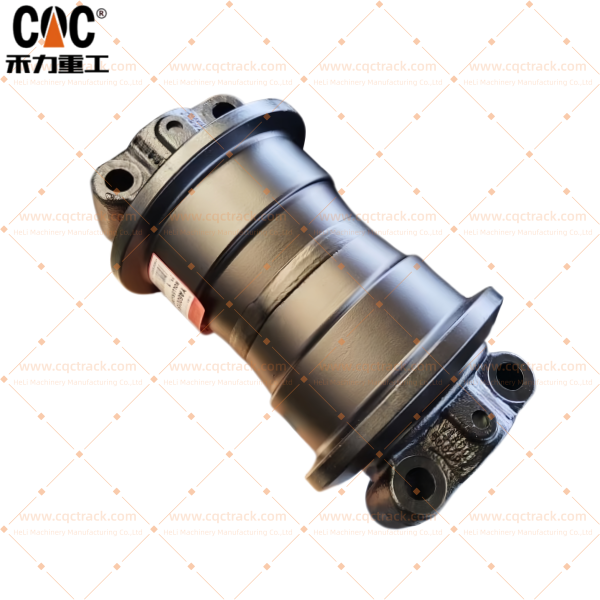
HITACHI YA60015002 9231278 9184516 EX200 ZX200 ZAX240 Track Bottom Roller Assembly / OEM and ODM Quality excavator undercarriage parts Source Manufacturer and factory / CQC TRACK


Hitachi Track Bottom Roller Assembly: Engineering Durability for EX200, ZX200 & ZAX240 Excavators
In the demanding world of hydraulic excavators, the undercarriage represents the foundation upon which machine productivity is built. Among its components, the Track Bottom Roller Assembly—often referred to as the lower roller or track roller—bears the entire operating weight of the machine while guiding the track chain across varied terrain. For Hitachi’s renowned EX200, ZX200, and ZAX240 series, the quality and reliability of bottom rollers directly impact uptime, operating costs, and fleet availability.
This article provides a comprehensive technical analysis of Hitachi bottom roller assemblies, focusing on part numbers YA60015002, 9231278, 9184516. It explores their engineering specifications, application compatibility, metallurgical requirements, and the strategic advantages of sourcing from a specialized OEM and ODM manufacturer such as CQC TRACK.
1. The Critical Role of the Track Bottom Roller Assembly
The track bottom roller assembly serves multiple essential functions within the undercarriage system:
- Load Distribution: Each roller transmits a portion of the machine’s weight to the track chain, distributing ground pressure evenly to prevent excessive sinkage in soft terrain.
- Track Guidance: The roller flanges keep the track chain aligned, preventing lateral movement that could lead to derailment.
- Shock Absorption: Rollers absorb impact loads from uneven ground, protecting the track frame and final drive from excessive stress.
Given the harsh operating environments—rock quarries, mining overburden, urban demolition, and heavy civil construction—the bottom roller is subject to constant abrasion, impact, and contamination. Its design and material composition are therefore critical to long-term reliability.
2. Component Identification and Application Mapping
The three part numbers covered in this article correspond to bottom roller assemblies used across Hitachi’s mid-size excavator platforms:
| Part Number | Compatible Models | Roller Type | Key Features |
|---|---|---|---|
| YA60015002 | EX200-1, EX215, EX220, EX200-5 | Single-flange bottom roller | Legacy EX series; robust cast body; designed for 20–22 ton class machines |
| 9231278 | ZX200-1, ZX250, ZX225, ZX210-3 | Single-flange bottom roller | Modern ZX platform; optimized for extended service intervals; compatible with long-track (LC) variants |
| 9184516 | ZAX240-3, ZAX240-5, ZX240-3, ZX240-5 | Single-flange bottom roller | Heavier-duty construction; suitable for 24–27 ton class; increased load capacity |
While the EX200 and ZX200 share a similar weight class (approximately 20 metric tons), their undercarriage systems differ in track pitch, roller spacing, and final drive configuration. The ZAX240 and ZX240 represent a heavier class (24–27 tons), requiring bottom rollers with increased load-bearing capacity and enhanced sealing systems.
2.1 Cross-Platform Considerations
For fleet managers operating mixed Hitachi equipment, understanding interchangeability is crucial. The 9231278 roller is generally compatible with ZX200 series, while the 9184516 is designed for the larger ZAX240/ZX240 class. The YA60015002 remains specific to the EX200 legacy platform, though some aftermarket manufacturers offer upgraded versions that adapt the EX200 to modern sealing and metallurgy standards.
3. Engineering Specifications and Technical Features
3.1 Dimensional Parameters
High-quality bottom rollers must adhere to precise OEM dimensions to ensure proper fitment and function:
- Roller Diameter: Typically 220–260 mm depending on model and track pitch
- Flange Width: Critical for maintaining track alignment
- Mounting Bolt Pattern: Matches the track frame drilling; typically 2 or 4 bolts per roller
- Shaft Diameter: Precision-ground to fit within the track frame mounting brackets
Reputable manufacturers like CQC TRACK utilize CMM (Coordinate Measuring Machine) inspection to verify that each roller meets OEM dimensional tolerances within ±0.1 mm.
3.2 Metallurgical Composition
The bottom roller assembly consists of several components, each requiring specific material properties:
| Component | Material | Properties |
|---|---|---|
| Roller Body | Forged 35CrMo or 40CrMnMo alloy steel | High strength, impact resistance, fatigue life |
| Shaft | 45# or 40Cr steel (case-hardened) | Wear resistance at bearing interfaces |
| Flanges | Induction-hardened to 52–58 HRC | Abrasion resistance against track chain links |
Forged steel is preferred over cast alternatives because forging refines the grain structure, eliminating internal voids and enhancing toughness—critical for components subjected to cyclic impact loads.
3.3 Heat Treatment Profile
The roller body undergoes induction hardening on the tread surface (where the track chain contacts) and the flange surfaces. Key specifications include:
- Surface Hardness: 52–58 HRC
- Case Depth: 6–12 mm (depending on roller size and application)
- Core Hardness: 28–35 HRC (maintains ductility for impact absorption)
A gradual hardness gradient from the surface to the core prevents spalling and delamination—common failure modes in poorly manufactured rollers.
3.4 Sealing System
The sealing system is arguably the most critical element of a bottom roller’s longevity. Contamination ingress (dirt, sand, water) rapidly destroys bearings and leads to roller seizure. High-quality bottom rollers utilize:
- Floating Seal Technology: Duo-cone or equivalent metal-faced seals with mirror-finished wear rings
- Seal Material: Nitrile rubber (NBR) for standard applications; fluoroelastomer (FKM) for high-temperature environments or extended service intervals
- O-Ring Quality: Precision-molded to maintain consistent compression and prevent leakage
The YA60015002, 9231278, and 9184516 rollers manufactured by CQC TRACK are assembled with floating seals that undergo pressure testing to verify leak-proof integrity before shipment.
4. OEM and ODM Manufacturing: A Strategic Sourcing Advantage
For international buyers—whether aftermarket distributors, fleet operators, or equipment rebuilders—understanding the distinction between OEM and ODM manufacturing is essential when selecting a supplier like CQC TRACK.
| Service Type | Description | Value to Buyer |
|---|---|---|
| OEM Manufacturing | Production of components exactly to buyer’s specifications, drawings, or physical samples | Enables distributors to brand and market products under their own name with assured quality |
| ODM Manufacturing | The manufacturer designs and produces components based on market needs; buyers private-label ready-made products | Reduces time-to-market; leverages manufacturer’s engineering expertise and existing tooling |
For Hitachi bottom rollers, an OEM/ODM manufacturer offers:
- Custom Branding: Laser etching of buyer’s logo, part number, and batch information on the roller body
- Packaging Solutions: Custom boxes, labels, and palletization for retail or wholesale distribution channels
- Engineering Support: Assistance with cross-referencing, fitment verification, and design modifications for specialized applications
5. Quality Assurance Protocols for Export-Grade Components
When sourcing bottom rollers from a manufacturer such as CQC TRACK, international buyers should expect rigorous quality control measures that go beyond basic visual inspection.
5.1 Material Traceability
Each batch of steel used for forging rollers is accompanied by mill test certificates (MTC) certifying chemical composition and mechanical properties. This traceability ensures consistency and allows buyers to verify compliance with international standards (ASTM A29, EN 10083, or equivalents).
5.2 Dimensional Inspection
Finished rollers undergo CMM inspection to verify:
- Outer diameter and flange width within tolerance
- Shaft diameter and straightness
- Mounting bolt hole positioning
- Concentricity and radial runout
A First Article Inspection (FAI) report is typically provided for new production runs, giving buyers confidence in the tooling and manufacturing process.
5.3 Hardness Verification
A hardness traverse from the tread surface to the core is performed using Rockwell or Vickers testers. The hardened case depth is measured to ensure it meets the specified range, with a gradual hardness gradient that prevents surface cracking under load.
5.4 Seal Integrity Testing
Each assembled roller undergoes air pressure testing to verify floating seal performance. Rollers failing this test are rejected and disassembled for root cause analysis—ensuring that only leak-proof components reach the customer.
5.5 Non-Destructive Testing (NDT)
Critical components may be subjected to magnetic particle inspection (MPI) to detect surface or subsurface cracks in the roller body or shaft that could lead to premature failure.
6. Application-Specific Considerations
6.1 EX200 Series (YA60015002)
The EX200 remains a widely deployed machine in many global markets, particularly in regions where equipment is maintained beyond typical economic life. For these legacy machines, sourcing high-quality aftermarket rollers is essential to keeping older fleets operational. The YA60015002 roller, when manufactured with modern sealing technology and forged steel, can outperform the original cast rollers common in early EX200 production.
6.2 ZX200 Series (9231278)
The ZX200 platform introduced several undercarriage improvements, including larger-diameter rollers and enhanced sealing systems. The 9231278 roller is designed to meet these higher standards. For aftermarket buyers, selecting a roller that replicates the ZX200’s improved geometry and sealing is critical to achieving expected service life.
6.3 ZAX240 / ZX240 Series (9184516)
The ZAX240 and ZX240 machines operate in the 24–27 ton class, with higher ground pressures and greater load demands. The 9184516 roller features increased flange thickness, larger shaft diameter, and enhanced sealing to handle these demands. In quarry and mining applications, these rollers are subject to the most severe abrasion and impact conditions, making material quality and heat treatment paramount.
7. Installation and Maintenance Best Practices
To maximize the service life of Hitachi bottom rollers, proper installation and maintenance are essential:
- Bolt Torque: Use new, grade 10.9 or 12.9 bolts and tighten to manufacturer-specified torque (typically 250–350 Nm depending on bolt size and thread pitch). Uneven torque can distort the mounting bracket or lead to premature roller failure.
- Alignment: Verify that all bottom rollers are aligned parallel to the track frame; misalignment causes uneven flange wear and track derailment.
- Lubrication: While sealed rollers are maintenance-free, regular inspection for oil leaks (indicating seal failure) is essential. Any roller showing grease or oil leakage should be replaced promptly to prevent bearing seizure.
- Wear Synchronization: Replace bottom rollers as a complete set (all rollers on both sides) to ensure even load distribution. Mixing new and worn rollers can accelerate wear on the newer components.
8. Conclusion
The Hitachi YA60015002, 9231278, and 9184516 Track Bottom Roller Assemblies are fundamental components for maintaining the mobility, stability, and productivity of EX200, ZX200, and ZAX240 series excavators. Whether deployed in urban construction, infrastructure development, or quarry operations, these rollers endure continuous abrasion, impact, and contamination—demanding the highest standards of material quality, heat treatment, and sealing technology.
For aftermarket distributors, fleet managers, and equipment rebuilders, sourcing these components from a specialized OEM and ODM manufacturer like CQC TRACK offers a strategic advantage: engineering precision, certified quality, supply chain reliability, and cost-effectiveness. By combining advanced manufacturing capabilities with deep expertise in Hitachi undercarriage systems, CQC TRACK delivers bottom rollers that perform with the durability of OEM components while providing the flexibility and value of a true manufacturing partner.
In the competitive landscape of heavy equipment aftermarket, choosing the right undercarriage supplier is not merely a procurement decision—it is an investment in operational reliability, customer satisfaction, and long-term business success.
Disclaimer: Part numbers and model references are provided for cross-reference purposes only. They are intended to indicate compatibility with original equipment manufacturer (OEM) specifications. CQC TRACK is an independent OEM/ODM manufacturer of aftermarket undercarriage components.
Products categories
-

CATERPILLAR 1634145 6I9396 CR5726 E324 Track Ro...
-

LIUGONG(51c0249)-LG936-track roller Ass’y...
-

HITACHI EX400 ZX450 9072631 Track Bottom Roller...
-

KOMATSU (209-30-00191 , KM2143) PC750 Track Rol...
-

(1273806/6I6524/CT9130/CR7158)CATERPILLAR-E70B/...
-

Hitachi excavator track roller /EX1200-6 Sku:4...


