
Komatsu 2092751172 2092751173 2092751170 PC800 Track Sprocket Assy / Rock Arm Final Drive Sprocket Wheel Group / Manufactured By CQC TRACK

Technical White Paper: Komatsu2092751172 / 2092751173 / 2092751170PC800 Rock Arm Final Drive Sprocket Wheel Assembly
Source Manufacturer: HELI Machinery Manufacturing Co., Ltd. (CQC TRACK)
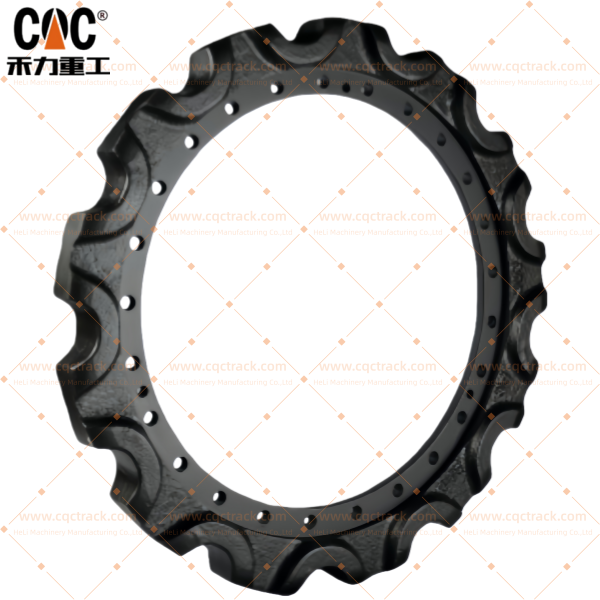
1. Executive Summary: Engineering the Power Interface for Heavy-Duty Rock Applications
The final drive sprocket wheel assembly is the critical power transmission interface between the hydraulic drive motor and the track chain in crawler undercarriage systems. For the Komatsu PC800—a heavy-duty machine operating in rock excavation, quarrying, mining overburden removal, and large-scale earthmoving—the sprocket assembly designated by reference numbers 2092751172, 2092751173,2092751170 must withstand extreme torsional stresses, continuous abrasive contact with track chain bushings, and the severe impact loads inherent to rock arm operations where the undercarriage encounters jagged terrain, shot rock, and abrasive mineral fines.
The term “Rock Arm” in the context of Komatsu PC800 applications refers to the reinforced undercarriage configuration specifically engineered for severe rock conditions. This configuration demands sprocket assemblies with enhanced metallurgical properties, deeper case hardening, and superior impact resistance compared to standard-duty components.
HELI Machinery Manufacturing Co., Ltd., operating under the CQC TRACK brand, manufactures this critical power transmission component as a vertically integrated producer. Through precision closed-die forging, advanced induction heat treatment, and stringent quality management protocols, CQC TRACK delivers sprocket assemblies engineered for mechanical interchangeability with Komatsu OEM specifications while incorporating material and process enhancements specifically optimized for rock arm duty cycles.
This document provides a comprehensive technical exposition of the Komatsu PC800 Rock Arm Sprocket Wheel Assembly, detailing the engineering philosophy, material metallurgy, manufacturing protocols, quality assurance frameworks, and application-specific considerations that define this critical undercarriage component.
2. Product Identification and Cross-Reference Matrix
Accurate component identification is the foundational prerequisite for procurement and maintenance operations in heavy equipment management. The following matrix establishes the interrelationship between the various reference numbers and their application context.
| Specification Parameter | Details |
|---|---|
| Primary OEM Reference Numbers | 2092751172, 2092751173, 2092751170 |
| Component Type | Final Drive Sprocket Wheel Assembly / Drive Sprocket Group |
| Primary Application | Komatsu PC800 Crawler Excavator / Rock Arm Configuration |
| Configuration Designation | Rock Arm (Severe-duty reinforced undercarriage) |
| Functional Classification | Power Transmission & Track Drive Component |
| Operating Weight Class | 80-tonne class heavy equipment |
| Manufacturing Origin | HELI Machinery Manufacturing Co., Ltd. (CQC TRACK) |
| Engineering Grade | Severe-Duty Rock Mining & Heavy Construction Grade |
Application Note: The PC800 Rock Arm configuration is specifically engineered for operations in shot rock, quarry floors, and mining overburden where standard undercarriage components experience accelerated wear. Rock Arm sprockets feature enhanced metallurgy and deeper case hardening to withstand the unique demands of rock terrain.
3. Functional Role in the Rock Arm Undercarriage System
In the track chassis architecture of the Komatsu PC800 Rock Arm configuration, the sprocket wheel assembly serves as the primary driver of the undercarriage system, performing functions that directly impact machine mobility, digging efficiency, and component longevity under severe rock conditions.
3.1 Primary Operational Functions
1. Torque Conversion and Power Transmission:
The sprocket mounts directly to the final drive planetary hub, receiving high-torque rotational input from the hydraulic motor via splined shaft or keyed interface. Through precision tooth engagement with the track chain bushings, it converts rotational energy into linear tractive force, propelling the machine across rock-strewn worksites. In rock arm operations, smooth torque delivery is critical to maintain tractive effort when excavating against hard material faces.
2. Track Chain Synchronization:
The sprocket’s tooth pitch and contour are precisely calibrated to match the track chain specifications of the PC800 Rock Arm configuration. Proper synchronization ensures even load distribution across multiple teeth, minimizing localized stress concentrations that lead to premature tooth wear, spalling, or fracture—failure modes that are accelerated in rock applications where shock loads are frequent and severe.
3. System Integration and Alignment:
As the primary drive element, the sprocket works in concert with the idler, track rollers, and carrier rollers to maintain proper track geometry and tension. Any misalignment, wear imbalance, or installation error in the sprocket can propagate accelerated wear throughout the entire undercarriage system—making precision manufacturing and correct installation critical requirements for achieving optimal component life in rock arm operations.
3.2 System Integration Context
| Interface Component | Functional Relationship |
|---|---|
| Final Drive Motor | Mounts via precision-machined bolt pattern or splined interface; torque transmitted through high-strength connection |
| Track Chain Assembly | Sprocket teeth engage track bushings; tooth profile must precisely match chain pitch and bushing diameter |
| Track Frame | Provides structural mounting and establishes alignment reference |
| Seal System | Interfaces with sprocket sealing surfaces to retain final drive lubricant and exclude rock fines and abrasive contaminants |
4. Technical Deconstruction: The Anatomy of the PC800 Rock Arm Sprocket Assembly
The performance and service life of a sprocket in the PC800 Rock Arm class are determined by the synergistic integration of advanced material science, forging technology, precision machining, and thermal treatment. Each manufacturing stage is executed under controlled conditions to ensure consistent quality and performance.
4.1 Material Metallurgy: Foundation for Rock Duty
The selection of base material is the critical first step in achieving the required combination of surface wear resistance, core toughness, and fatigue strength essential for rock arm duty cycles.
Base Material Specification:
- Grade: High-strength chromium-molybdenum alloy steel (equivalent to 42CrMo4 / SAE 4140) or high-grade manganese-boron forging steel
- Material Characteristics:
- Excellent hardenability enabling deep, uniform case hardness
- High tensile strength (typically 900-1100 MPa after heat treatment) for resistance to plastic deformation under peak rock impact loads
- Good toughness at elevated temperatures
- Superior fatigue resistance under cyclic loading conditions
- Enhanced impact absorption for rock terrain traversal
Rock Arm Material Enhancements:
Compared to standard-duty sprockets, Rock Arm configurations may incorporate:
- Higher alloy content for improved hardenability
- Refined grain structure through controlled forging parameters
- Enhanced cleanliness standards with reduced inclusion content
Material Validation Protocol:
Every material batch undergoes spectrographic chemical analysis to verify composition against certified specifications, ensuring batch-to-batch consistency and full traceability throughout the production process.
4.2 Forging Process: Grain Flow Optimization for Impact Resistance
The transition from raw material to sprocket blank occurs through closed-die hot forging—a process that fundamentally enhances the component’s mechanical properties compared to cast alternatives. This is particularly critical for rock applications where impact loads are severe and frequent.
| Forging Parameter | Specification | Engineering Significance |
|---|---|---|
| Method | Closed-die hot forging | Refines grain structure; eliminates internal porosity; aligns grain flow with component geometry |
| Grain Flow | Optimized to follow tooth contour and radial geometry | Enhances fatigue strength at stress concentration points (tooth root) by up to 30% versus cast components |
| Material Integrity | Ultrasonic testing per applicable standards | Detects internal inclusions or voids that could serve as crack initiation sites under rock impact loading |
| Alternative Comparison | Forged vs. Cast | Forged sprockets exhibit superior impact resistance, fatigue life, and resistance to catastrophic failure in rock applications |
The closed-die forging process aligns the metallic grain flow with the component’s geometric contour, creating an anisotropic structure with superior impact strength compared to cast alternatives. This is particularly critical for the PC800 Rock Arm class, where impact loads from traversing shot rock and excavating against hard material faces create severe stress concentrations at the tooth root.
4.3 Precision CNC Machining: Dimensional Accuracy
The forged blank undergoes multi-axis CNC machining to achieve the precise geometry required for proper fit and function. Dimensional accuracy is verified using coordinate measuring machines (CMM) and precision measurement tools.
Critical Machined Features:
| Feature | Tolerance Requirement | Function |
|---|---|---|
| Tooth Profile | AGMA Class 9 or equivalent; ISO 6336-compliant | Ensures proper engagement with track chain bushings; minimizes wear, noise, and power loss |
| Pitch Diameter | Precision tolerance (typically ±0.3 mm) | Maintains correct chain-to-sprocket fit for smooth power transmission |
| Bore Diameter | IT7-IT8 tolerance class | Ensures concentric mounting to final drive; prevents eccentric loading and vibration |
| Mounting Bolt Pattern | Positional accuracy within tight tolerances | Prevents eccentric loading, seal damage, and bolt fatigue failure |
| Sealing Surfaces | Fine surface finish (Ra ≤ 0.8 μm) | Critical for lubricant retention and contaminant exclusion in abrasive rock environments |
The tooth profile is machined to the exact involute form specified by the original equipment design, ensuring smooth engagement with the track chain and eliminating undue stress concentrations that accelerate wear—a critical requirement when operating on rock surfaces where shock loads are transmitted directly through the track system.
4.4 Heat Treatment and Surface Engineering for Rock Duty
Heat treatment is the core of the durability advantage offered by CQC TRACK Rock Arm sprockets. The process creates a graduated hardness profile that maximizes wear resistance against rock abrasion while maintaining core toughness for impact absorption.
Induction Hardening Protocol:
| Parameter | Specification |
|---|---|
| Surface Hardness (Teeth) | 58–62 HRC (optimized for rock abrasion resistance) |
| Effective Case Depth | 3–5 mm minimum; enhanced for extended wear life in rock applications |
| Core Hardness | 28–35 HRC (quenched and tempered condition) |
| Hardness Gradient | Gradual transition from case to core prevents delamination under impact |
Technical Rationale for Rock Arm Applications:
- The hardened surface (58-62 HRC) provides extreme abrasion resistance against track bushing contact and abrasive rock fines (silica, quartz, granite particles)
- The deep case depth (3-5 mm) ensures retained hardness throughout the usable wear life of the sprocket—even after significant tooth wear from rock contact
- The ductile core (28-35 HRC) absorbs impact loads from rock traversal and prevents catastrophic tooth fracture under shock loading conditions
- The induction hardening process localizes heat treatment to tooth surfaces only, preserving core ductility for impact resistance
4.5 Surface Protection and Corrosion Resistance
For components exposed to harsh rock mining environments—including abrasive dust, moisture, and temperature extremes—surface protection extends service life and maintains sealing integrity.
| Surface Treatment | Application | Benefit |
|---|---|---|
| Hard Chrome Plating | Seal running surfaces | Minimizes friction; prevents corrosion-induced seal damage; maintains sealing integrity in abrasive environments |
| Zinc-Nickel Alloy Plating | Non-contact surfaces | Provides enhanced corrosion resistance in wet rock mining conditions |
| Anti-Friction Coating | Optional tooth surfaces | Reduces friction during initial break-in; extends tooth life in rock applications |
| Paint / Primer Coating | External non-contact surfaces | Provides corrosion protection and brand identification |
5. Rock Arm Application Engineering Considerations
5.1 Distinct Operational Demands of Rock Arm Configurations
The PC800 Rock Arm configuration presents unique operational characteristics that influence sprocket design and wear patterns:
| Operational Factor | Impact on Sprocket | Engineering Response |
|---|---|---|
| Shock Loading from Rock Contact | High-impact forces transmitted through track chain to sprocket teeth | Forged grain flow optimization; ductile core for impact absorption |
| Abrasive Rock Fines | Accelerated tooth wear from silica and mineral particles | Deep case hardness (58-62 HRC); enhanced case depth (3-5 mm) |
| Uneven Rock Terrain | Variable load distribution across sprocket circumference | Precision tooth geometry; reinforced tooth profile |
| High Tractive Effort | Increased torque demand during rock excavation | High-strength alloy steel; proper heat treatment |
| Contaminant Exposure | Seal damage from rock dust and debris | Hard chrome plated sealing surfaces; fine surface finish |
5.2 Rock Arm Wear Mode Analysis
Unlike standard-duty applications where gradual wear is the primary failure mode, rock arm sprockets face:
- Impact-induced tooth fracture from sudden contact with large rocks
- Accelerated abrasive wear from silica and quartz particles
- Spalling and delamination from cyclic loading on hardened surfaces
- Seal contamination from fine rock dust penetrating sealing interfaces
These factors necessitate sprocket designs with enhanced metallurgy, deeper case hardening, and superior seal surface finishes.
6. Manufacturing Capabilities: HELI CQC TRACK as a Source Manufacturer
HELI Machinery Manufacturing Co., Ltd. (CQC TRACK) operates as a vertically integrated manufacturer, distinguishing itself from parts distributors and trading companies through direct control over the entire production value chain—from raw material sourcing through final assembly and testing.
6.1 Vertical Integration Architecture
| Production Stage | In-House Capability |
|---|---|
| Material Sourcing | Direct procurement from certified steel mills; spectrochemical analysis verification |
| Forging | Closed-die forging with controlled grain flow optimization; high-tonnage forging presses |
| Machining | Multi-axis CNC turning, gear hobbing, and grinding with micron-level precision; 3D scanning verification |
| Heat Treatment | Computer-controlled induction hardening and carburizing furnaces; digital process logging; real-time temperature monitoring |
| Surface Finishing | In-house plating and coating capabilities |
| Quality Testing | Ultrasonic testing, hardness mapping, run-out testing, and seal interface inspection |
6.2 Quality Assurance Framework
The CQC TRACK quality system incorporates mandatory inspection gates that ensure batch-to-batch consistency and full traceability across all production stages.
Incoming Material Validation:
- Spectrographic chemical analysis against certified specifications
- Ultrasonic testing per applicable standards for internal flaw detection
- Hardness verification and grain structure examination
In-Process Controls:
- 100% dimensional inspection of critical features using CMM and precision measurement equipment
- Real-time monitoring of heat treatment parameters with digital record retention
- Magnetic particle inspection for surface and sub-surface defects
Final Assembly Validation:
- Hardness mapping: multiple-point verification per tooth profile
- Run-out test to verify concentricity and dynamic balance
- Seal surface inspection to ensure proper interface geometry
Traceability Systems:
- Material certificates per applicable standards
- Digital retention of heat treatment logs and inspection reports
- Production lot traceability enabling root cause analysis and warranty validation
7. Technical Specifications Summary
| Specification | Detail |
|---|---|
| Component Type | Final Drive Sprocket Wheel Assembly |
| OEM Reference Numbers | 2092751172, 2092751173, 2092751170 |
| Compatible Equipment | Komatsu PC800 Crawler Excavator – Rock Arm Configuration |
| Configuration | Rock Arm (Severe-duty reinforced undercarriage) |
| Operating Weight Class | 80-tonne class |
| Material | High-strength Cr-Mo alloy steel (42CrMo4/SAE 4140 equivalent) or Mn-B forging steel |
| Forging Method | Closed-die hot forging with grain flow optimization |
| Tooth Profile | Precision-machined to match Komatsu PC800 Rock Arm track chain pitch; ISO 6336-compliant |
| Surface Hardness (Teeth) | 58–62 HRC |
| Effective Case Depth | 3–5 mm minimum |
| Core Hardness | 28–35 HRC (quenched and tempered) |
| Sealing Surfaces | Precision ground; hard chrome plated; Ra ≤ 0.8 μm finish |
| Certifications | Quality system compliant with industry standards |
| Manufacturer | HELI Machinery Manufacturing Co., Ltd. (CQC TRACK) |
8. Value Proposition for Rock Mining Operations
8.1 Economic Rationale for Source Manufacturer Selection
| Factor | OEM Sourcing | Generic Aftermarket | HELI CQC TRACK |
|---|---|---|---|
| Cost Structure | Premium pricing with distributor markup | Variable; often lower initial cost | Competitive direct manufacturer pricing |
| Quality Control | High, but limited traceability | Inconsistent; supply chain variable | Vertically integrated with full traceability |
| Material Validation | OEM-specified only | Variable; often unverified | Spectrographic analysis; ultrasonic testing |
| Supply Chain Stability | Subject to OEM production schedules | Variable sourcing; availability uncertain | Direct manufacturer control with predictable lead times |
| Technical Support | Limited to distributor network | Typically none | Direct engineering access for failure analysis |
| Rock Arm Engineering | General undercarriage focus | Rarely addressed | Application-specific Rock Arm design considerations |
8.2 Total Cost of Ownership Considerations for Rock Applications
For PC800 Rock Arm fleets operating in quarrying, mining overburden, and rock excavation, the total cost of ownership advantages of quality-sourced sprocket assemblies include:
- Extended service intervals through superior wear resistance and deep case hardness optimized for rock abrasion
- Prevention of collateral damage to track chains and final drives from sprocket failure in remote rock mining locations
- Reduced unplanned downtime from premature sprocket tooth wear or catastrophic failure during critical production periods
- Predictable wear cycles enabling scheduled maintenance planning around production schedules
- Warranty validation through documented traceability and material certifications
- Enhanced safety margins through reliable power transmission during rock excavation operations
9. Maintenance, Inspection, and Replacement Strategy for Rock Arm Applications
9.1 Inspection Protocol for Rock Mining Conditions
Regular inspection of the sprocket assembly enables predictive maintenance and prevents catastrophic failures. Rock arm operations require enhanced inspection frequency due to accelerated wear rates.
| Inspection Point | Criteria | Frequency |
|---|---|---|
| Tooth Profile Deformation | Monitor for “hooking,” asymmetric wear, or material deformation; compare to unworn reference | Daily visual; weekly detailed |
| Tooth Base Condition | Check for cracks at the tooth root using appropriate inspection methods | Daily (rock applications) |
| Seal Condition | Verify no lubricant leakage past seals; inspect for damage or rock dust penetration | Daily |
| Mounting Bolts | Confirm torque retention; inspect for loosening or corrosion | Weekly |
| Track Chain Condition | Inspect track bushings for wear; worn chains accelerate sprocket wear | Daily |
| Impact Damage Assessment | Check for visible impact marks or tooth deformation from rock contact | Daily |
9.2 Replacement Strategy Recommendations for Rock Arm
| Consideration | Recommendation | Rationale |
|---|---|---|
| System Synchronization | Replace sprocket simultaneously with track chain when both show significant wear | Prevents mismatched engagement that accelerates wear on new components in rock conditions |
| Complete Undercarriage Assessment | Evaluate all components (rollers, idler, chain, carrier rollers) during replacement planning | Ensures balanced wear across all undercarriage components in severe rock duty |
| Final Drive Inspection | Inspect final drive hub, splines, and seal surfaces during sprocket replacement | Identifies potential issues before they cause premature sprocket failure |
| Pair Replacement | Replace both sides simultaneously if wear patterns are comparable | Maintains balanced machine performance on rock terrain |
| Rock Arm Specific | Schedule replacement during planned quarry maintenance periods | Minimizes operational disruption |
| Installation Specifications | Adhere to specified torque values using calibrated tools; tighten in crisscross pattern | Prevents bolt loosening, eccentric loading, and seal damage |
| Warranty Documentation | Maintain installation records and retain original packaging for traceability | Enables warranty validation if issues arise |
9.3 Failure Mode Prevention for Rock Arm
| Failure Mode | Root Cause | Design Mitigation |
|---|---|---|
| Tooth Root Cracking | Cyclic bending stress; impact loads from rock contact; material fatigue | Forged grain flow optimization; ductile core material (28-35 HRC); proper heat treatment |
| Abrasive Tooth Wear | Contamination (silica, quartz, rock fines); friction with track bushings | Deep case hardness (58-62 HRC); induction-hardened tooth surfaces; 3-5 mm effective case depth |
| Premature Seal Failure | Surface imperfections; rock dust corrosion; misalignment | Precision ground sealing surfaces (Ra ≤ 0.8 μm); hard chrome plating; runout tolerance control |
| Mounting Failure | Bolt loosening; incorrect torque; misalignment from rock impact | Precision bolt pattern; proper torque specifications; crisscross tightening procedure |
| Spalling / Delamination | Inadequate case depth; improper heat treatment for rock duty | Controlled induction hardening with verified case depth; hardness mapping verification |
10. Conclusion: Engineering Confidence for Rock Arm Mining Operations
The Komatsu 2092751172 / 2092751173 / 2092751170 PC800 Rock Arm Sprocket Wheel Assembly, as manufactured by HELI Machinery Manufacturing Co., Ltd. (CQC TRACK), represents a convergence of advanced material science, precision manufacturing, and application-specific engineering for severe rock excavation conditions. Developed for the rigorous demands of quarrying, mining overburden removal, and rock excavation operations, these assemblies incorporate:
- Forged steel construction with controlled grain flow for superior impact resistance, fatigue strength, and resistance to catastrophic failure in rock applications
- Deep-case induction hardening (58-62 HRC, 3-5 mm effective depth) providing extended wear life through differential hardness profiles optimized for rock abrasion
- Precision-machined tooth geometry (AGMA Class 9 or equivalent) ensuring perfect engagement with Komatsu PC800 Rock Arm track chain systems
- Advanced sealing surfaces engineered to maintain final drive seal integrity and prevent contaminant ingress from rock dust and abrasive fines
- Rock Arm-optimized design considerations addressing the unique operational demands of severe rock excavation applications
- Vertically integrated manufacturing ensuring full traceability, batch-to-batch consistency, and quality control throughout the production process
- Certified quality systems providing documented validation of materials, processes, and final assembly
For fleet managers, maintenance engineers, and procurement specialists responsible for maximizing the availability, productivity, and cost-effectiveness of Komatsu PC800 Rock Arm excavators operating in severe rock conditions, sourcing these sprocket assemblies from a specialized manufacturer offers a demonstrable path to optimized total cost of ownership, reduced unplanned downtime, and enhanced operational safety in the most demanding rock mining environments.
Disclaimer: Komatsu, PC800, Rock Arm, and part numbers 2092751172, 2092751173, and 2092751170 are trademarks and property of Komatsu Ltd. HELI Machinery Manufacturing Co., Ltd. (CQC TRACK) is an independent manufacturer specializing in the production of premium replacement undercarriage components.
Products categories
-

HITACHI 1033091 HT1025 ZX200 EX200 Track Sprock...
-

LIUGONG EXCAVATOR-46A0292 / CLG950-Sprocket-oem...
-

HYUNDAI 81Q410010 81Q510050 81E610052 R130 HX14...
-

Liugong excavator-CLG-950 final drive sprocket ...
-
Excavator PC75 Sprocket Made in Italy sprocket
-

LIUGONG 46A0372 CLG965 Sprocket Wheel AS/Final ...


